
Cuban Railway (5 pesos, piedfort)
PDFGeneral information

Description
Piedfort with a steam locomotive returns to the history of Latin America's first railway, a line opened in Cuba in 1837. The image is the same as on a regular coin, but the blank itself is thicker: the word “piedfort” comes from the French pied fort - “strong leg”. Such coins are minted with the same stamp as regular ones, but on a thicker and heavier disk, usually twice as heavy as a standard one; the tradition dates back to France in the 16th century, where similar samples were made as gifts and samples.
The railroad in Cuba was born out of the needs of the sugar economy. Reed and its products had to be transported from the depths of the island to the Havana piers, and already in 1830 the first work began, and in 1837 a steam locomotive ran along the line from Havana to Bejucal - about 27.5 kilometers. By 1839 the road reached Guines. The island became the first in Latin America and throughout the Spanish-speaking world where trains ran on rails, and only the third in the world after Great Britain and the United States; in Spain, the first line opened only in 1848.
Piefortes are valued for several reasons: a tiny issue, a noticeably larger volume of precious metal, a more expressive relief and “medal” appearance, as well as the prestige of an exemplary coinage, not intended for circulation. The Cuban locomotive pieforte is a rare example of such an issue among coins of the socialist camp: it ranks among the rarest items of the Cuban program and serves as an adornment to any collection of Cuban silver.
The very image of a steam locomotive has long become a symbol for the island of the industrial era, the work of builders and machinists who carried rails through sugar fields to port cities. On the pieforte, this image takes on special significance in a literal sense: the same lines as on a regular coin, but a noticeably deeper relief and a thick disk, creating the impression of a small commemorative medal.
Early pieforts were minted as samples for checking stamps and as gifts, and in modern times mints issue them for the sake of collectors. For a Cuban steam locomotive, this option is especially appropriate: the theme of the railway is the theme of heavy, solid metal, and the thickened blank makes the image of the locomotive almost tangible. Taking such a coin in your hand, you feel not only the design, but also the thoroughness with which the island’s rail tracks were built.
Obverse
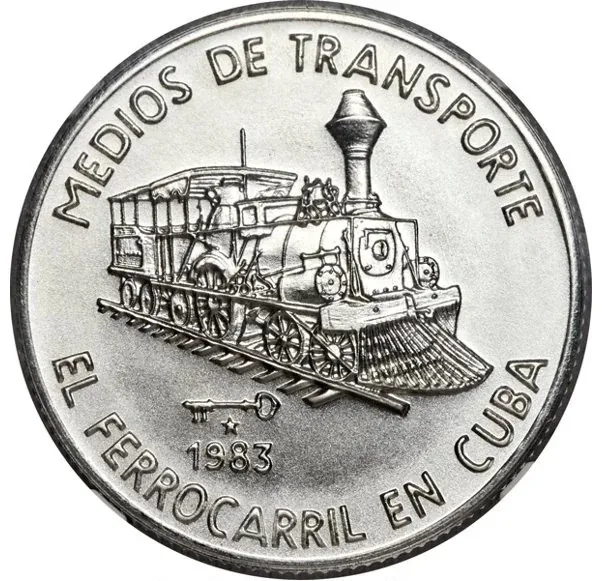
The artistic side reproduces the same design as a regular steam locomotive coin: a first-generation locomotive with a tall chimney, cylindrical boiler, driver's cabin and tender, placed on a rail bed. In front of the car there is an arc MEDIOS DE TRANSPORTE, below it is EL FERROCARRIL EN CUBA, year 1983 and a mint mark in the form of a key with a star. The pattern literally repeats the usual release, only the thickness of the disk and the depth of the relief change; the composition is associated with the artist Alberto Gonzalez Perestol.
Reverse
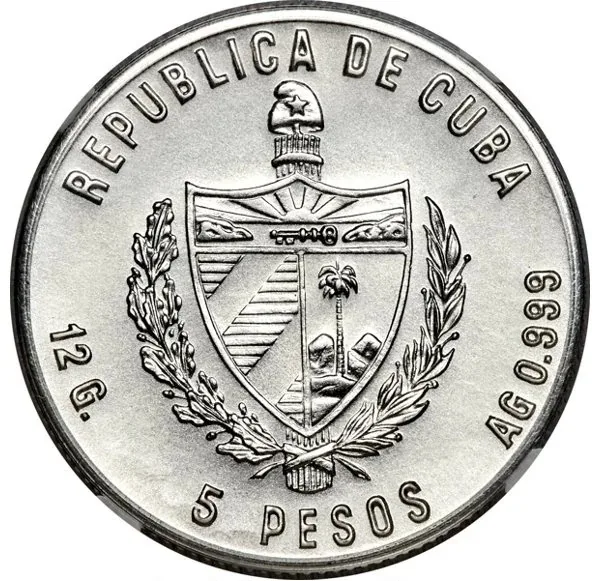
The official side is occupied by the coat of arms of the Republic of Cuba: a shield with a rising sun and a palm tree, a Phrygian cap with a star and laurel branches. The composition harkens back to a design by Charles Edward Barber used on Cuban coins from the early 20th century. Above the shield is the inscription REPUBLICA DE CUBA, below - 5 PESOS. This side is the same for the entire program and links this coin to all other issues, despite differences in subject matter, metal and size.