
Cuban Solenodon (5 Pesos)
PDFGeneral information
Пруф
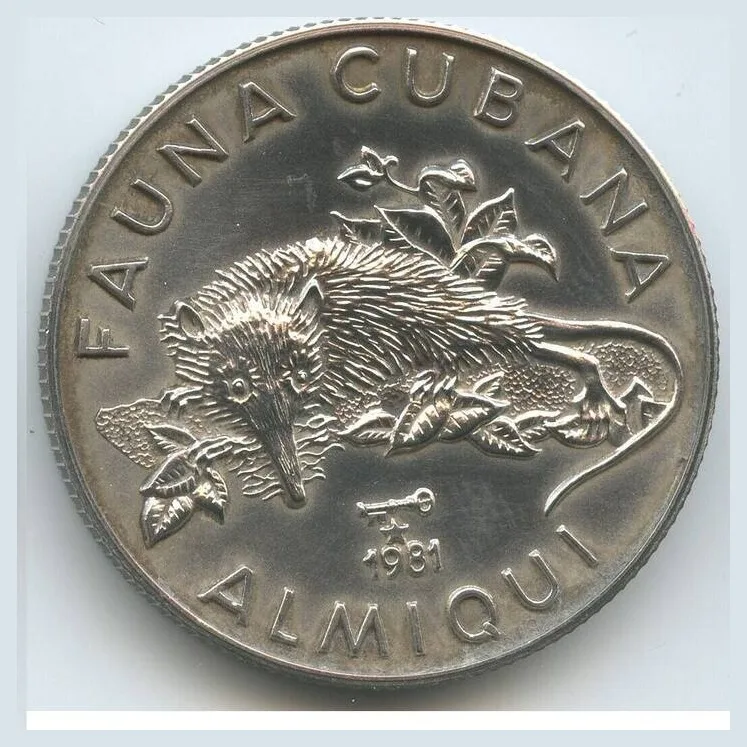
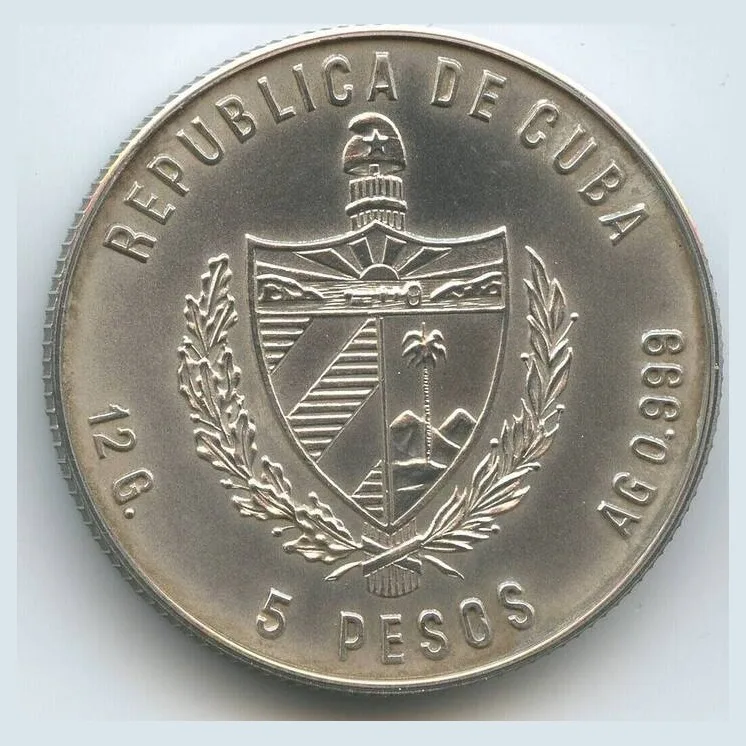
Исполнение Proof («пруф»). Это та же монета, что и основная карточка, но отчеканена на полированных заготовках двумя ударами: поле получило зеркальную поверхность, рельеф — матовую и контрастную. Тираж — 1000 экземпляров, каталожный номер Аледона AAEE 059; обычное исполнение BU — 5000 экземпляров (AAEE 062). Характеристики обоих исполнений одинаковы: серебро 999 пробы, масса 12 г, диаметр 30 мм, рубчатый гурт; монетный двор Empresa Cubana de Acuñaciones (Гавана, Куба). Официальная сторона — герб Кубы с легендой REPUBICA DE CUBA, художественная сторона — кубинский щелезуб с названием программы и годом. По каталогу Аледона 1999 года пруфовая монета стоила $38, обычная — $26.

Description
The Cuban solenodon (Solenodon cubanus) is one of the most unusual mammals on the planet. It is the size of a large rat but has nothing in common with rodents: it is a relic of an ancient line of insectivores that split from other mammals many millions of years ago. It has a long flexible snout, thick dark-brown fur, powerful claws on the forelegs and an almost naked scaly tail. Its eyesight is weak, but smell and touch are keen: it finds prey — insects, worms, small vertebrates — with its nose, rooting through the forest litter.
The chief oddity of the solenodon is its venomous saliva. The animal has special glands in the lower jaw, and the venom enters a wound along a groove in the incisor. Among mammals venomous species are very few, and this gives the solenodon a special position in zoology: the very name of the genus comes from a Greek word for “grooved tooth”. The venom helps it hunt prey larger than insects and defend itself; for a human it is not deadly but painful.
The Cuban solenodon lives in the mountain forests of the eastern part of the island and is extremely rare. Its way of life is nocturnal; by day it hides in burrows and crevices. In the twentieth century the animal was considered extinct until living individuals were found again: the event was notable news for biologists. Today the species is protected and listed among animals threatened with extinction; its closest relative is the Hispaniolan solenodon on the neighbouring island.
In 1981 the Havana mint issued for collectors the series “Fauna Cubana II”, a continuation of the series of the same year. The solenodon appeared in it alongside the tocororo bird and the armoured gar: three different classes of animals, each with its own title of the “rare and distinctive”. On the coin the creature is shown in a characteristic pose, with an extended snout and a raised tail, so that even by silhouette it is easy to tell from a rat or a shrew.
What lends this subject special value is that the creature is almost unknown to the wide public: even many Cubans have never seen it alive, because it leads a secretive nocturnal life in hard-to-reach forests. In this sense the coin plays an educational role: it introduces an animal whose existence many do not suspect and turns rarity into a subject of interest. Such issues build up an idea of the richness of the nature of a small island.
Obverse
The artistic side shows the Cuban solenodon against forest vegetation. The relief conveys the long mobile snout, thick fur, strong claws on the forelegs and a thin scaly tail. Around it are leaves and branches. The inscriptions name the programme — FAUNA CUBANA, the animal and the year 1981; the mint mark is beside them. The scene looks calm, but the creature fills almost the whole field and at once draws the eye with its unusual appearance. The fur is rendered in short strokes, and the snout turned out to be one of the most expressive details of the relief.
Reverse
The official side is the same on every coin of the series: the national arms of the Republic of Cuba in Charles Edward Barber’s drawing. The shield is divided into three fields, a Phrygian cap with a star stands above it, with laurel and oak branches on the sides; the inscription REPUBLICA DE CUBA runs along the arc and the coin’s denomination is marked below. The strict heraldry is set against the lively, almost naturalistic image of the animal or bird on the other side and reminds us that this is a state issue.