
Cuban Volanta Coach (1 peso)
PDFGeneral information

Description
Volanta is a small open carriage that appeared in Cuba in colonial times and remained in Havana life until the beginning of the 20th century. The catalog of José María Aledón writes that it was “a type of open carriage, a common means of transportation in Cuba, as in other countries of the Americas, for more than three hundred years.” People used the volanta to run errands and visit others; they carried luggage, mail, and passengers to the port and train station.
High wheels and elastic suspension allowed the carriage to roll along the uneven pavements of old Havana. The name is connected, according to one version, with the lightness and “volatility” of its movement - the cart seemed to float above the pavement. Whatever the etymology, the volanta has become firmly entrenched in Cuban speech and everyday life: it is mentioned in songs, stories and urban legends, and a model of the volanta is often found among souvenirs of old Havana.
With the advent of the tram and the automobile, the volante gradually disappeared from the streets, but remained in the city’s memory as an image of a leisurely, old Havana - with the clatter of hooves, the shouts of the driver and the shadow of the awning in the midday heat. By placing it on a coin, medalists preserved not so much a means of transportation as an entire era of urban life: that time when distance was measured by the patience of a horse and the quality of the springs.
The horse-drawn carriage fits naturally into the story of transport on the island: before there were rails and steamships, people moved this way - in horse-drawn carts along roads where every turn was an event. The volante on the coin reminds us of where the history of Cuban roads began.
Like any means of transportation, the volanta reflected the position of the owner: a well-groomed horse, polished harness and a clean body spoke of prosperity, and hired carriages stood at squares and piers waiting for riders. For city residents, it was a familiar part of the street scene, just like trams and taxis were later. It is this everyday life that the coin preserves: not a ceremonial exit, but everyday city transport of bygone times.
The choice of crew for the coin says a lot about the intention of the program: in the story about transport, the volant represents the earliest, horse-drawn stage - the time when there was neither a locomotive nor a steamship on the island, and speed was measured by the trot of a horse. Next to the train and the ship, it reminds us that any technical progress begins with the simple and familiar.
Obverse
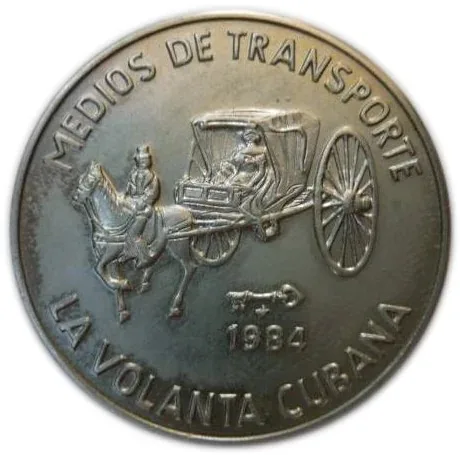
The artistic side shows the volanta in motion: a light open carriage on high wheels, drawn by a horse, with a driver on the handlebar. The master emphasizes the characteristic silhouette of the cart - the raised body, the spokes of the wheels, the stretched lines and the living line of the horse's figure. Legends go around in a circle: MEDIOS DE TRANSPORTE denotes the program, LA VOLANTA CUBANA - “Cuban volanta” - names the plot, next to it is the year 1984. Sources name the author of the engraving as medalist E. Cepero.
Reverse
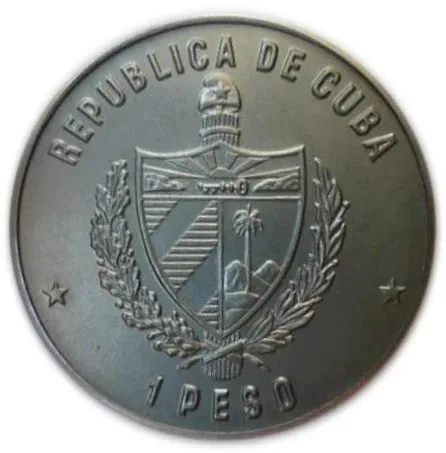
The official side is occupied by the coat of arms of the Republic of Cuba: a shield with a rising sun and a palm tree, a Phrygian cap with a star and laurel branches. The composition harkens back to a design by Charles Edward Barber used on Cuban coins from the early 20th century. Above the shield is the inscription REPUBLICA DE CUBA, below - 1 PESO. This side is the same for the entire program and links this coin to all other issues, despite differences in subject matter, metal and size.