
Emerald Hummingbird (1 Peso)
PDFGeneral information

Description
The green gleam is the chief mark of the emerald hummingbird. But this gleam is not pigment: the colour arises from the microscopic structure of the feathers, which refracts light so that with each turn of the bird the shade shifts from deep emerald to golden. That is why the bird looks now dark, now shining, and it is probably because of this effect that hummingbirds have always attracted collectors and artists. Scientists call the species Chlorostilbon ricordii; in English it is the Cuban emerald.
It lives in Cuba and in the Bahamas. It prefers open places with flowering bushes: woodland edges, gardens, the margins of swamps. It feeds on nectar but does not disdain small insects; for such a tiny bird such a diet is a necessity, because continuous flight demands a lot of energy. Males guard feeding territories aggressively, and in the morning short aerial skirmishes can be watched above a flowering hedge.
The scientific name of the species recalls Ricord, the French naturalist whose name became attached to the bird in the nineteenth century. In Cuba itself the bird is known simply as colibrí, and that word became the basis of the inscription on the coin. For locals the emerald is a familiar neighbour, one whose swift flight is noticed on the veranda and in the yard.
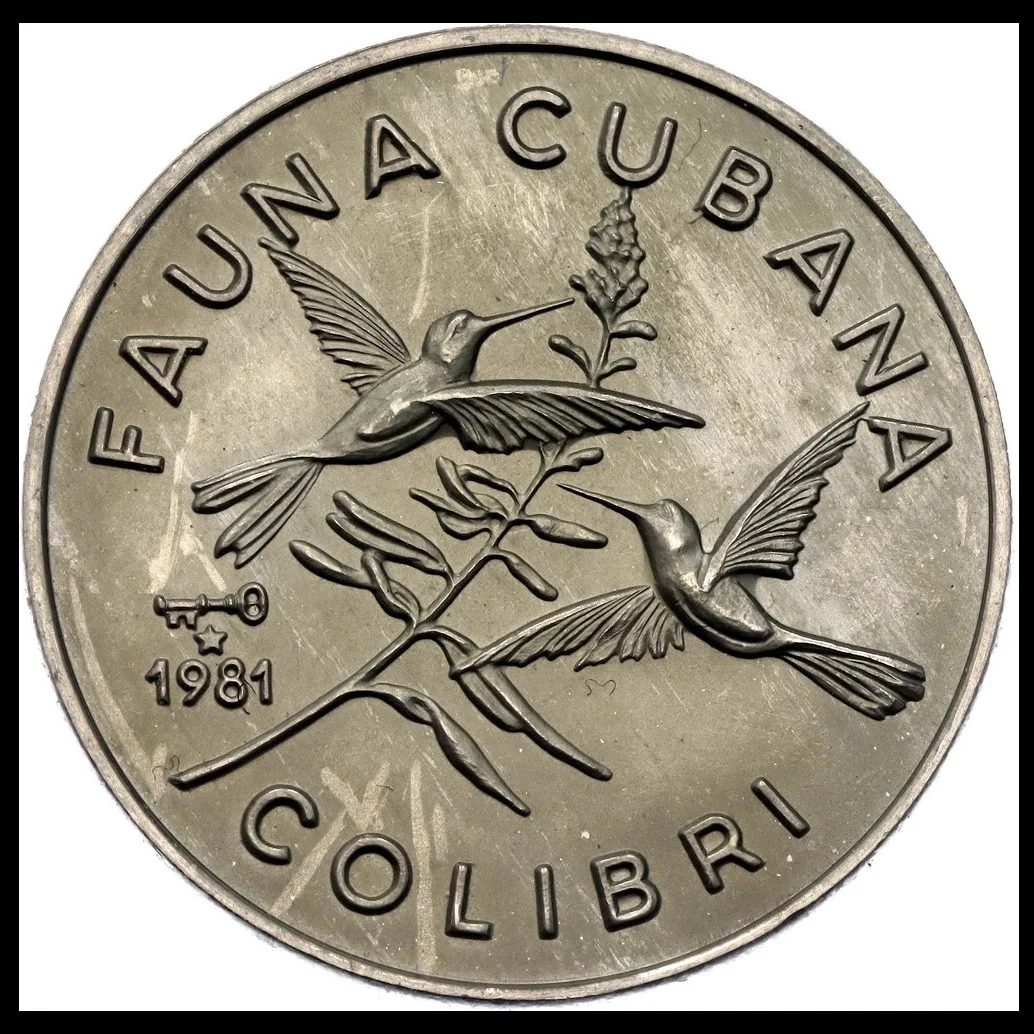
The coin was struck in 1981 in Havana within the series “Fauna Cubana I”. The series has three subjects, was not meant for circulation and was conceived as a collectible. The bird is depicted in relief: a thin line of beak, a clear contour of plumage, a forked tail. Such a drawing conveys the hummingbird’s character well — composure, lightness and precision of movement.
The coin is interesting also for its composition. The bird is placed not strictly in the centre but with a slight offset, and thanks to this room remains in the field for the flower, the hummingbird’s main partner. Such a device recalls Japanese prints, where emptiness is as important as the image. It is no accident that this miniature is loved under a magnifying glass: every line is a feather, every dot an eye, and together they create a sense of life.
Obverse
The obverse is the artistic side. The emerald hummingbird is shown among leaves and flowers: an elongated body, a thin straight beak, a forked tail, light modelling of feathers. The relief is low, but the bird is well set off from the background. The inscriptions FAUNA CUBANA, COLIBRI and the year 1981 are struck, with the mint mark nearby. The composition resembles a zoological plate in which every detail serves to identify the species. The bird’s gaze is directed at the flower, which gives the scene an inner logic.
Reverse
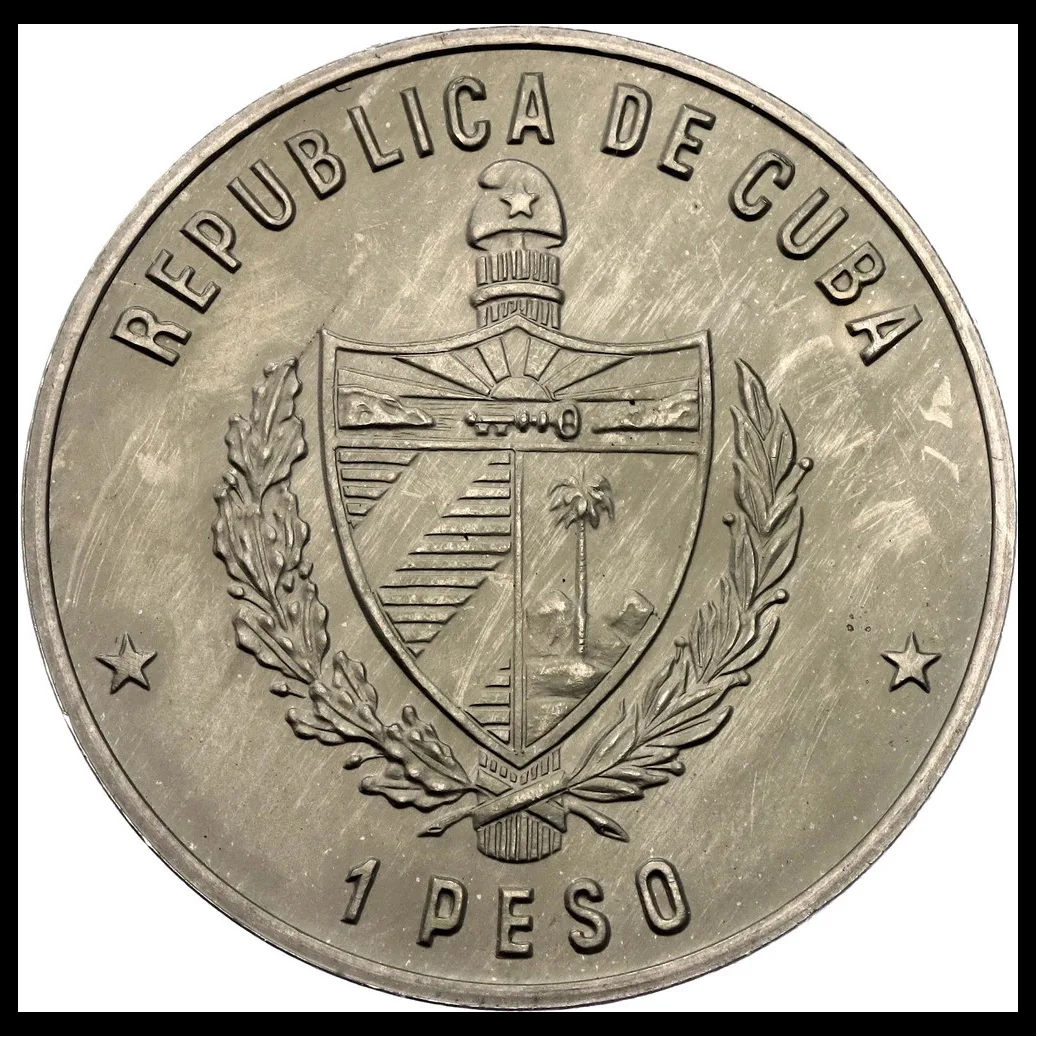
The official side is the same on every coin of the series: the national arms of the Republic of Cuba in Charles Edward Barber’s drawing. The shield is divided into three fields, a Phrygian cap with a star stands above it, with laurel and oak branches on the sides; the inscription REPUBLICA DE CUBA runs along the arc and the coin’s denomination is marked below. The strict heraldry is set against the lively, almost naturalistic image of the animal or bird on the other side and reminds us that this is a state issue. The arms read well on a small coin thanks to a crisp outline.