
Emerald Hummingbird (5 Pesos)
PDFGeneral information
Пруф
Исполнение Proof («пруф»). Это та же монета, что и основная карточка, но отчеканена на полированных заготовках двумя ударами: поле получило зеркальную поверхность, рельеф — матовую и контрастную. Тираж — 1000 экземпляров, каталожный номер Аледона AAEE 051; обычное исполнение BU — 5000 экземпляров (AAEE 054). Характеристики обоих исполнений одинаковы: серебро 999 пробы, масса 12 г, диаметр 30 мм, рубчатый гурт; монетный двор Empresa Cubana de Acuñaciones (Гавана, Куба). Официальная сторона — герб Кубы с легендой REPUBICA DE CUBA, художественная сторона — изумрудный колибри с названием программы и годом. По каталогу Аледона 1999 года пруфовая монета стоила $39, обычная — $24.

Description
The emerald hummingbird (Chlorostilbon ricordii) is one of the most striking residents of Cuban gardens. The bird’s back and flanks shimmer with a metallic green, the belly is lighter, and the male’s tail is forked and tinged with blue. The bird is about ten centimetres long — noticeably larger than the bee hummingbird, but still fitting easily on a palm. Besides Cuba the species occurs in the Bahamas, and on the island it can be seen almost everywhere: in parks, gardens, on woodland edges and even in city flowerbeds.
Like all hummingbirds the emerald feeds on nectar, but it also eats small insects, snatching them in flight. Its flight is swift: it can hover, fly forward, sideways and even backward. The male defends his feeding territory by swooping at larger birds and at times stages real aerial contests above flowering bushes. The nest is a small cup of plant down that the bird wraps with spider silk.
In the name of the species is sewn the name of a French naturalist: the Latin ricordii honours Alexandre Ricord, a nineteenth-century naturalist. This is a reminder that the scientific description of Cuban fauna owes much to European researchers who came to the island and studied its nature. Today the bird is valued not only by scientists but by Cubans, who consider the emerald hummingbird part of everyday life.
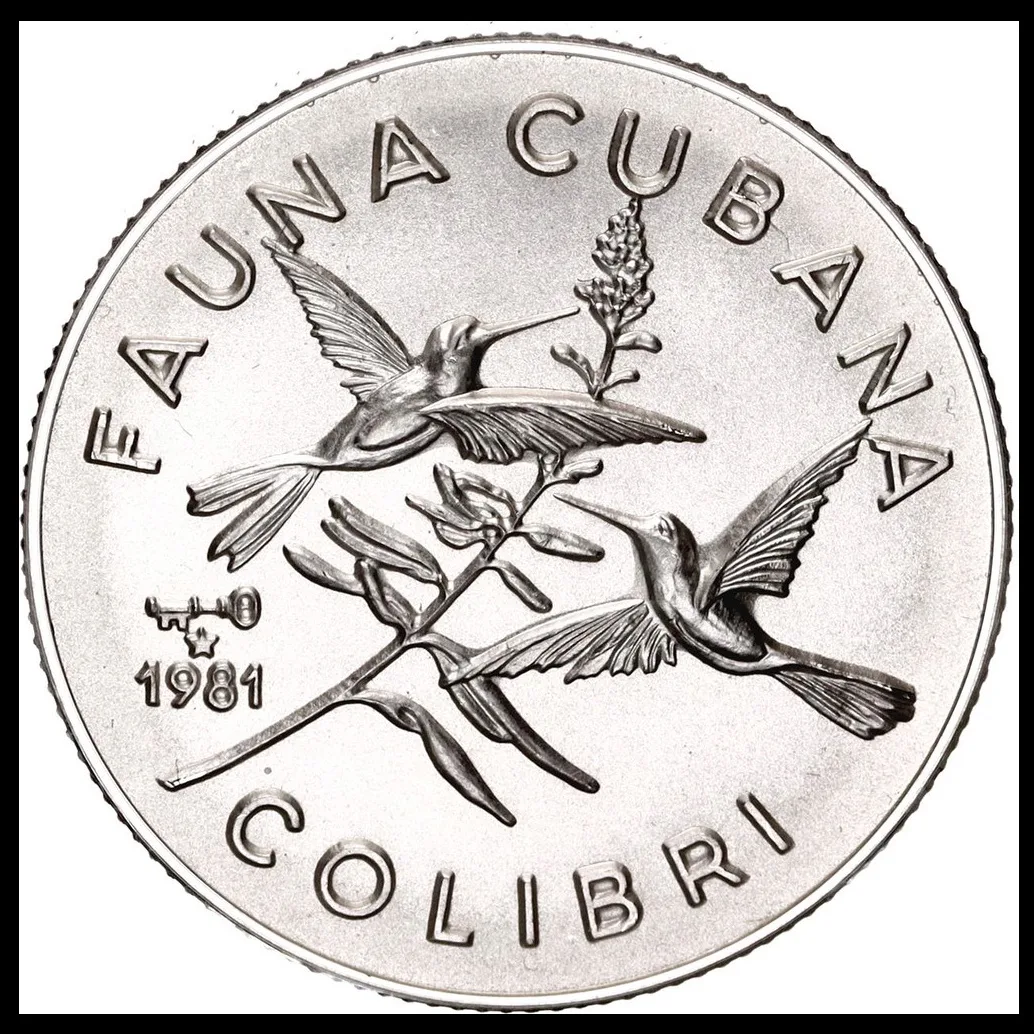
In 1981 the Havana mint issued for collectors the series “Fauna Cubana I” — three animals, among them the hummingbird. On the coin the bird is shown among greenery, and thanks to the relief the structure of the body is clearly visible: a straight thin beak, an elongated neck, a forked tail. The subject stresses exactly the feature that gave the species its name — the green gleam of the plumage.
For a collector the coin is interesting also because it shows the green gleam not with paint but with relief — so the colour has to be guessed from form. The master who made it deliberately focused on the outline of the bird and on the contrast between the thin beak and the broad breast. As a result the emerald hummingbird on the coin looks no less alive than in a photograph, though there is not a single patch of colour on it.
Obverse
The artistic side shows the emerald hummingbird among branches and leaves. The bird is rendered in detailed relief: a thin straight beak, an elongated body, a forked tail, fine feathers on the breast and back. Leaves and a flower around it set the environment in which the bird feeds. The inscriptions are FAUNA CUBANA, COLIBRI and the year 1981; the mint mark stands beside them. Light glides over the relief, and the bird seems to freeze for a moment above the flower. The wings are slightly raised, and the pose conveys swiftness.
Reverse
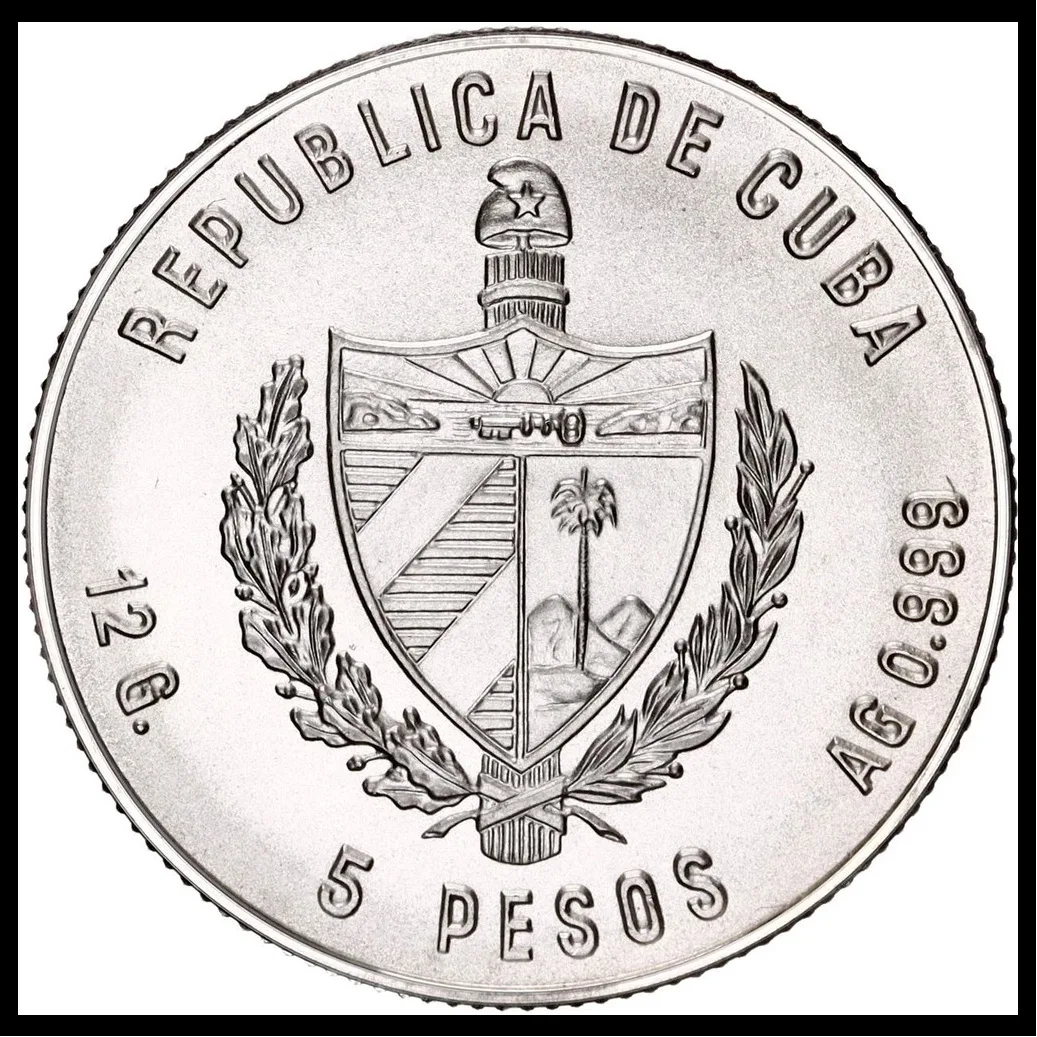
The official side is the same on every coin of the series: the national arms of the Republic of Cuba in Charles Edward Barber’s drawing. The shield is divided into three fields, a Phrygian cap with a star stands above it, with laurel and oak branches on the sides; the inscription REPUBLICA DE CUBA runs along the arc and the coin’s denomination is marked below. The strict heraldry is set against the lively, almost naturalistic image of the animal or bird on the other side and reminds us that this is a state issue.