
Hot air balloon (1 peso, pattern)
PDFGeneral information

Description
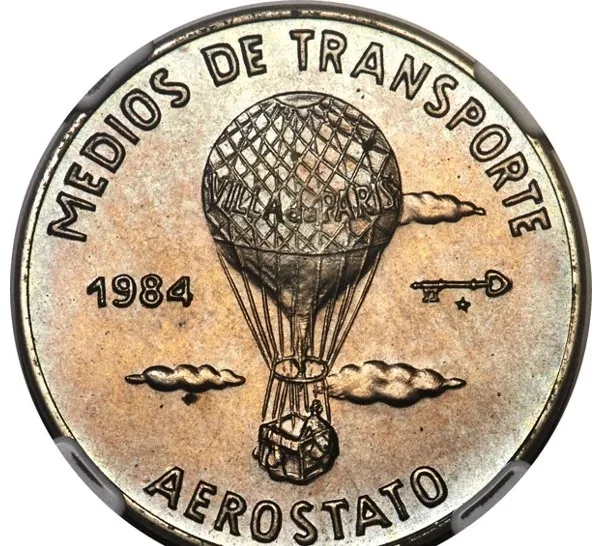
The balloon coin occupies a special place among Cuban issues: it is not an ordinary coin, but a test piece - the so-called pattern. The drawing with the balloon was not approved, and the planned series with such a plot was not released for mass release. However, before the authorities’ decision became known, the mint in Havana managed to produce and distribute a few copies, which reached collectors as evidence of a failed plan.
Trial issues are a special and rarest page of numismatics. They are minted not for circulation, but to evaluate the future design and check the readiness of the stamps: approved samples go into series, rejected ones are usually destroyed. Only sometimes a few copies manage to leave the mint - and then they become a memory of what an “airy” program page might look like. The Cuban balloon is exactly such a case.
The balloon itself - aerostato - has been part of the history of transport since 1783, when the Montgolfier brothers lifted into the sky the first apparatus filled with hot air with people on board. Cylinders made the dream of flight a reality long before the airplane and before the airship; Scientists, aeronauts and the first aeronauts climbed on them. The word “balloon” to this day means a lighter-than-air apparatus, and the balloon itself has become a universal symbol of the dream of flight and freedom.
For the Cuban program, the story with the balloon was supposed to be the beginning of the “air” line - from the balloon to the airship - and that’s why it’s so unfortunate that the coin with it did not appear en masse. But it is precisely this lack of implementation that gives the sample its special value: before us is a sketch on metal that shows an idea that was never included in the official program of the mint.
Striking proof-quality pieces is not a Cuban specialty: many countries' mints issued examples to evaluate the designs, and today such coins are among the most coveted in collections. The balloon shows that this program also had unwritten pages: an idea that could have been a beautiful continuation of the theme remained at the sample level. For a coinage historian, this is a valuable document of creativity: the proof coin shows how the masters sought a balance between technical image and artistic expression.
Obverse
The artistic side depicts a hot air balloon - an aerostat with a rounded dome and a basket suspended under it. The dome is conveyed with smooth lines that emphasize the volume, and the basket and slings give the image the scale and fragility of a man-made structure floating in the sky. The legends of the program were also to be placed here - MEDIOS DE TRANSPORTE and the title of the plot with the year 1984. Since the drawing remained unapproved, this image is a kind of sketch on metal.
Reverse
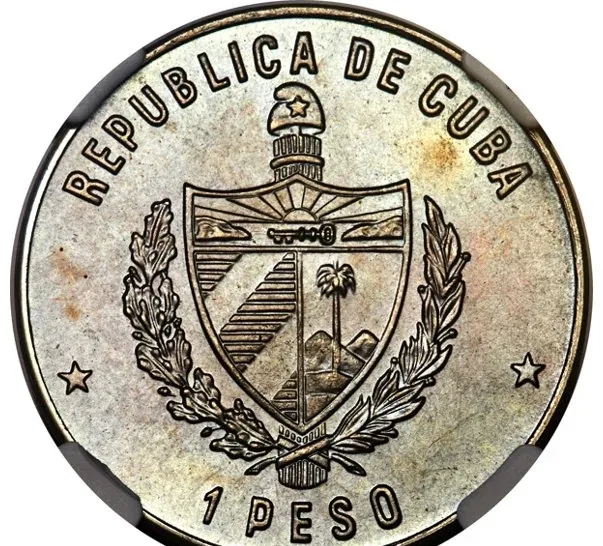
The reverse bears the state coat of arms of Cuba: a shield with a landscape of the island - a rising sun, a palm tree, hills and a key, a symbol of Cuba's position as the “key to the New World” - above the shield there is a Phrygian cap on a staff with a star, on the sides there are oak and laurel branches. REPUBLICA DE CUBA - “Republic of Cuba” is engraved at the top, 1 PESO at the bottom, and the technical inscriptions of the issue are placed at the edge. The design draws on the Cuban coinage tradition established in 1915–16 by US Mint engraver Charles Edward Barber.