
Swallowtail Butterfly (50 Pesos, Gold)
PDFGeneral information

Description
The subject “Swallowtail Butterfly” in the rarest version of the Cuban Caribbean Fauna of 1996 repeats the design of the other coins, so the story of its hero is shared with them.
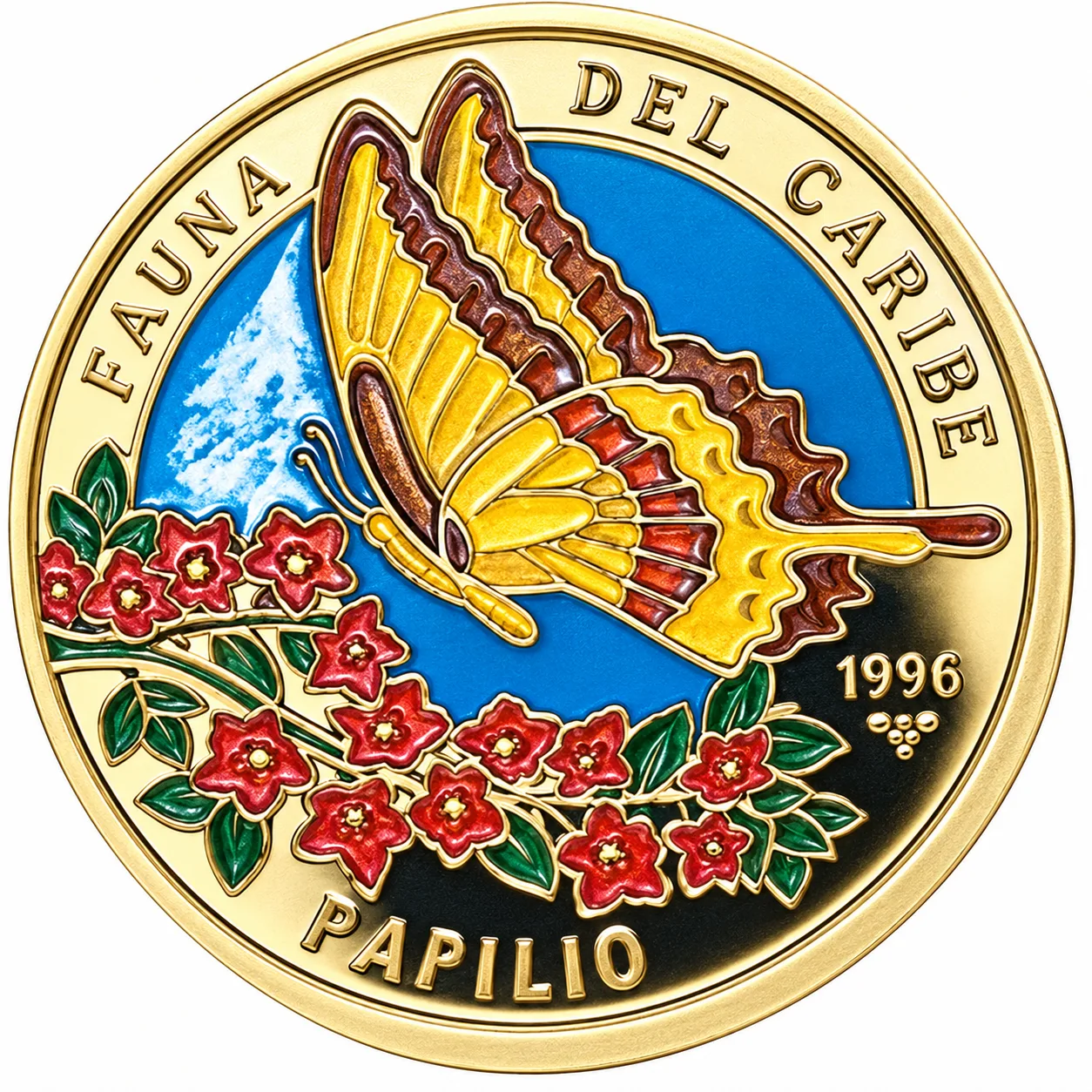
The theme of this coin is a large day-flying butterfly of the swallowtail family, Papilionidae. The reverse bears only the generic name PAPILIO, Latin for “butterfly”, so the species cannot be determined strictly from the coin. The most probable candidate is the androgeus swallowtail, Heraclides (Papilio) androgeus, which Cubans call “Perro de Montaña”. The working formula adopted here is: a swallowtail butterfly of the genus Papilio, most probably the androgeus swallowtail.
The alternatives are less likely, because they have a dark wing ground with yellow markings. These are Cuban endemics: Poey’s swallowtail Heraclides caiguanabus (“Perro de Costa”), black with a row of yellow spots and a red spot in the corner of the hind wing, and Heraclides oviedo (“Perro de Bosque”), with dark brown wings, a yellow band and a spatulate tail. The yellow field with a dark border and row of spots on the coin is closest to a male androgeus.
The caterpillars of swallowtails, to which the androgeus belongs, feed on the leaves of citrus and related plants; early in life they resemble bird droppings, and when disturbed they push a brightly coloured scented organ out of a fork behind the head. The adult butterfly then emerges from a pupa that looks like a twig. The coin shows only the last, most beautiful stage of this transformation.
The androgeus swallowtail is the only Cuban swallowtail with marked sexual dimorphism. In males the wings are mostly yellow, with a row of black, red and blue spots along the edge; in females the wings are black with a bluish field on the hind wing. The wingspan runs from about eleven and a half to fourteen centimetres, making it the largest swallowtail on the island. The species is common in wooded parts of Cuba and on the Greater Antilles, except Jamaica.
The technique complicates final identification: the coloured reverses were painted by hand and the drawing is simplified, so the yellow field may represent either the yellow wings of the androgeus or a yellow band on a dark ground. The butterfly on the coin sits on red tubular flowers, and the long tails on the hind wings underline its swallowtail nature. It is an ordinary scene of the Cuban forest, where bright insects feed on nectar.
Obverse
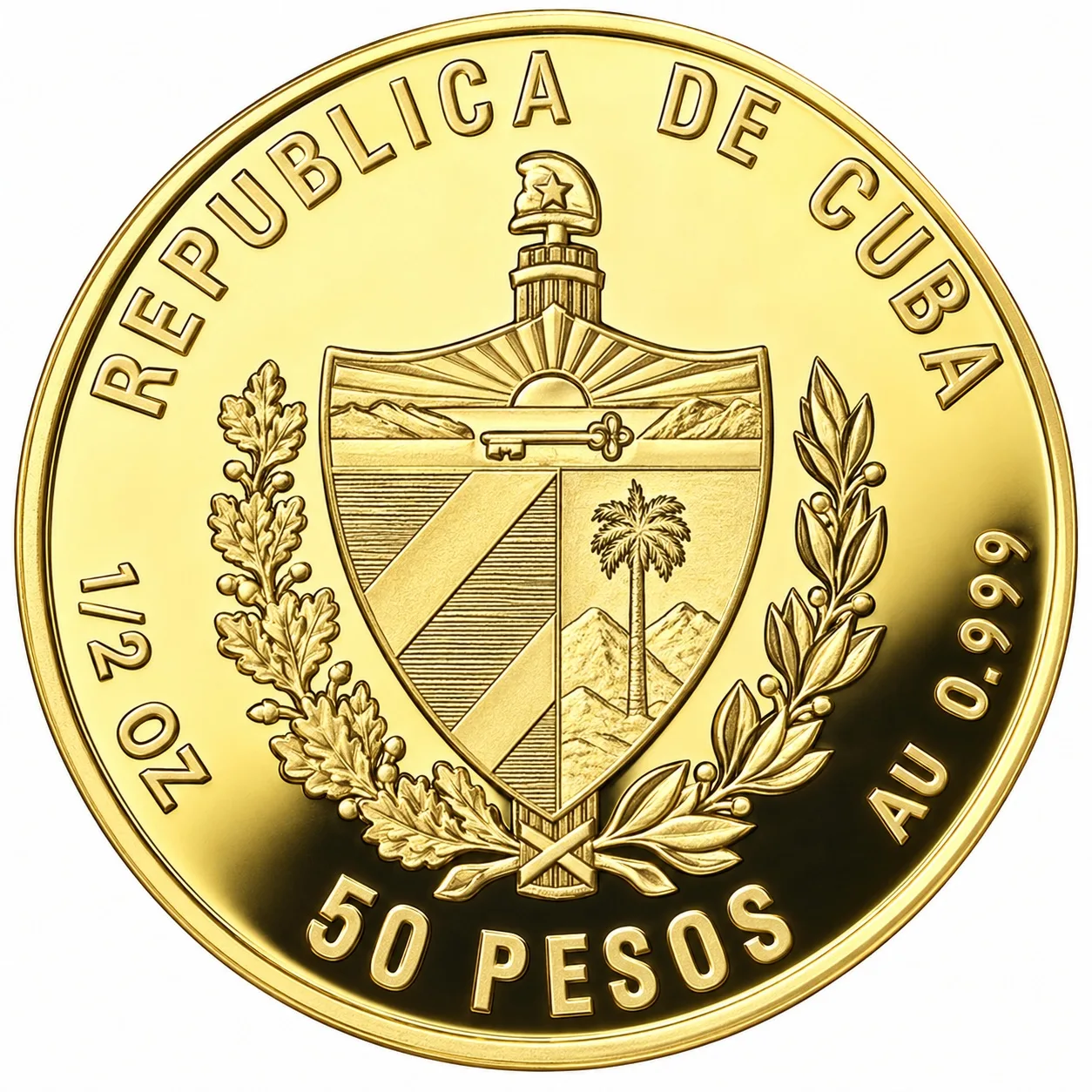
The obverse repeats the official layout of the whole programme: Barber’s coat of arms of the Republic of Cuba (a shield with a key between two capes, a royal palm and mountains, topped by a Phrygian cap on a bundle of fasces), the legend REPUBLICA DE CUBA and the inscription “50 PESOS” at the bottom. The symbols on the arms do not change from coin to coin and give the coloured subject on the other side an official frame: the key, the palm and the cap of liberty are familiar to every Cuban.
Reverse
The reverse shows in colour a swallowtail butterfly on red tubular flowers: yellow wings with a dark network of veins and a dark border containing a row of small red-brown spots, and long tails on the hind wings. Above the picture is the inscription FAUNA DEL CARIBE, below it PAPILIO, and on the right the year 1996 and the mint mark, a key with a star. This composition can be regarded as the crown of the whole programme: the same picture as on the other coins, but offered in its most limited form. The arms on one side and a living natural image on the other give a complete picture in which the state and its nature are shown side by side.