
Swallowtail Butterfly (10 Pesos)
PDFGeneral information

Description
The coin with the subject “Swallowtail Butterfly” is one of the coloured issues of the Republic of Cuba in 1996 devoted to the animal world of the Caribbean basin, and introduces one of its inhabitants.
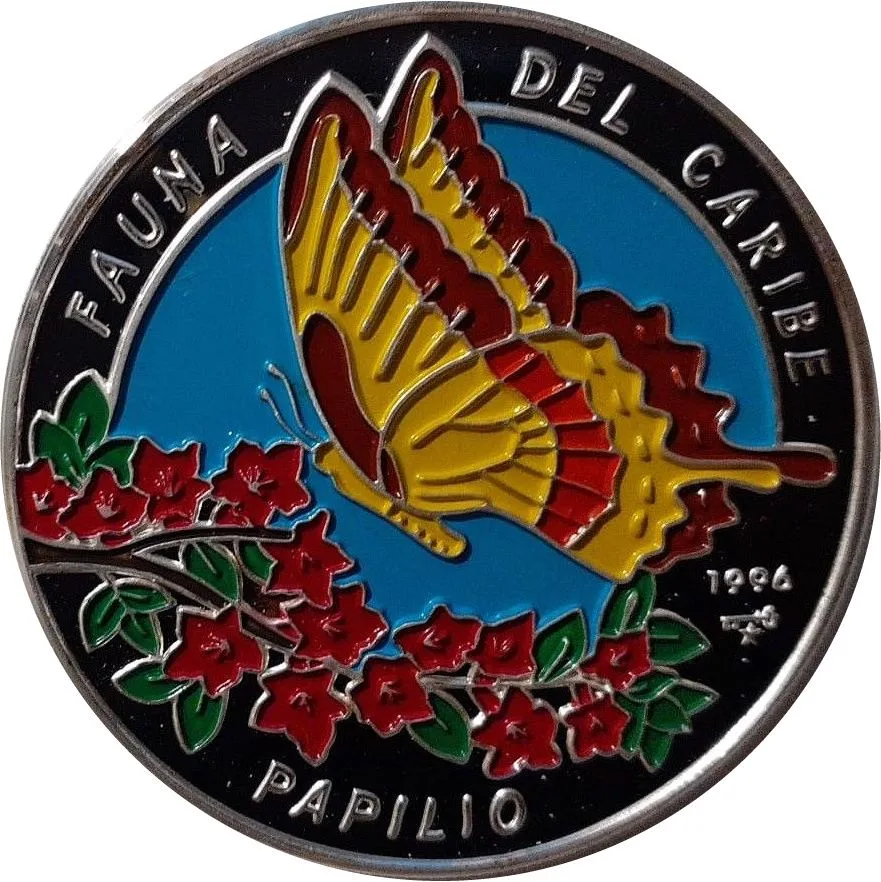
The theme of this coin is a large day-flying butterfly of the swallowtail family, Papilionidae. The reverse bears only the generic name PAPILIO, Latin for “butterfly”, so the species cannot be determined strictly from the coin. The most probable candidate is the androgeus swallowtail, Heraclides (Papilio) androgeus, which Cubans call “Perro de Montaña”. The working formula adopted here is: a swallowtail butterfly of the genus Papilio, most probably the androgeus swallowtail.
The alternatives are less likely, because they have a dark wing ground with yellow markings. These are Cuban endemics: Poey’s swallowtail Heraclides caiguanabus (“Perro de Costa”), black with a row of yellow spots and a red spot in the corner of the hind wing, and Heraclides oviedo (“Perro de Bosque”), with dark brown wings, a yellow band and a spatulate tail. The yellow field with a dark border and row of spots on the coin is closest to a male androgeus.
The technique complicates final identification: the coloured reverses were painted by hand and the drawing is simplified, so the yellow field may represent either the yellow wings of the androgeus or a yellow band on a dark ground. The butterfly on the coin sits on red tubular flowers, and the long tails on the hind wings underline its swallowtail nature. It is an ordinary scene of the Cuban forest, where bright insects feed on nectar.
The caterpillars of swallowtails, to which the androgeus belongs, feed on the leaves of citrus and related plants; early in life they resemble bird droppings, and when disturbed they push a brightly coloured scented organ out of a fork behind the head. The adult butterfly then emerges from a pupa that looks like a twig. The coin shows only the last, most beautiful stage of this transformation.
The androgeus swallowtail is the only Cuban swallowtail with marked sexual dimorphism. In males the wings are mostly yellow, with a row of black, red and blue spots along the edge; in females the wings are black with a bluish field on the hind wing. The wingspan runs from about eleven and a half to fourteen centimetres, making it the largest swallowtail on the island. The species is common in wooded parts of Cuba and on the Greater Antilles, except Jamaica.
Obverse
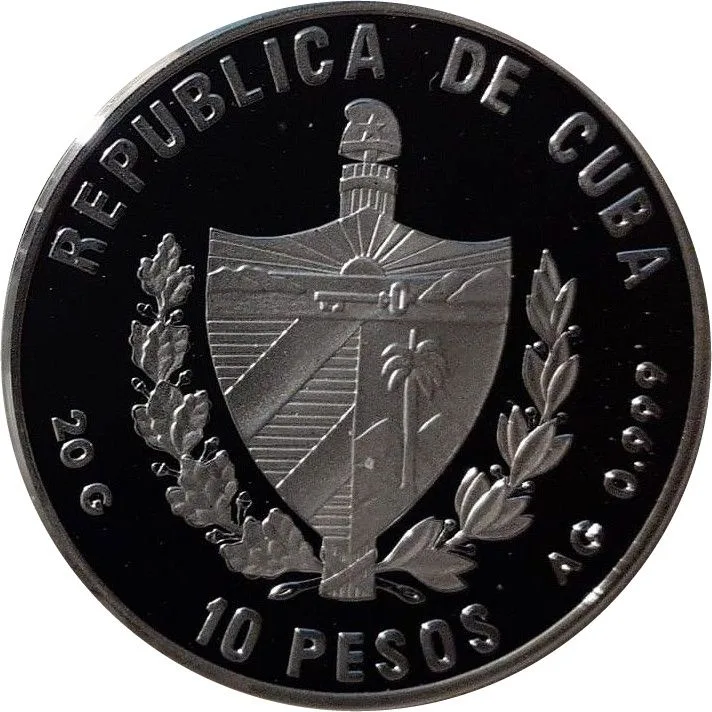
The obverse bears the Cuban coat of arms drawn by Charles Edward Barber (a shield with a key between two capes, a royal palm and mountains, topped by a Phrygian cap on a bundle of fasces). The inscription REPUBLICA DE CUBA follows the upper edge, and the figure and word “10 PESOS” fill the lower part. In this heraldry the key stands for Cuba’s position between the two Americas, the royal palm for the native landscape, and the Phrygian cap for the freedom on which the republic was built.
Reverse
The coloured artistic side shows a butterfly settled on red flowers: yellow wings, dark veins and a border with reddish-brown spots, and long “tails” on the hind wings. The programme name FAUNA DEL CARIBE is placed at the top, the subject PAPILIO at the bottom, and on the right stand the year 1996 and a key with a star, the mint mark. The paints were applied by hand. The contrast between the strict arms and the lively coloured picture is the main feature of this design.