
Spotfin Butterflyfish (20 Pesos)
PDFGeneral information

Description
The Cuban Caribbean Fauna of 1996 turns coins into miniature zoological postcards; the subject “Spotfin Butterflyfish” is one of these cards, and it deserves a careful look.
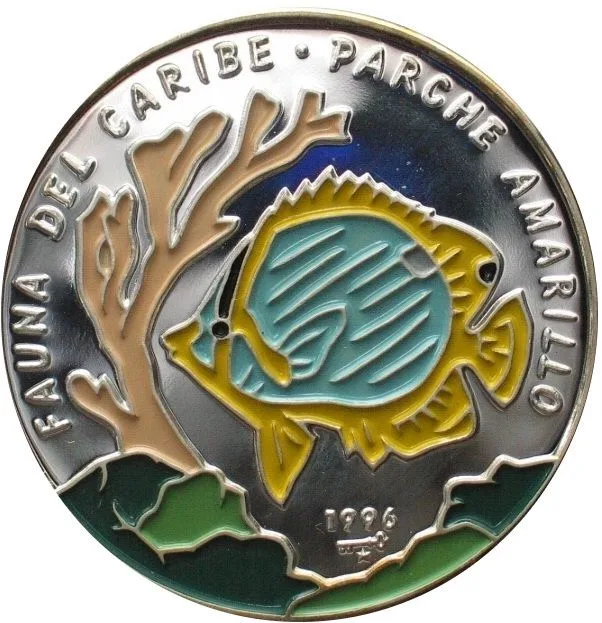
The coin shows a fish that Cubans call “parche amarillo”, the “yellow patch”. This is how Cuban ichthyologists label the spotfin butterflyfish, Chaetodon ocellatus Bloch, 1787, of the family Chaetodontidae. The fish has a disc-shaped body strongly flattened from the sides, a small mouth on a short pointed snout, a pale ground colour, a dark band through the eye and yellow edging on the fins; the artist carried exactly these features over into the coloured drawing.
Confusion has long surrounded the name on this coin. Some English-language catalogues call the subject “Yellow Perch”, but that is a mistake: the yellow perch (Perca flavescens) is a freshwater fish of North America that does not occur in Cuban waters, while the Spanish word “parche” in Cuban usage means a butterflyfish. Other “patches” live on the island’s reefs too, parche ocelado, parche rayado and parche narizón, and the picture on the coin is stylised and tinted by hand, so there is no absolute guarantee that C. ocellatus was the model; it is simply the best-supported identification.
Butterflyfishes got their name from the flat bright body and the fluttering manner of swimming: the narrow profile lets them squeeze into crevices of the reef and pick up food where larger fish cannot reach. Cuban reefs are considered among the best preserved in the Caribbean basin, and such a fish is a typical resident. The choice of subject for the coin is therefore natural: it speaks of the beauty of the island’s underwater world.
The species lives on reefs of the western Atlantic, from New England and Bermuda down to Brazil, and is common in the Caribbean Sea, including the waters of Cuba. An adult grows to about twenty centimetres. The Latin species name ocellatus, “eyed”, points to the dark rounded mark at the base of the soft part of the dorsal fin, which looks like an eye and draws a predator’s attention away from the real head. The fish lives in stable pairs and keeps close to coral formations.
Its diet is varied: tube worms, small crustaceans, hydroids and even coral polyps, which it picks off with a small mouth set with fine teeth. The species has no commercial fishing value but is highly valued by aquarists for its beauty and peaceful nature. The IUCN Red List places it in the Least Concern category, so nothing seriously threatens it today.
Obverse
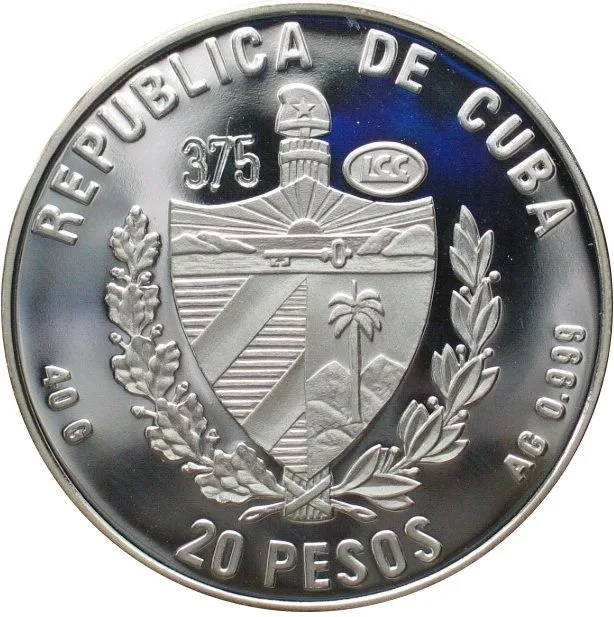
The obverse is occupied by the national arms of the Republic of Cuba after Charles Edward Barber, a shield with a key between two capes, a royal palm and mountains, topped by a Phrygian cap on a bundle of fasces. The legend REPUBLICA DE CUBA frames the arms from above; “20 PESOS” can be read below. The familiar elements of the arms carry an old meaning: the key is the strategic position of the island, the palm its plant emblem, and the fasces under the cap the union and strength of a free people.
Reverse
The reverse is a coloured portrait of the fish on a pale field: a flat body in profile, a dark band through the eye, a yellow edge on the fins. The legends FAUNA DEL CARIBE and PARCHE AMARILLO run around it, with the year 1996 and the mint mark, a key with a star. The paint was laid on by hand, so tones vary between pieces. It is the combination of heraldry and nature study that makes the coin look like a page from a Cuban atlas of animals.