
Wood Duck (1 Peso)
PDFGeneral information

Description
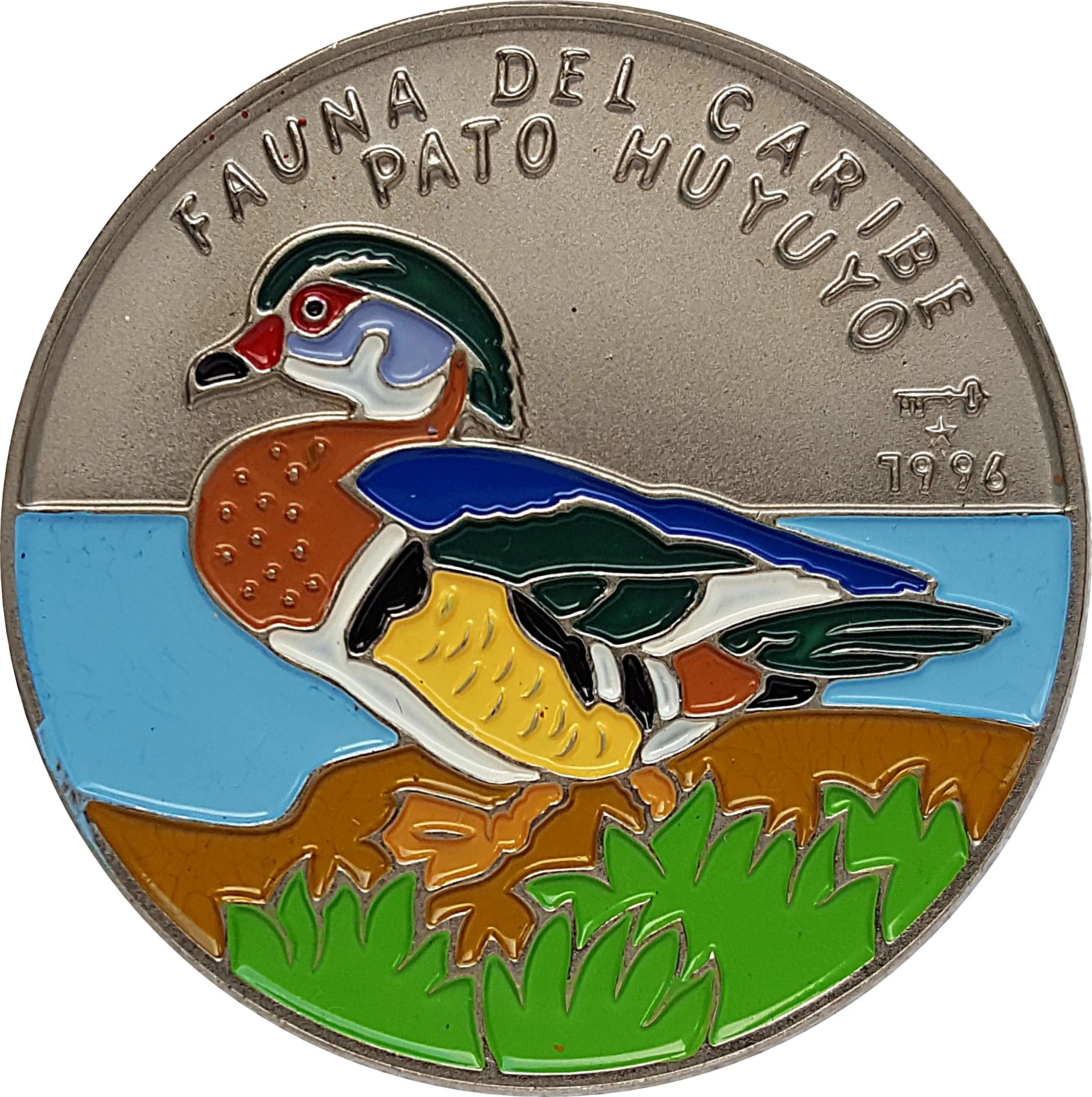
The subject “Wood Duck” belongs to the Cuban Caribbean Fauna programme of 1996, in which every inhabitant of the region gets its own coloured composition. The story begins with the hero itself.
This coin shows the wood duck, Aix sponsa (Linnaeus, 1758), labelled with its Cuban popular name PATO HUYUYO. Sources also give the forms huyuyo, pato joyuyo, pato de la Florida and pato real; in English it is the Wood Duck or Carolina Duck. It is a small woodland duck of the family Anatidae, about fifty centimetres long, with a wingspan of sixty-odd centimetres.
The drake is among the most gorgeous of all waterfowl: an iridescent green crested head, a red bill, a chestnut breast and white-and-black markings on the body. The female is plainer, grey-brown, but with a clearly visible white ring around the eye. The artist who designed the coin chose this bright, showy bird.
The breeding range of the wood duck lies in North America, in southern Canada, the United States and northern Mexico, but Cuba also has a resident, non-migratory population, and neighbouring Puerto Rico, the Bahamas, Hispaniola and Jamaica have their own groups. Among Cuban ducks it is the only one that nests in tree cavities: it uses natural hollows in trees and palms, readily takes nest boxes, and keeps to shaded streams, oxbows, small lakes and swamps.
The bird’s fate in Cuba is not easy. Cuban authors write that, because of its tasty meat, the duck suffered badly from hunting and became rare, although worldwide the IUCN lists the species as Least Concern. A geographical caveat is worth remembering: popular Cuban texts call it “native to Cuba”, whereas it is a North American species with a local resident population. Another well-known Cuban duck, the West Indian whistling duck (Dendrocygna arborea), is not the subject here: “huyuyo” in Cuba means Aix sponsa.
On the first day of their lives, wood duck ducklings do something hard to imagine: at their mother’s call they jump out of a nest cavity, sometimes high above the ground, and land unharmed on the forest floor. Then the family sets off for the water. This habit is one reason why the species is so loved by naturalists, and the drake’s plumage has inspired artists and engravers for years.
Obverse
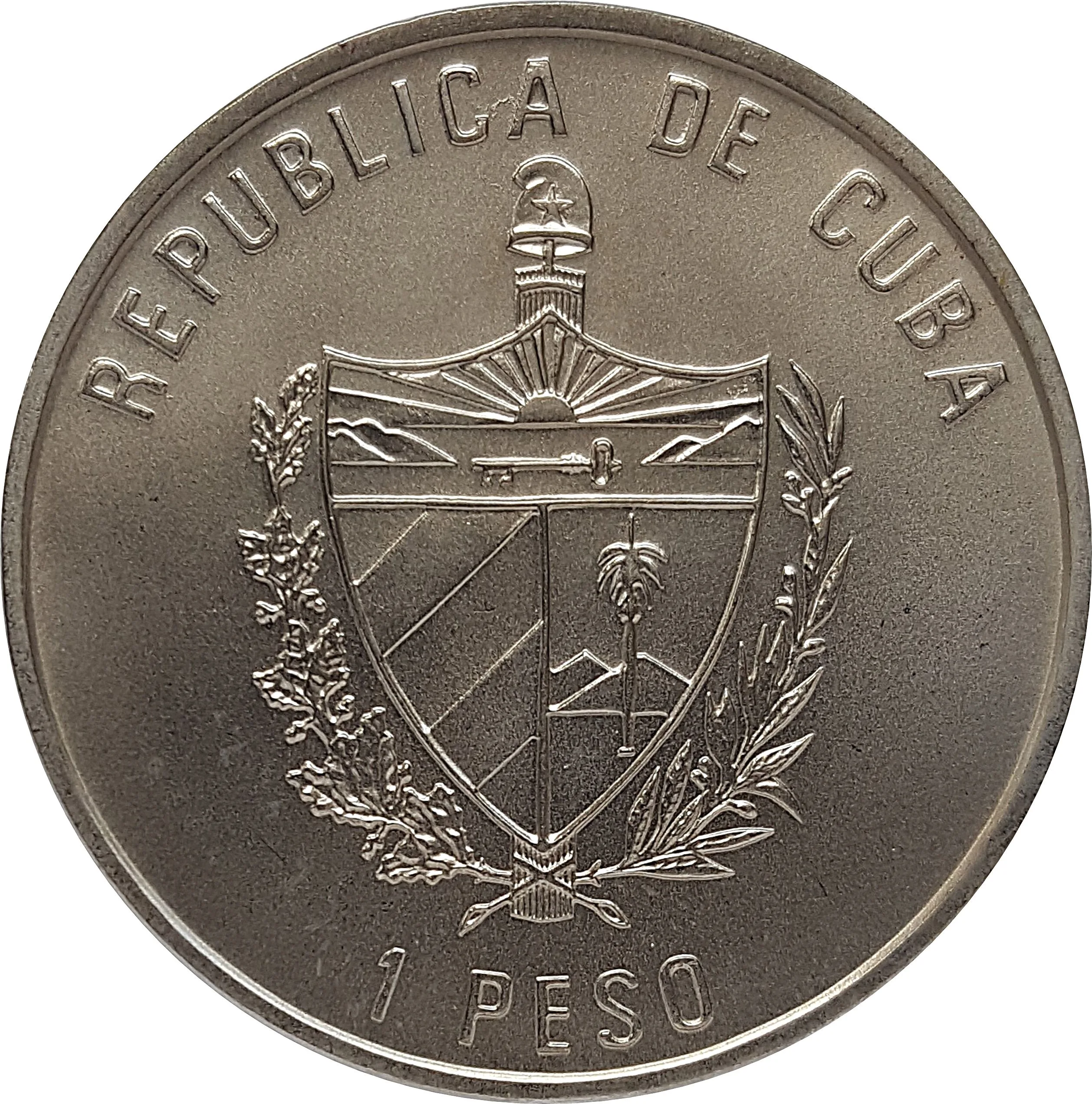
The official side carries the national coat of arms of the Republic of Cuba, drawn by Charles Edward Barber: a shield with a key between two capes, a royal palm and mountains, topped by a Phrygian cap on a bundle of fasces. The legend REPUBLICA DE CUBA arcs above it and the words “1 PESO” stand below. The symbolism of the arms is traditional: the key recalls the island’s position as the “key to the Gulf of Mexico”, the palm the country’s own nature, and the cap above the fasces freedom and unity.
Reverse
The picture side shows the wood duck in colour; around the rim runs the legend FAUNA DEL CARIBE · PATO HUYUYO, with the year 1996 and the mint mark, a stylised key with a star. The engraving was made by Ryneel Castellanos Cuesta from a drawing by Elena Delgado Álvarez. The paint was applied by hand, so shades differ from coin to coin. In this way the official and artistic sides form a single story: the arms of the state and a portrait of a member of its wildlife.