
Wood Duck (10 Pesos)
PDFGeneral information

Description
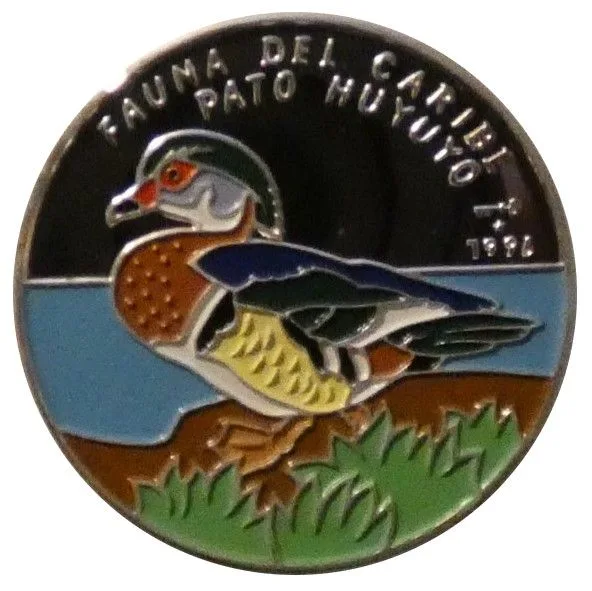
The coin with the subject “Wood Duck” is one of the coloured issues of the Republic of Cuba in 1996 devoted to the animal world of the Caribbean basin, and introduces one of its inhabitants.
This coin shows the wood duck, Aix sponsa (Linnaeus, 1758), labelled with its Cuban popular name PATO HUYUYO. Sources also give the forms huyuyo, pato joyuyo, pato de la Florida and pato real; in English it is the Wood Duck or Carolina Duck. It is a small woodland duck of the family Anatidae, about fifty centimetres long, with a wingspan of sixty-odd centimetres.
The breeding range of the wood duck lies in North America, in southern Canada, the United States and northern Mexico, but Cuba also has a resident, non-migratory population, and neighbouring Puerto Rico, the Bahamas, Hispaniola and Jamaica have their own groups. Among Cuban ducks it is the only one that nests in tree cavities: it uses natural hollows in trees and palms, readily takes nest boxes, and keeps to shaded streams, oxbows, small lakes and swamps.
The bird’s fate in Cuba is not easy. Cuban authors write that, because of its tasty meat, the duck suffered badly from hunting and became rare, although worldwide the IUCN lists the species as Least Concern. A geographical caveat is worth remembering: popular Cuban texts call it “native to Cuba”, whereas it is a North American species with a local resident population. Another well-known Cuban duck, the West Indian whistling duck (Dendrocygna arborea), is not the subject here: “huyuyo” in Cuba means Aix sponsa.
On the first day of their lives, wood duck ducklings do something hard to imagine: at their mother’s call they jump out of a nest cavity, sometimes high above the ground, and land unharmed on the forest floor. Then the family sets off for the water. This habit is one reason why the species is so loved by naturalists, and the drake’s plumage has inspired artists and engravers for years.
The drake is among the most gorgeous of all waterfowl: an iridescent green crested head, a red bill, a chestnut breast and white-and-black markings on the body. The female is plainer, grey-brown, but with a clearly visible white ring around the eye. The artist who designed the coin chose this bright, showy bird.
Obverse
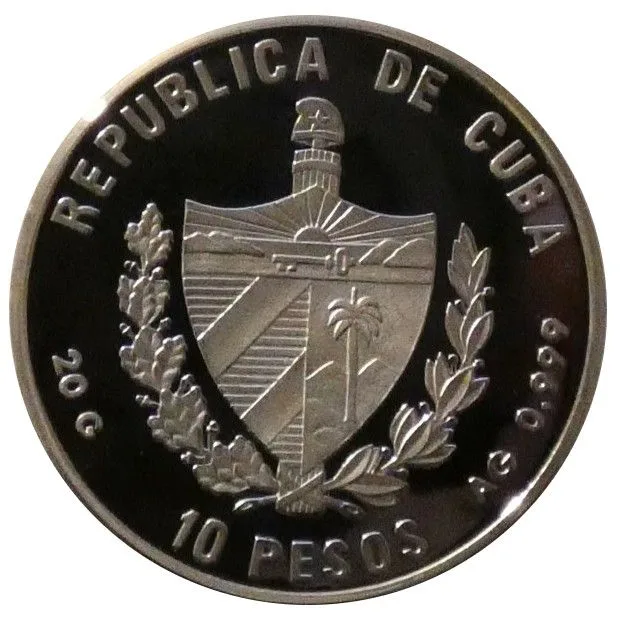
The obverse bears the Cuban coat of arms drawn by Charles Edward Barber (a shield with a key between two capes, a royal palm and mountains, topped by a Phrygian cap on a bundle of fasces). The inscription REPUBLICA DE CUBA follows the upper edge, and the figure and word “10 PESOS” fill the lower part. In this heraldry the key stands for Cuba’s position between the two Americas, the royal palm for the native landscape, and the Phrygian cap for the freedom on which the republic was built.
Reverse
On the reverse the wood duck appears in coloured paints, with its bright head and crest. The picture is framed by the legends FAUNA DEL CARIBE and PATO HUYUYO, the year 1996 and the mint mark, a key with a star. The engraver was Ryneel Castellanos Cuesta, the original drawing is by Elena Delgado Álvarez; the colour was applied by hand. The contrast between the strict arms and the lively coloured picture is the main feature of this design.