
Zeppelin (1 peso, cupro-nickel)
PDFGeneral information

Description
The era of airships did not last long, but it left a deep mark in the history of technology and in the human imagination. The first zeppelin - a rigid structure with a frame and gas compartments - took off in 1900; it was created by the German engineer Count Ferdinand von Zeppelin, whose name became a household name for all airships. The coin is dedicated to this very image: a fast-moving airship that seemed to be the future of long-distance communications for several decades.
The airship occupies a special place in the history of aeronautics between a balloon and an airplane. He combined the lifting force of gas with its own engine and controllability: the device could follow a given course, and not just drift at the will of the wind. In the 1920s and 1930s, huge airships made transatlantic flights, carried passengers and mail, and flew around the world; This is what made regular long-distance flights across the ocean possible, over which high-speed passenger aircraft had not yet flown.
For its time, the zeppelin was synonymous with speed, comfort and technical audacity, and its huge silver hull in the sky attracted crowds of spectators. This faith was cut short by a disaster: on May 6, 1937, a hydrogen-filled Hindenburg burned down during landing in Lakehurst (USA). The death of the passenger airship shocked the world and put an end to the era of regular transportation on lighter-than-air vehicles - they were already being replaced by airplanes.
The Cuban coin captured the airship at the very end of this short and bright era, when zeppelins were still perceived as a technological miracle, and not as a page of the past. The plot completes the “aerial” line of the program about means of transport: from a balloon that rose over Paris in 1783 to a huge airship of the 20th century.
The word “zeppelin” is still alive: it has firmly entered the languages of the world as a designation for an airship of a rigid structure, and later became the name of a rock band and a subject of nostalgia. For a collectible coin, the choice of such a plot is logical: the program about means of transport covers the path from a carriage and a steamship to an airship, and the airship ends it in the most spectacular way - a huge “cigar” floating in the sky.
Obverse
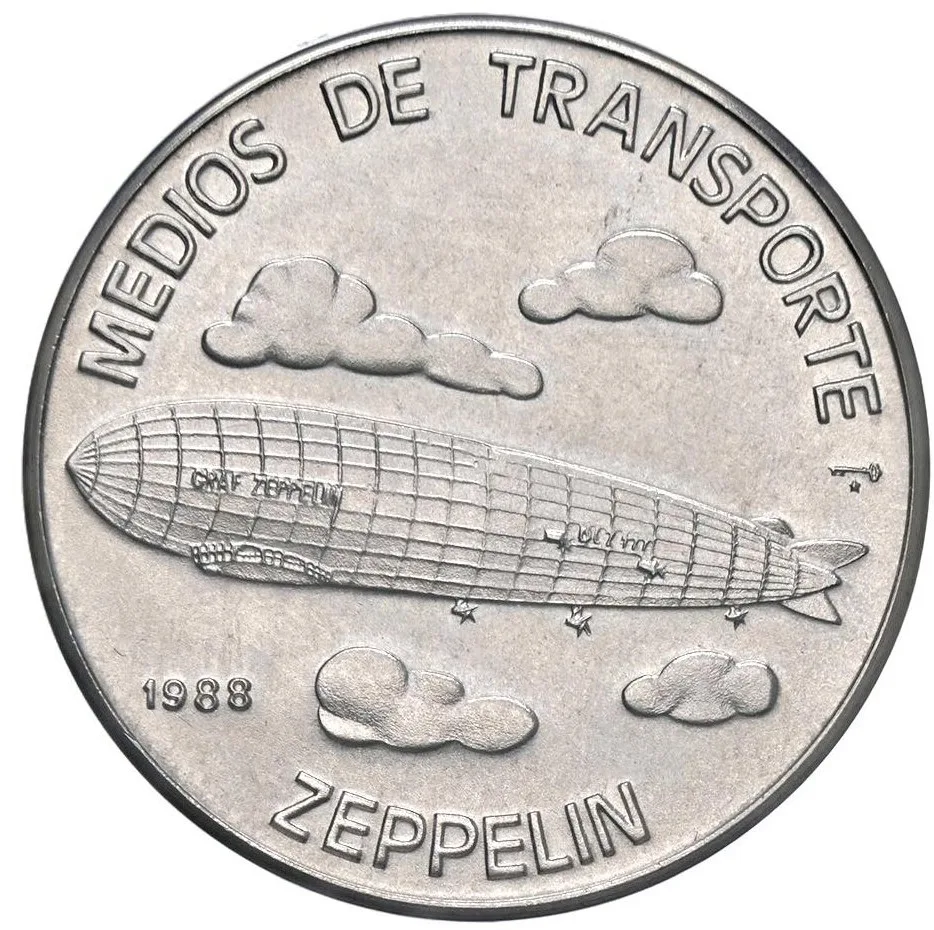
The artistic side depicts an airship - an elongated cigar-shaped body with stabilizer fins and a gondola suspended from below. The device is shown in flight, its swift silhouette occupies almost the entire field of the coin. The legend MEDIOS DE TRANSPORTE names the program, the inscription ZEPPELIN indicates the plot; here the year is 1988. The engraving of most of the scenes in the program was done by Alberto González Pereztol; his drawing combines an almost drawing-like precision of form with a sense of flight.
Reverse
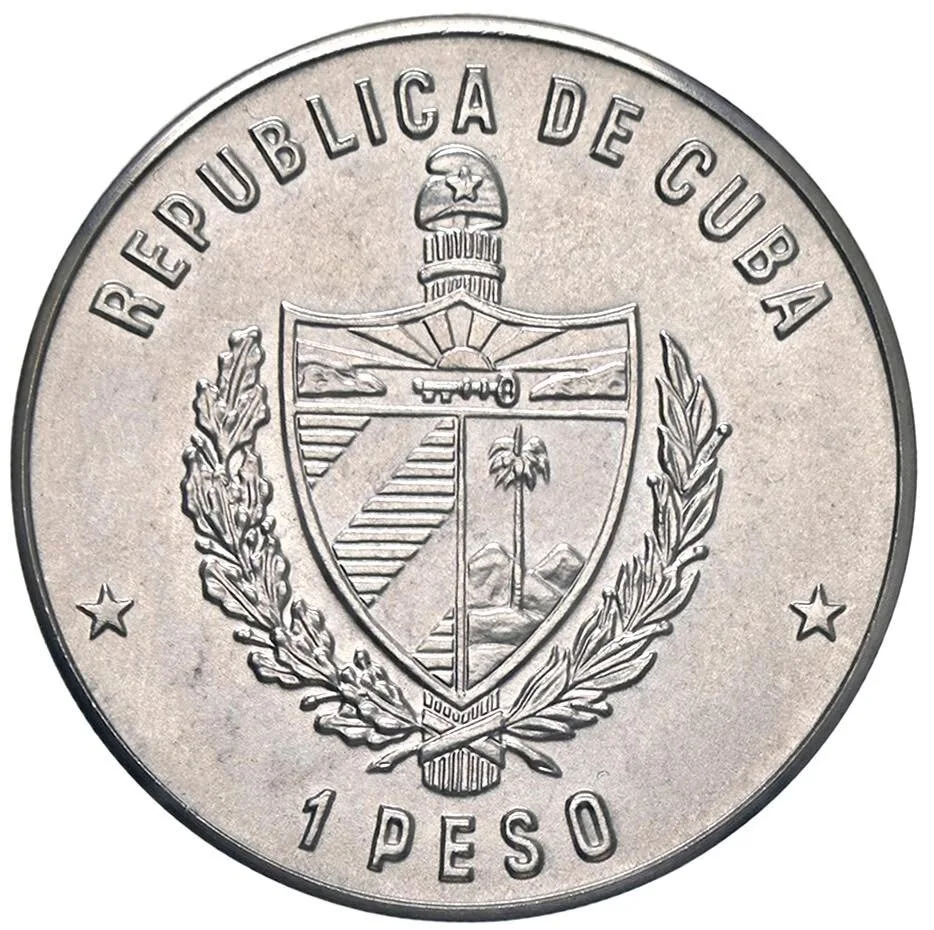
The official side is the same for all editions of the program: the coat of arms of the Republic of Cuba is a shield with a rising sun, a palm tree and a Cuban landscape, topped with a Phrygian cap with a star and framed by laurel branches. The design dates back to the work of American engraver Charles Edward Barber, adopted for Cuban coins in the early 20th century. Around the circle is the legend REPUBLICA DE CUBA, and below is the denomination of 1 PESO. The strict, symmetrical design is contrasted with the free composition of the artistic side and serves as an invariable feature of the Cuban coin program.