
Zeppelin (5 pesos, silver)
PDFGeneral information

Description
The Silver Airship is a coin about an airship that, in the first third of the 20th century, seemed to be the future of long-distance communications. Count Ferdinand von Zeppelin's first Zeppelin took off in 1900; a rigid structure apparatus with a frame and gas compartments gave its name to a whole class of aircraft, and since then the word “Zeppelin” has become a household word. This is not just a technical curiosity: airships combined the lifting force of gas with their own engine and controllability, which means they gained freedom that balloons did not have.
In the 1920s and 1930s, airships made transatlantic flights, transported passengers and mail, and flew around the world. To the public they were a symbol of speed, comfort and technical audacity, and the huge silver hulls sailing over cities drew crowds. It was airships that showed that the ocean could be crossed by air long before the advent of high-speed passenger aircraft.
On May 6, 1937, the hydrogen-filled Hindenburg caught fire while landing in Lakehurst (USA). The disaster shocked the world and virtually put an end to regular passenger flights on lighter-than-air craft - by that time the planes were already taking over long-distance routes. The coin, published half a century after these events, returns the viewer to the very end of this short era.
For the Cuban program on means of transport, the airship became the logical conclusion of the “aerial” line, which began with the idea of a balloon. The Silver Edition emphasizes the significance of the story: it turns a technical dream of the last century into an elegant piece of memorabilia and reminds that the history of transport is not only victories, but also lost paths of development.
Silver conveys the shine of the metal body well, and therefore the plot with an airship in this material looks especially natural. Decades after the Hindenburg disaster, interest in airships was revived: new designs for a new generation of aircraft appeared, and the image of the Zeppelin became a symbol of nostalgia for the era of romantic travel. The silver Cuban coin catches this note: it reminds not so much of technology as of a dream.
For the Cuban issue, it is significant that the airship received a silver, copper-nickel, and even large copper design: this theme, apparently, was in steady demand among collectors.
Obverse
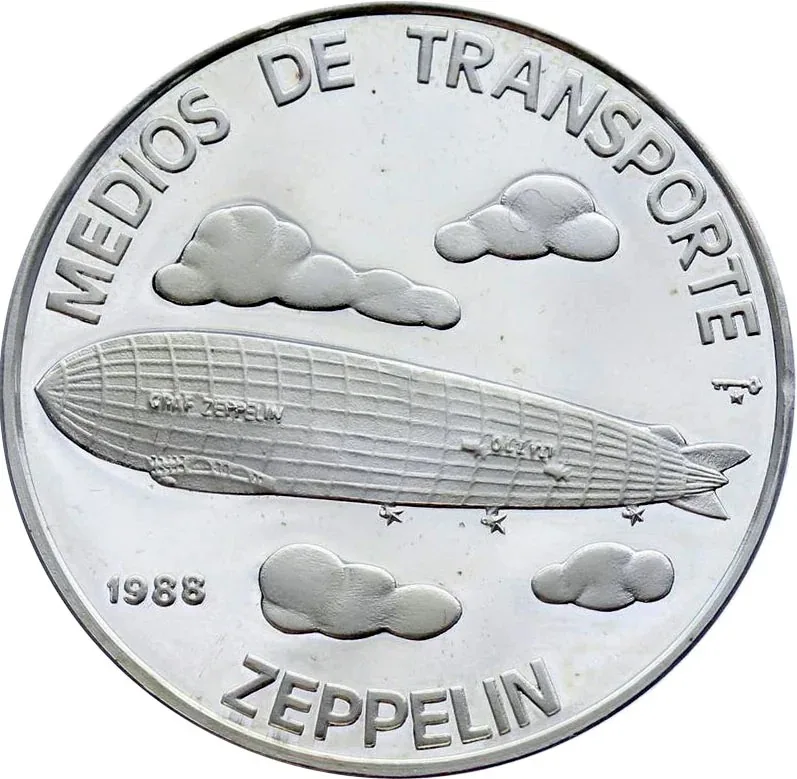
On the artistic side, there is an airship in flight: an elongated hull, tail and gondola, calmly floating over a field of coins. The silver surface conveys the shine of the case, and the thin lines convey its frame. The circular inscriptions MEDIOS DE TRANSPORTE and ZEPPELIN are accompanied by the year 1988. The engraving of the program's scenes is associated with the name of Alberto Gonzalez Perestol.
Reverse
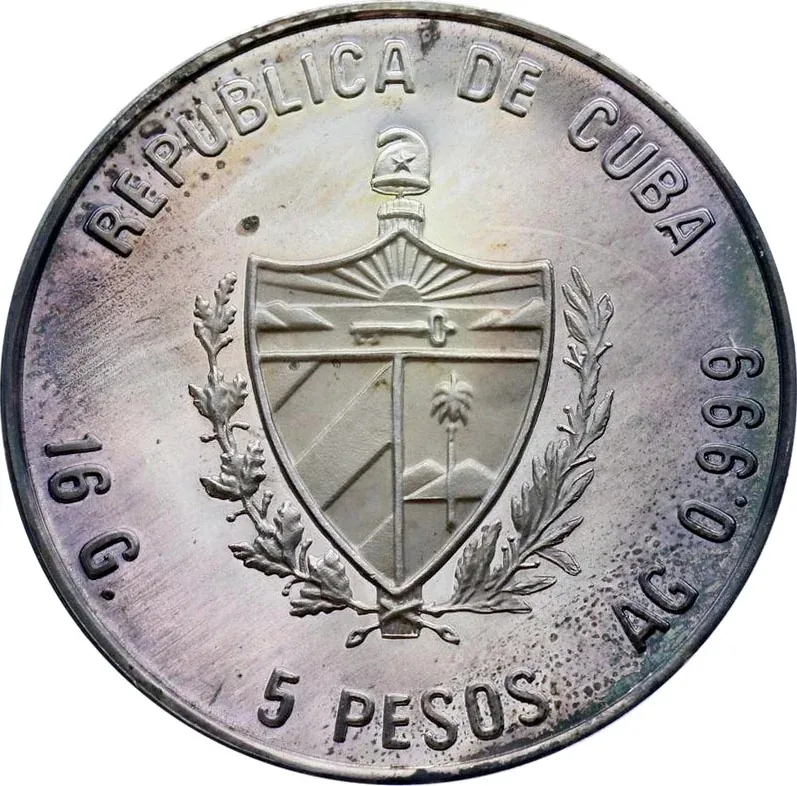
The official side is occupied by the coat of arms of the Republic of Cuba: a shield with a rising sun and a palm tree, a Phrygian cap with a star and laurel branches. The composition harkens back to a design by Charles Edward Barber used on Cuban coins from the early 20th century. Above the shield is the inscription REPUBLICA DE CUBA, below - 5 PESOS. This side is the same for the entire program and links this coin to all other issues, despite differences in subject matter, metal and size.