
Sköll
PDFGeneral information

Description
To understand Skoll's chase after the Sun one must picture the celestial chariot itself. According to the Prose Edda, when the gods made the world they took sparks that had flown out of Muspelheim and set them in the sky. A girl named Sol, daughter of the man Mundilfari, was seated to drive the chariot of the Sun; her horses are called Arvak and Alsvid, Early-waker and All-swift. Under their shoulders the gods placed bellows to cool the heat. Before the Sun stands the shield Svalin: without it the mountains and seas would burn. Skoll, the Mocker, chases this chariot, and Sol urges the horses on: she has no other choice.
Skoll, like his brother Hati, is a son of Fenrir. Their mother, a giantess, lives in the Iron Wood, and the Voluspa calls her the old woman who fostered the wolf kin. The seeress foretells that from this kin one will be born who, taking the shape of a troll, will swallow the Moon. The other will swallow the Sun. As the Prose Edda testifies, on that day the sky will darken, the stars will fall and the mountains will collapse.
There is still an exit from the story. Before Skoll seizes the Sun, she bears a daughter who will take her place in the sky. This detail makes Ragnarok not a hopeless catastrophe but a transition. Light does not vanish, it is passed on. Norse mythology often joins destruction and rebirth: after the battle a new green earth will rise from the sea, and two humans, Lif and Lifthrasir, will survive the fire in the branches of Yggdrasil.
This issue of the coin belongs to a paired design in which Skoll and Hati are shown side by side. Two wolves, day and night, pursuing two luminaries, form a single symmetrical composition, and the image of Skoll provides its solar half.
For a Norse listener the image of a wolf at the heavenly road was not frightening only outwardly. It is also a reminder: the order of the world is held by motion, and once it stops, everything collapses. That is why the chase is described as eternal and not final: for the Sun to shine, someone has to run after it.
The image of a beast devouring a luminary is one of the most widespread in world mythology. In China an eclipse was explained by a celestial dog swallowing the Sun, in India by the demon Rahu, whose head is left as only a mouth, and among many peoples of the North and Siberia by a predatory beast. The Scandinavian version stands out in making the pursuers characters of a family saga: they have a father, a mother and a brother, and the chase is built into the story of the end of the world. Skoll is not just a beast but part of a kin with whom the gods have been at feud from the beginning. Thus a natural phenomenon becomes a drama in which everyone has motives and a fate.
Obverse
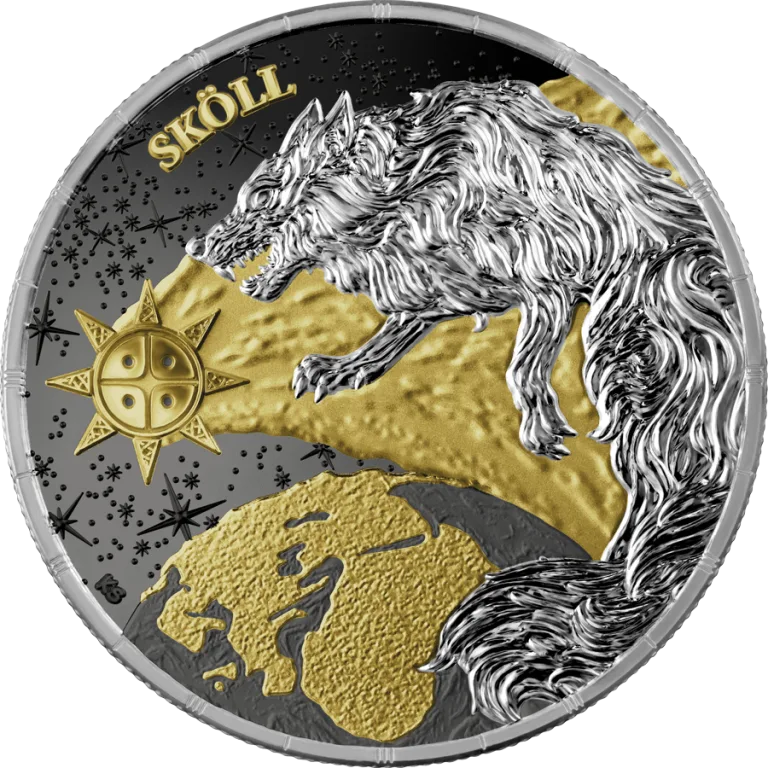
On the obverse Skoll is a wolf racing after the solar chariot. Golden accents on the dark ruthenium-toned field set off the solar disc and the sky, while the silver relief gives volume to fur and muscle. The inscription SKÖLL and runes can be read beside him.
Reverse
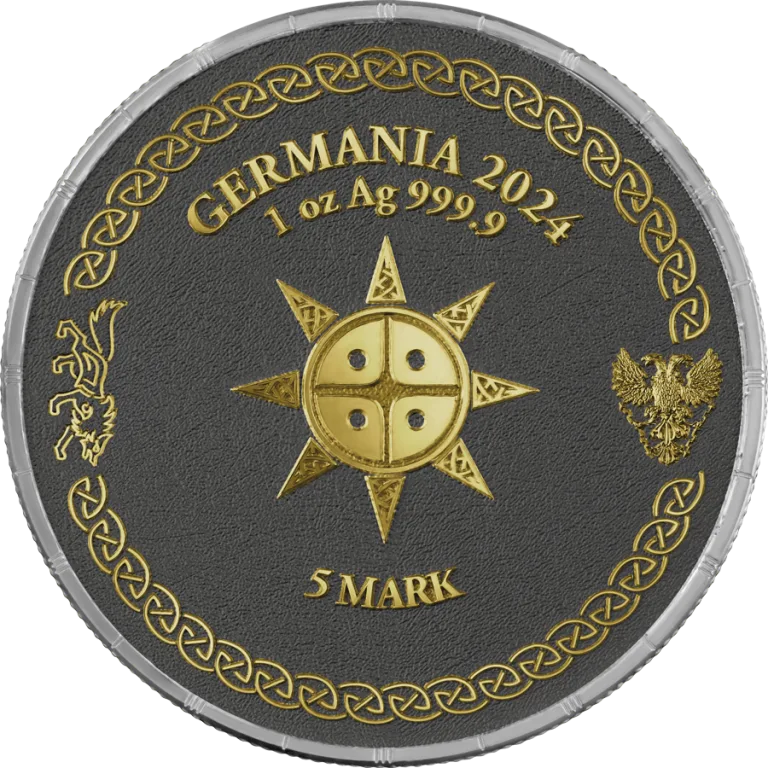
The reverse shows the double-headed eagle of the Germania Mint beside the symbol of the Sun. This reverse forms a pair with the reverse of Hati: where one shows the sun, the other shows the moon. The design is by Kinga Sabatowicz.