
Sköll & Hati
PDFGeneral information
Description
Wolves chasing the Sun and the Moon are among the most vivid images of Norse cosmology. According to the Prose Edda, when the gods ordered the world they took sparks from Muspelheim and set them in the sky. A man named Mundilfari gave his children the names Sol and Mani, Sun and Moon, and the gods, angered by such audacity, took the children to the sky: Sol to drive the chariot of the Sun, Mani to guide the Moon. After them rushed the wolves: Skoll after the Sun and Hati after the Moon. Every day the chase is repeated, and every day the luminaries manage to escape.
But on the day of Ragnarok everything will change. The old seeress in the Voluspa describes how Skoll will swallow the Sun and Hati will seize the Moon. The sky will turn red, the stars will go out, the earth will shudder. The fetters will fall and the inhabitants of Hel will come out into the light. Fenrir himself, the father of the wolves, will come out with them. Yet even in this apocalypse there is hope: before Skoll overtakes the Sun, she will bear a daughter, who will continue her mother's path.
The image of the celestial wolves combines fear and beauty. On the one hand are predatory beasts greedy for light; on the other, the balance between day and night, light and darkness. Scholars of mythology have long argued about what lies at the root of the subject: impressions of eclipses, the image of stars, or the eternal tension between hunter and prey. Each explanation gives a new view of the story, and each attracts artists.
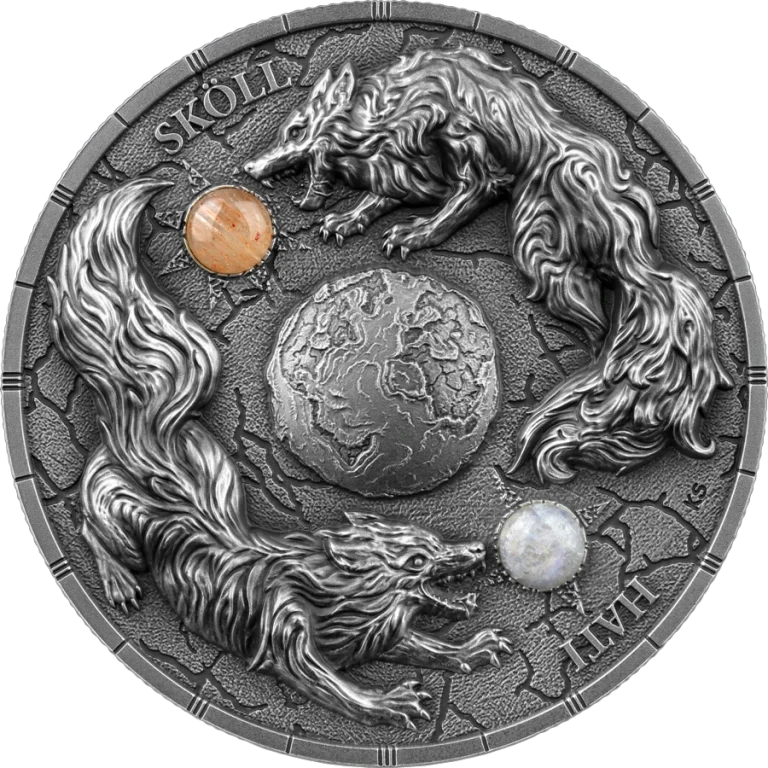
The coin in its enhanced relief execution lets one examine this scene up close, with a depth that a flat picture can hardly convey. Two wolves, two luminaries and a cracked earth ready to fall into the abyss create a sense of approaching ending.
There is a subtler thought in the subject as well. The wolves do not flee from the gods, do not defend themselves, do not reason: they simply do what is destined for them, and in this lies the cold honesty of northern thought. Fate is neither evil nor good, it simply is. The heroes of the Eddas know of it in advance, and their courage is measured by the fact that they go out to meet it all the same.
There is also a hidden mathematics of myth in the double composition. Two wolves, two luminaries, two directions of the chase: one runs after the light of day, the other after the light of night, and the sky turns out to be divided into two equal halves. The same principle of balance underlies the whole of Scandinavian cosmology: ice and fire, Aesir and Vanir, gods and giants, life and death. Ragnarok in this sense is not a violation of balance but its final and brightest demonstration.
Obverse
The obverse shows the main heroes pursuing the Sun and the Moon; under an ultraviolet torch the world on the coin glows like hot lava. The celestial bodies are adorned with moonstone and sunstone, which by design bring luck, prosperity and balance.
Reverse
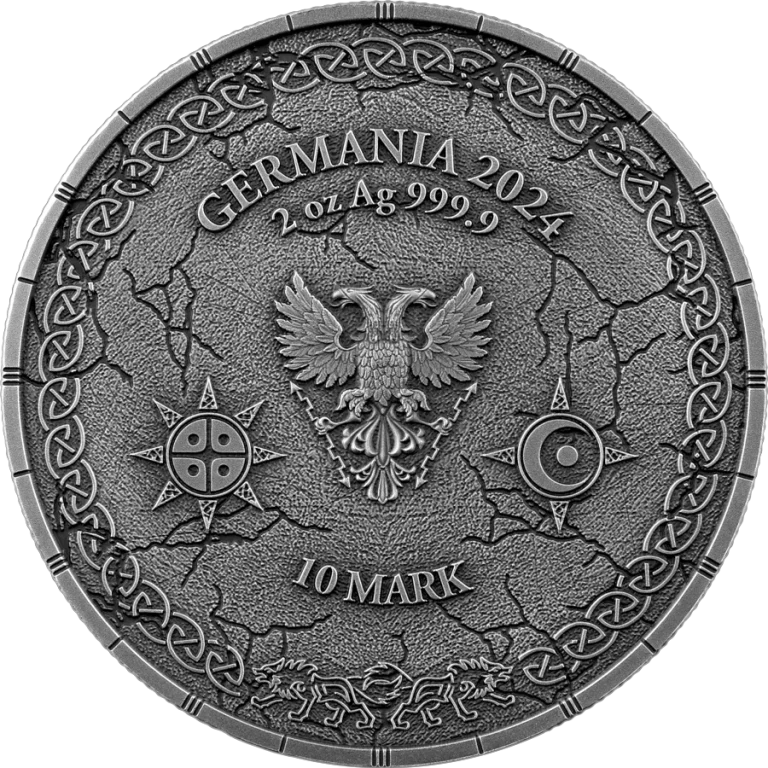
The reverse shows two wolves, a cracked earth on the brink of vanishing, and the symbols of the Sun and the Moon. Beside them is the double-headed eagle of the Germania Mint. The design is by Kinga Sabatowicz.