
Alpamys Batyr
PDFGeneral information


Description
Alpamys-batyr is the Kazakh heroic epic, one of the best-known Turkic dastans in the world. Kazakhs and Karakalpaks call it “Alpamys”, Uzbeks “Alpomysh”, Altaians “Alyp-Manash”, Bashkirs “Alpamysha and Barsynkhylu”, Kazan Tatars “Alpamsha”. The hero is a batyr, a champion from the Konyrat clan, and the main events of the epic are tied to the legendary land of Zhideli-Baisyn. The Kazakh version is known from many recordings: the one made from Sultanbek Akkozhaev is considered the fullest and most artistically accomplished, while the first printed edition appeared in Kazan in 1899, and before the revolution the epic was reprinted seven times.
The plot is largely the same among the different peoples. The childless Baibori and Baisary, heads of the clan, long pray to God for children, and Baibori’s son is born: Alpamys. From the cradle he is betrothed to the beautiful Gulbarshyn (Barchin in the Uzbek tradition), Baisary’s daughter. After a quarrel Baisary migrates with his clan to the land of the Kalmyks. Learning that Kalmyk champions are courting Gulbarshyn, Alpamys sets off for his bride, defeats his rivals in contests, marries and brings her home. Then he goes again to help his father-in-law, is taken prisoner and spends seven years in an underground dungeon; when he escapes and returns, he learns that a usurper has ruined his family and wants to take Gulbarshyn as his wife, with the wedding fixed for that very day.
Next comes the scene that every Kazakh reader knows by heart. Unrecognised, in strange clothes, Alpamys enters the wedding feast and proves the only man able to bend the old heroic bow; he wins the shooting contest, is recognised, and with his friends deals with his enemies and unites the people again under his rule. Such an ending — the return home on the very day of the wife’s wedding, the bow that only its master can draw — so resembles the “Odyssey” that Kazakh scholars often point out the likeness. Alpamys himself is described as a warrior whom neither fire nor bullet nor sword can harm, and his chief traits are fearlessness, honour and care for his people; in Gulbarshyn are embodied intelligence, strength of character and fidelity.
The origin of the epic is lost in the depths of the centuries. The scholar Viktor Zhirmunsky believed that the tale arose in the foothills of the Altai as early as the Turkic Khaganate, in the sixth to eighth centuries; closest to the ancient stage stands the Altai Alyp-Manash, in which the hero has the traits of a shaman. In the ninth and tenth centuries the Oghuz carried the tale to the lower Syr Darya, where it entered the “Book of Dede Korkut” as the story of Bamsi-Beyrek, while another version was taken by the Kipchaks to Kazakhstan, Bashkiria and the Volga. The epic took its final form, in the view of scholars, between the fourteenth and seventeenth centuries. It was more than once banned and attacked: in the Soviet Union in the 1950s critics fell upon the dastans, and this campaign is known as the “trial of Alpamysh”; nevertheless it was published no fewer than 55 times up to 1984, and in 1999, at the request of Uzbekistan, UNESCO marked the thousandth anniversary of the epic.
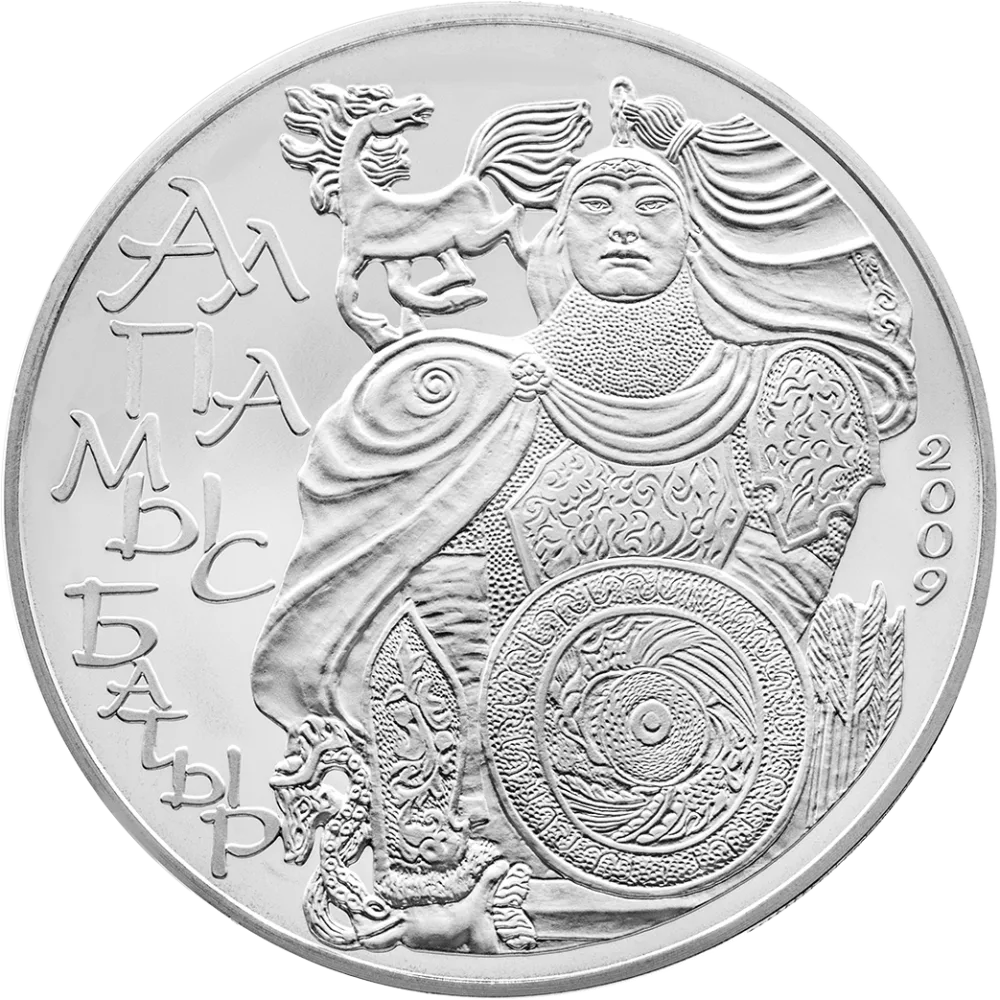
The silver 500-tenge coin entered circulation on 4 December 2009 as a collectors’ issue for those who gather items in precious metal. It was supplied in a souvenir case with a certificate, and so from the start it was meant as a gift rather than for circulation. It is a stand-alone issue: it has no paired base-metal coin, and that is its distinction, since the image of the batyr is given in a single, silver form and repeated nowhere else. Instead of a lone portrait, the coin draws a whole epic world at once: a warrior in armour, a horse, weapons and a monster. This multi-figure composition is naturally read as a summary of the poem rather than as a portrait.
The epic lives on today: the composer Yerkegali Rakhmadiyev, with a libretto by K. Kenzhetayev, created the opera “Alpamys”, which in 2021, for the thirtieth anniversary of Kazakhstan’s independence, was named premiere of the year at the Astana Opera. So an ancient poem that survived bans and neglect has returned to the stage, and the image of Alpamys remains for Kazakhs a symbol of courage, fidelity and love of the native land.
Obverse
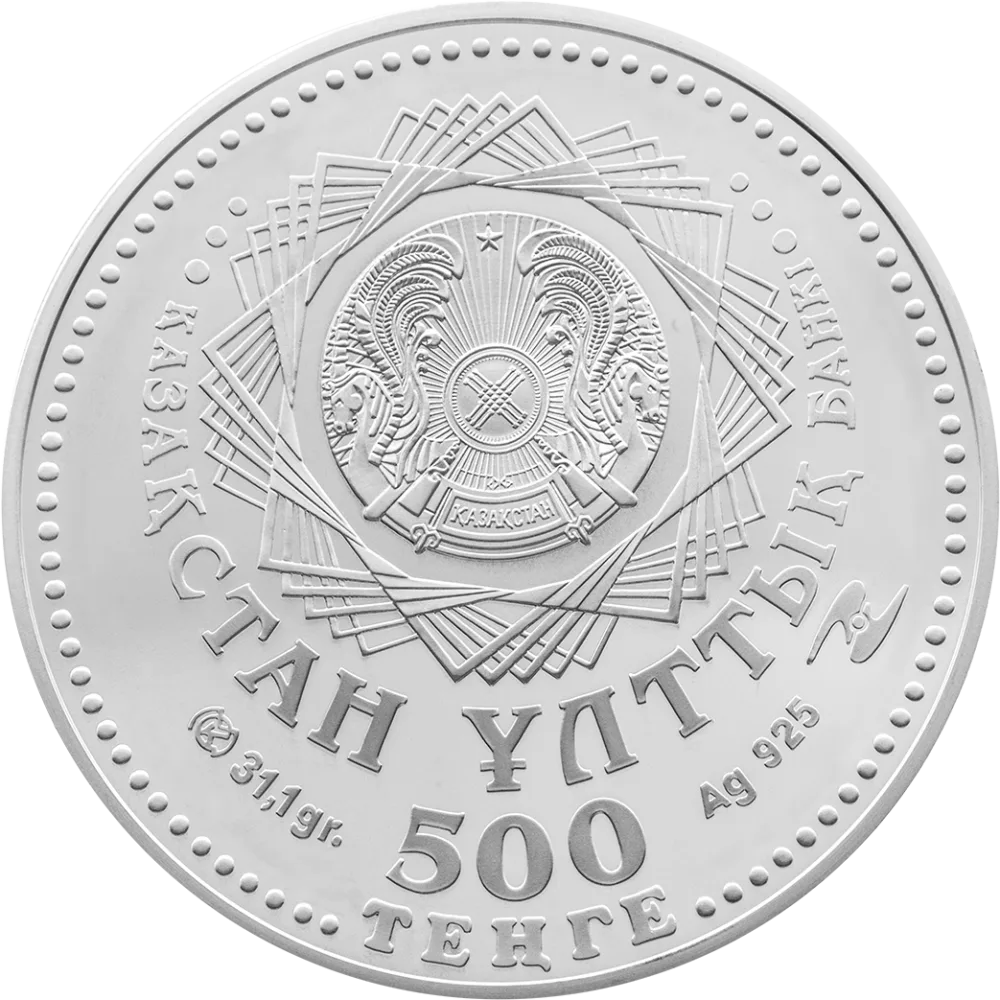
The official side of the coin carries the State Emblem of the Republic of Kazakhstan: in a circle bounded by a beaded rim are a shanyrak with radiating uyks, two winged tulpars, a star at the top and a ribbon reading QAZAQSTAN. The emblem lies on a background of rotated, overlapping squares forming a many-rayed rosette. Below are struck 500 TENGE, and along the lower arc runs the inscription QAZAQSTAN ULTTYQ BANKI.
Reverse
The story side shows a waist-length portrait of Alpamys-batyr, standing upright and stern. He wears a helmet and chainmail and holds a large round shield with an ornament of concentric rings; a sword and a quiver of arrows are visible. At the hero’s shoulder is the figure of a horse, and below, at his feet, a fantastic creature resembling a dragon or serpent, the enemy the hero must overcome. On the left the vertical letters ALPAMYS BATYR are struck, and on the right, also vertical, the year 2009.