
Nasreddin Hodja (silver)
PDFGeneral information


Description
Nasreddin Hodja is the hero of humorous tales and satirical anecdotes known from Turkey and the Balkans to Central Asia. His adventures are told in dozens of languages, beginning with Turkish, and every people calls him by its own name: Qozhanasyr in Kazakhstan, Nasriddin Afandi in Uzbekistan, Nasreddin Hoca in Turkey. Strictly speaking this is not a single fairy tale but a scatter of short miniatures, each with an unexpected twist and a gentle lesson. Nasreddin appears now as a sage, now as a simpleton, now as the butt of the joke, and it is often hard to tell who has outwitted whom in the conversation.
Where he came from is still disputed. The first anecdotes about the Hodja in Turkish sources appear in texts of the fifteenth and sixteenth centuries, and the oldest manuscript with his stories dates from 1571. Many sources name the village of Hortu near Sivrihisar as his birthplace and Akşehir as his last home; his tomb is shown there, and an international festival in his honour is held every July. Other scholars look for the roots of the figure in Central Asia, and still others see in him a Turkic counterpart of the Arab jester Juha. There is no single version, and perhaps that is the secret: he belongs to everyone.
In 2022 the tradition of telling comic tales about Nasreddin Hodja was added to UNESCO's list of intangible cultural heritage. The nomination was submitted jointly by Azerbaijan, Kazakhstan, Kyrgyzstan, Uzbekistan, Tajikistan, Turkey and Turkmenistan. For Kazakhstan this is no formality: stories about Qozhanasyr were told in bazaars and teahouses, at family feasts and at celebrations. The hero is always accompanied by his donkey, and his chief weapon is a remark that turns an argument upside down. Nasreddin likes to play the fool in order to expose a greedy landlord, a self-satisfied judge or a pompous official, and he laughs so good-naturedly that it is hard to take offence.
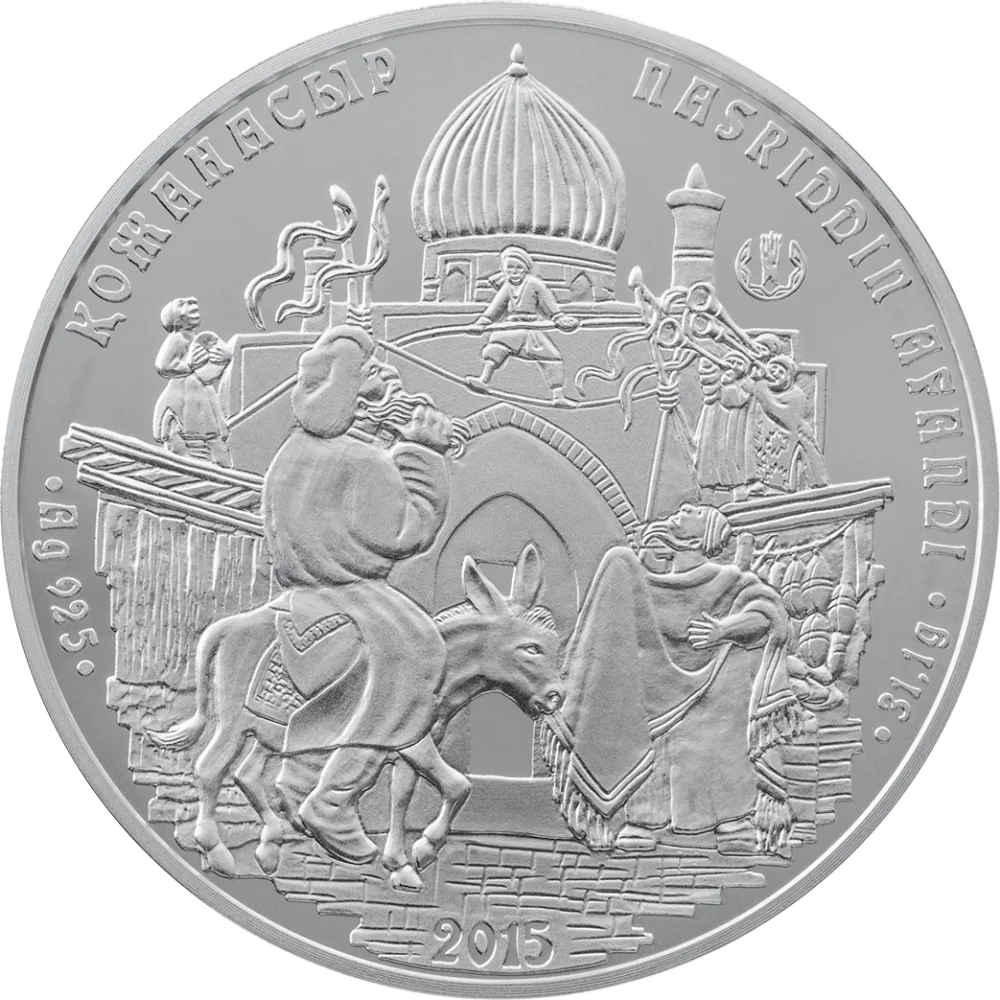
The silver 500-tenge coin is dedicated to this hero and was released on 25 December 2015. It was conceived as a collector's issue for the thoughtful enthusiast: it is supplied in souvenir packaging with a numbered certificate, and the mirror-like field sets off the fine detail of the relief. In this version the scene reads most clearly: the tiny figures of townsfolk, the pattern on the donkey's saddle-cloth, the brickwork of the pavement and the ornament on the dome are all easy to make out. The coin is the senior partner of the base-metal 50-tenge coin with the same design: both appeared on the same day and together show how a single subject can be offered both to the collector and to a wider public. The silver issue is meant for those who collect Kazakhstan's commemorative coins and want a full portrait of Qozhanasyr, and for anyone looking for a gift for a lover of Eastern stories.
Obverse
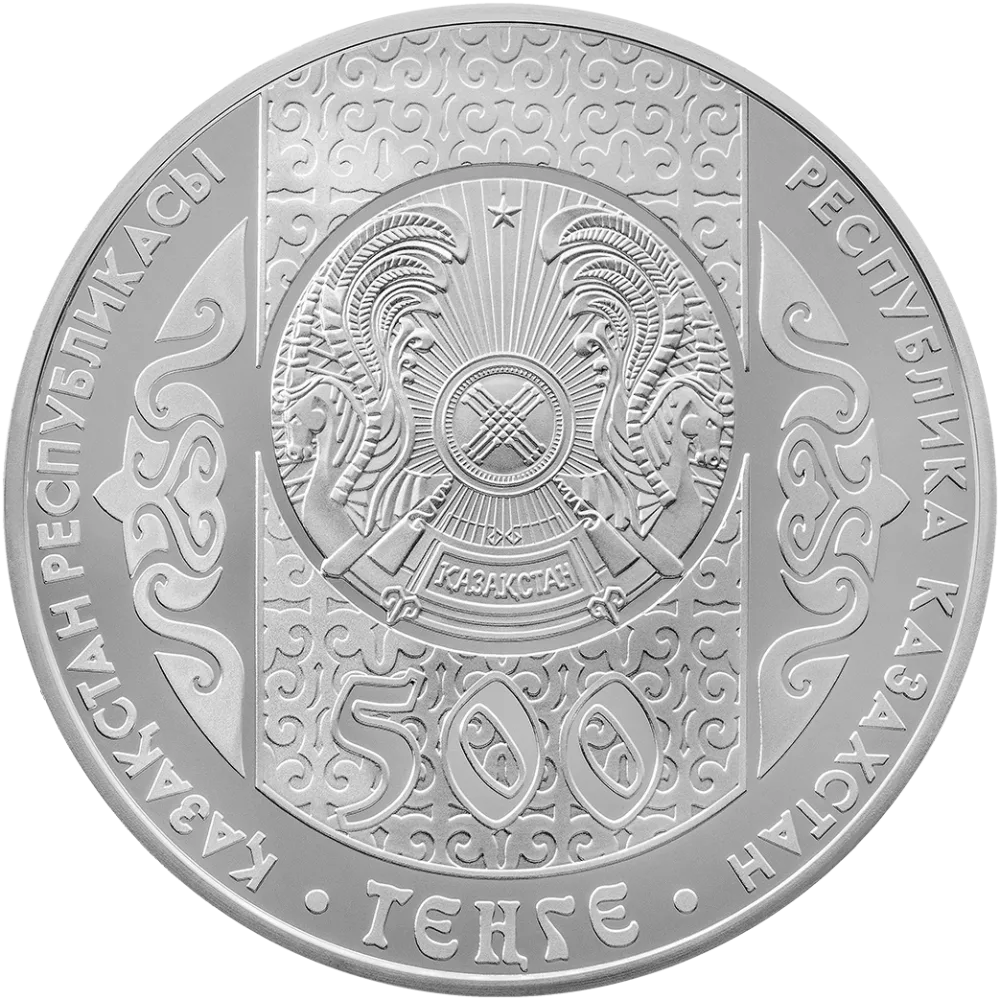
The official side bears the State Emblem of the Republic of Kazakhstan: the shanyrak with its radiating poles, winged horses, rays and star. The field around the emblem is filled with ornament that blends Kazakh and Eastern patterns, echoing the subject of the coin. At the bottom are the figure "500" and the word "TENGE", and a mirrored element of national ornament appears at each side. Around the rim run the inscriptions "QAZAQSTAN RESPÝBLIKASY" and "REPUBLIC OF KAZAKHSTAN".
Reverse
On the story side Nasreddin rides his donkey through a lively Eastern city. He wears a large turban and a long robe, has a beard and plays a musical instrument. The long-eared donkey walks with its head lowered, a patterned saddle-cloth with fringe and tassels on its back. Behind them rise a dome, a minaret and a pointed arch, while along the roofs and walls tiny figures of townsfolk, street performers and musicians with trumpets can be seen. Along the upper arc are the inscriptions "QOZHANASYR" and "NASRIDDIN AFANDI", and at the bottom the year "2015".