
Nasreddin Hodja (nickel silver)
PDFGeneral information


Description
All Nasreddin Hodja has is a sharp mind and a feel for words, and that is enough to win any argument. He is neither noble nor rich, yet a greedy landlord, a self-assured judge and a pompous ruler alike fail to throw him off balance. His stories are short: one pointed remark, one unexpected turn, and the moral is ready. In this they are kin to the parables of wandering dervishes, where laughter is a way of telling the truth without offending the listener. Beside the hero is always his long-eared donkey, who takes part in most of the stories: now he wanders off, now he digs in his heels, now he patiently endures his master's talk about his own wisdom.
The hero's name changes from country to country. The Turks call him Nasreddin Hoca, Uzbeks and Uyghurs Nasriddin Afandi, Kazakhs Qozhanasyr, and every people has its own details of his biography: here he is a village imam, there a travelling craftsman or a bazaar wit. Turkish tradition links him to Akşehir, where a tomb monument stands and a festival is held every year. Yet the argument over whether he ever really lived has never ended: some historians see a prototype in a teacher and preacher who lived in Asia Minor, others regard the figure as a composite. The first written anecdotes appeared in the fifteenth and sixteenth centuries, after which the stories spread across the Ottoman Empire and beyond.
In Central Asia the figure long ago outgrew the everyday joke. Monuments are raised to Nasreddin, books are written and films made about him, and his remarks are quoted like proverbs. In 2022 the oral tradition of comic tales about him was recognised by UNESCO as intangible heritage on a joint nomination by several countries, Kazakhstan among them. In Kazakhstan the tales of Qozhanasyr were passed from mouth to mouth, in bazaars, teahouses and at family celebrations, and only later written down and published. The Uzbek and Uyghur variants are especially close to the Kazakh ones in language and everyday detail, which is why the hero reads here as one's own.
The base-metal 50-tenge coin entered circulation on 25 December 2015 and is meant for a wide circle of collectors. It was issued in far greater quantity than its silver partner so that the story of the sage and his donkey would be within reach of anyone who wants to start a collection of fairy-tale coins or give one to a child or a friend. It is not a collector's rarity in a box with a certificate but a working coin that can sit in an album or ride in a pocket and still remain legal tender. Its design repeats the silver 500-tenge coin, and this is deliberate: the fairy-tale scene should be recognisable in any version. The small field is densely packed with detail, and it is more pleasant to study with a magnifying glass, when the figures on the city wall and the pattern on the dome come into view.
Obverse
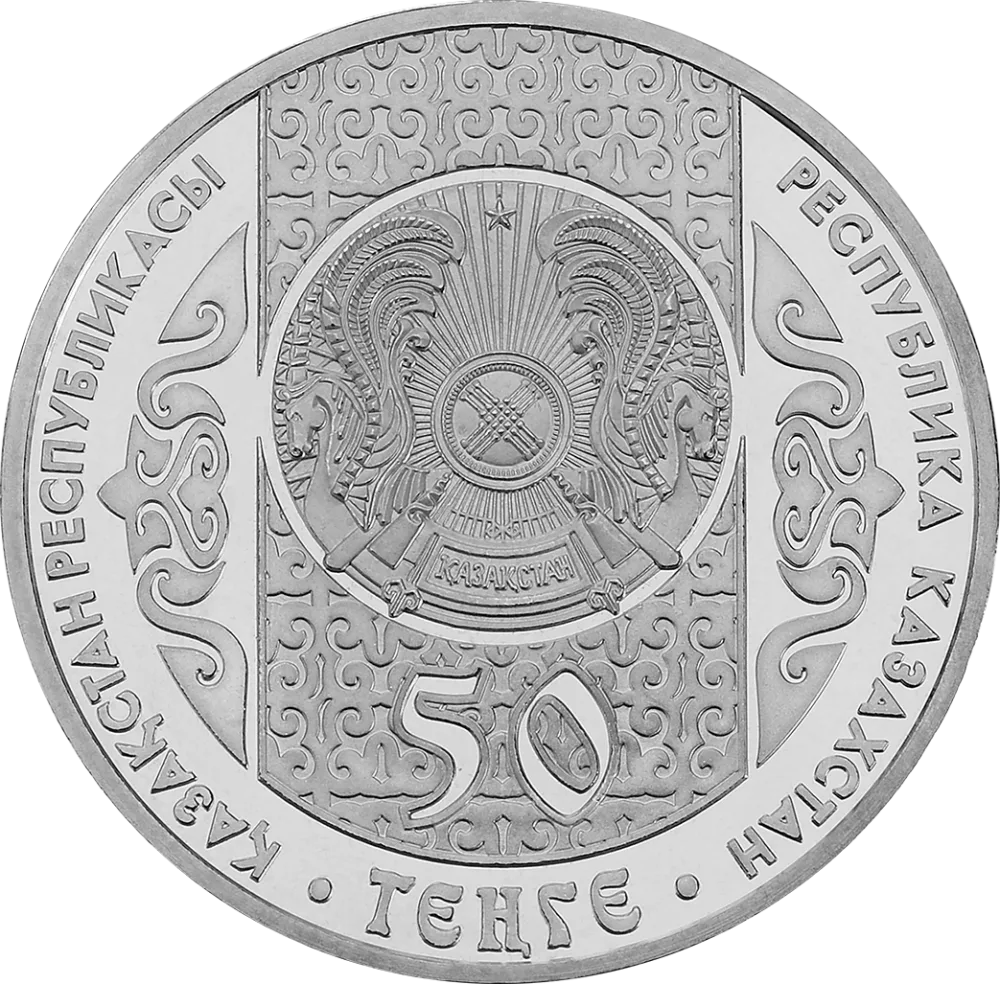
The official side follows the pattern common to this issue. In the centre, against an ornamental weave, is the State Emblem of the Republic of Kazakhstan: the shanyrak in a circle, two winged horses at the sides, a star and a ribbon inscribed "QAZAQSTAN". Along the rim run the names of the country in two languages: "QAZAQSTAN RESPÝBLIKASY" on the left and "REPUBLIC OF KAZAKHSTAN" on the right. At the bottom are the denomination, the figure "50", and the word "TENGE".
Reverse
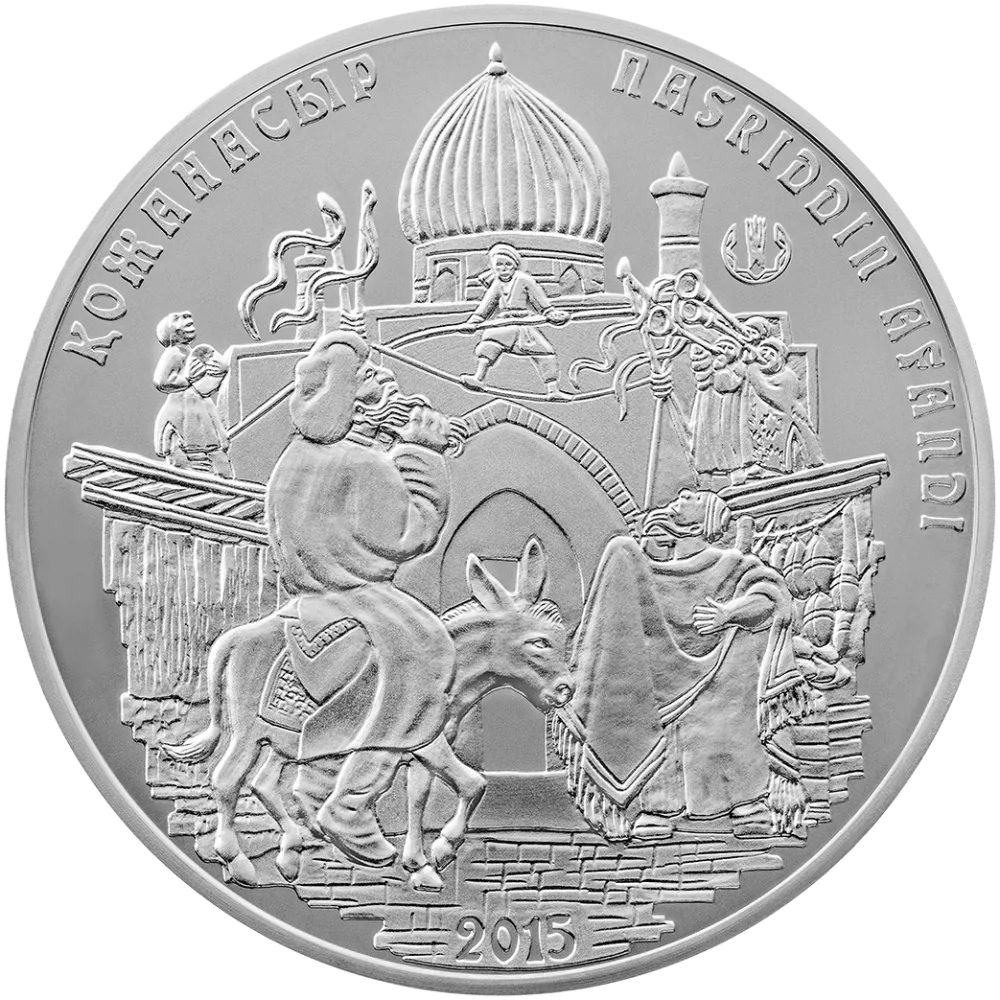
The story side shows the sage on the road. Nasreddin, with a full beard, a turban and a long robe, sits astride a donkey, which plods along the city wall with its long-eared head lowered. Behind him opens an Eastern city: a gate arch, a ribbed dome and a slender minaret, and above them a round medallion with ornament. Miniature figures of townsfolk and street performers crowd the walls and the rooftops, and curls of plant ornament are scattered along the edges. Around the circle is the hero's name "QOZHANASYR" and the Latin legend "NASRIDDIN AFANDI", and beneath the donkey's feet stands the year "2015".