
Sirko (silver)
PDFGeneral information
Description
The tale of Sirko is one of the most popular Ukrainian animal tales, and it speaks of loyalty, gratitude and the importance of not forgetting kindness. A peasant had a dog, Sirko, who had grown old. The master sees that he is no longer of any use and drives him out of the yard. Sirko wanders about the field, and a wolf meets him. Learning of his trouble, the wolf offers help: he promises to arrange that the master will take the dog back, on one condition — the dog must play along.
The trick is simple. When the master and his wife go out to reap and lay their child under a haystack, the wolf will seize the child and run across the field, and Sirko will dash after him, take the child away and return it to its parents, while the wolf “takes fright” and drops his prey. So it comes about. The grateful master takes bread and a piece of lard from his bag, brings the dog home, tells his wife to boil plenty of buckwheat dumplings and seats Sirko at the table beside himself, serving him so carefully that the dog will not burn his mouth. But Sirko remembers what he owes the wolf and decides to repay him.
The chance soon comes: the master is marrying off his daughter. Sirko invites the wolf to the vegetable garden, leads him into the house and sits him under the table, while he himself carries him the best morsels from the table and a bottle of vodka. The well-fed, tipsy wolf cannot hold himself back: “I’ll sing!” Sirko begs him to keep quiet, but the wolf howls under the table, and the house is in uproar. Some run out, some grab a stick, and Sirko throws himself on the wolf as if to throttle him. “Don’t beat the wolf,” says the master, “or you’ll kill Sirko too! He can handle him himself.” Sirko leads his guest out to the field: “You did me a service, and I repaid you with kindness.” And so they part.
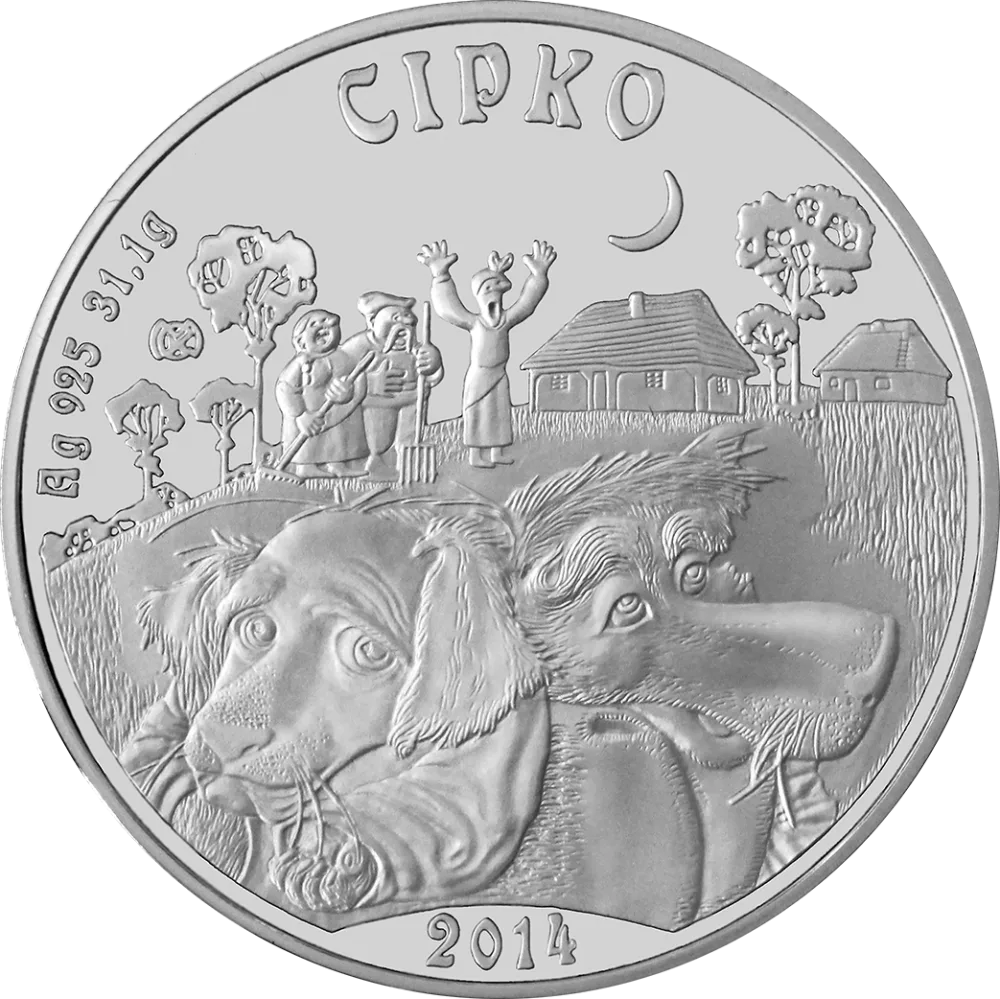
The silver 500-tenge coin entered circulation on 19 December 2014 as a collectors’ issue for those who gather items in precious metal. It was supplied in a souvenir case with a certificate, and was therefore conceived as a gift: on a small surface it holds a whole village with its cottages, trees, people and moon, so it is made for long looking rather than for counting in passing. The design does not retell the whole tale but catches its anxious moment: two beasts at the centre of attention, and behind them a village whose inhabitants have been thrown into alarm.
This coin is the silver “senior” record of the subject. On the same day, 19 December 2014, a base-metal 50-tenge coin with the same design was also issued, meant for the mass collector. The silver issue is for a gift and for a collection of precious metals, the base-metal one for those to whom assembling a full row of heroes matters more than owning silver. Together the two coins remind us that a Ukrainian tale lives in Kazakhstan alongside Kazakh, Tatar and Russian ones: the republic has many peoples, and Ukrainians are one of the country’s long-established communities.
Obverse
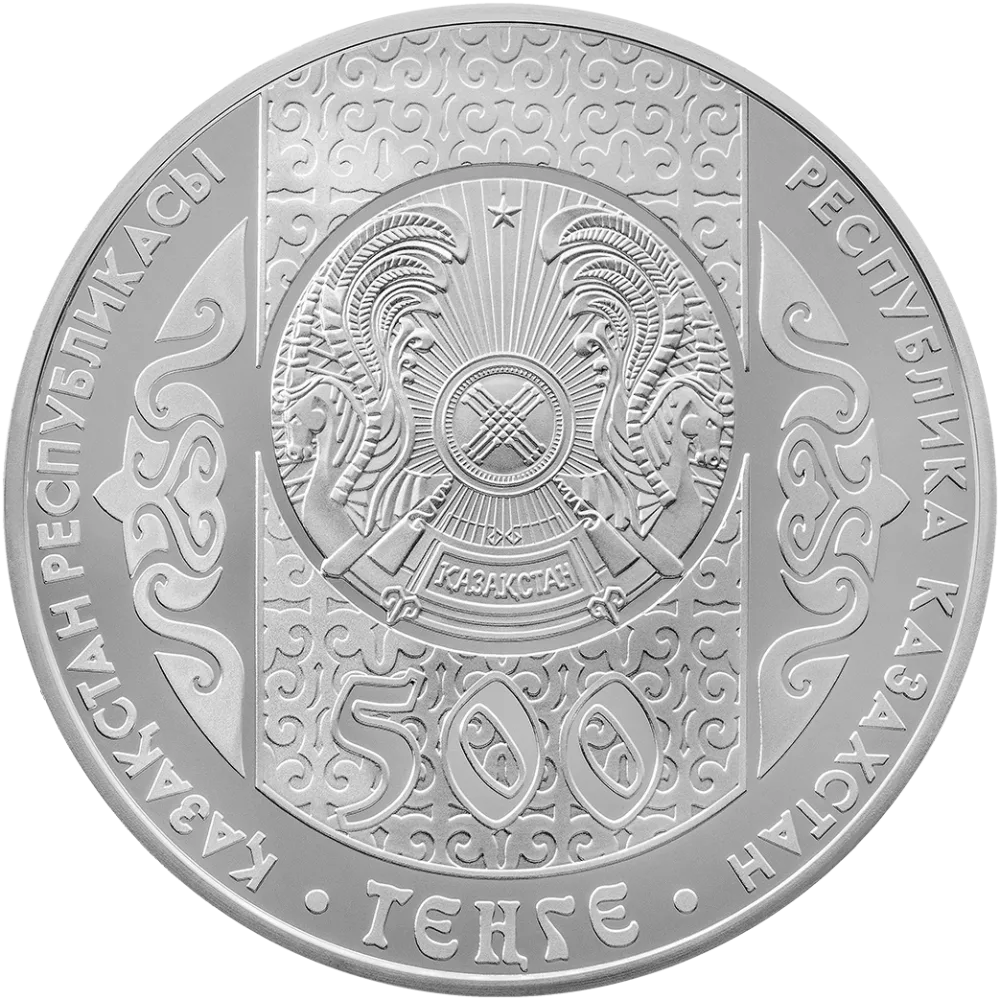
The official side of the coin carries the arms of the Republic of Kazakhstan. In a circle is the State Emblem: a shanyrak with radiating uyks, two winged tulpars, a star at the top and a ribbon reading QAZAQSTAN. It lies on a dense national ornament, with symmetrical curls repeated at either side of the central strip. Beneath the emblem the figure 500 is struck large, with the word TENGE below, and around the rim QAZAQSTAN RESPÝBLIKASY reads on the left and REPUBLIC OF KAZAKHSTAN on the right.
Reverse
The story side is built like a folk woodcut with two planes. In the foreground are two huge animal heads: on the left a shaggy one with drooping ears and wide-open eyes, on the right one with a long muzzle and ruffled fur. Behind them on a hill stand two Ukrainian cottages with thatched roofs and small windows, round-crowned trees around them, and on the slope three little figures: a woman, a man with a pitchfork and a figure in a long shirt with raised arms. A thin crescent moon hangs in the sky. At the top the word SIRKO is struck in wavy letters with the Ukrainian dotted I, and at the bottom the year 2014.