
The White Wolf (1 kg, sculptural)
PDFGeneral information


Description
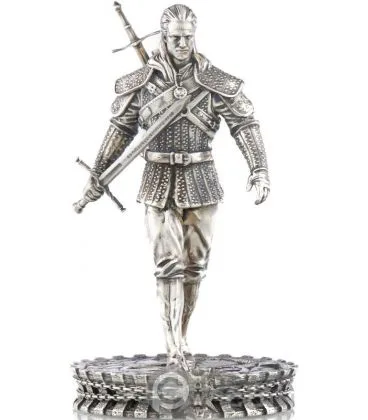
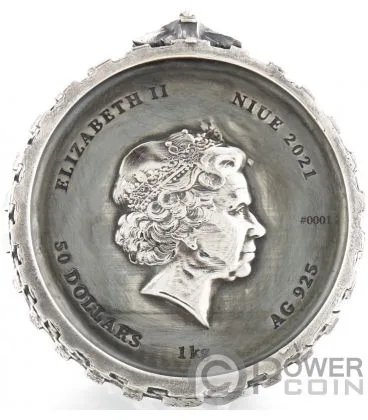
The kilogram version of the White Wolf is the same subject as the five-ounce statuette, resolved on a different scale. Here Geralt of Rivia stands more than fifteen centimetres tall, and the sculpture is meant to stand on a desk or in a display case as an object in its own right rather than to lie in a capsule. The pedestal, however, remains a coin: on its underside are struck the coat of arms of Niue, the name of Queen Elizabeth II, the year 2021, the weight, the silver fineness, the denomination of 50 dollars and the number of the piece. It is hard to call such an object a coin in the usual sense, and yet legally it is exactly that — legal tender of an island state, issued in a mintage of only one hundred. For numismatics the issue was a landmark: silver figurines had been made before, but they carried no monetary status, and the White Wolf of the Mint of Gdańsk (Mennica Gdańska) proved to be the world's first silver legal-tender piece cast in the form of a statue. It also opened a series of twelve statues based on Andrzej Sapkowski's Witcher — eight volumes of the saga and four main characters, one figure a year.
Geralt is a witcher, a mutant trained from childhood to kill monsters for payment. Men like him were raised in the mountain fortress of Kaer Morhen, in the School of the Wolf, and after all the trials only a handful were left on the Continent. Elves and dryads call him Gwynbleidd — White Wolf — and that name has clung to him more firmly than the official one; there is also a third, far less flattering, the Butcher of Blaviken, the memory of a massacre in a market square that he himself dislikes discussing. Sapkowski invented the character in the mid-1980s, and over four decades the witcher has moved from Polish prose into cinema, games and comics, while remaining a figure of literature: a man whose trade is to go where others do not and to be paid for it. In the kilogram statue this duality is especially clear, because the scale allows one to see the craft rather than only the silhouette.
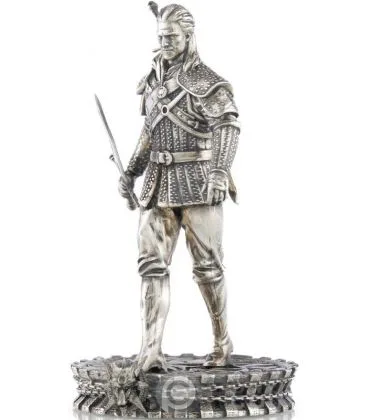
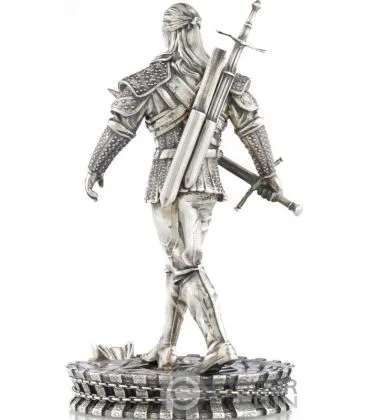
The sculpture follows the books, not the screen adaptations. Geralt stands in full armour with a drawn sword in his right hand; the blade is covered in runic script — not ornament but the mark of a trade, since witcher swords are inscribed with runes because they are used against beings for whom ordinary steel is useless. Behind his back hangs the second pair of scabbards: a witcher carries two swords, a steel one against men and beasts of flesh and a silver one against the undead and offspring of pure magic. On his chest is the medallion of the School of the Wolf with a wolf's head, received after the trials; it serves both as a badge and as a kind of compass, for it vibrates near strong magic. The pose is not ceremonial: the torso is slightly turned, the weight rests on one leg, and there is a readiness to move in it — this is how the books describe him, collected and always on guard. On the kilogram casting one sees things that are lost at small size: clasps on the belts, the facets of the vambraces, the straps on the boot shafts, the seams on the gloves.
The difference between the two editions is not only one of weight. The five-ounce statuette lives in a capsule and a box, taken out to be examined and put back; the kilogram piece is immediately conceived as an object with a permanent place. Hence the mintage too: a thousand pieces against one hundred. One hundred for the whole world is no longer a coin for a collection but an object that rarely comes to market and is almost never offered for sale. The antiqued silver with darkening works to the same effect: recesses grow dark, raised parts grow light, and in side lighting the figure reads in full volume, like old bronze. The set includes a themed box, a certificate of authenticity and a special brush for removing dust so as not to wear away the patina. Some English-language dealers state that the actual striking was carried out by the New Zealand Mint; the Mint of Gdańsk's own materials speak of design and issue, so that mention is best taken as trade-side information.
In the saga Geralt matters not only as a slayer of monsters. His story is about choosing between the lesser and the greater evil and about trying to keep one's own rules where everyone else breaks them. He is bound to Yennefer of Vengerberg, the sorceress whom a djinn brought to him, and to Ciri, the girl obtained by the Law of Surprise — and both bonds prove more important than any contract. The White Wolf stands at the beginning of that road: there is no Ciri yet, no war yet, only a witcher with a sword and his trade. That is why the first statue of the series is a portrait of the hero before he became a legend, and the kilogram edition turns that portrait into something close to a monument.
Obverse
The official side is hidden beneath the pedestal and faces downwards. In the centre the coat of arms of Niue is struck, and around it runs the legend: ELIZABETH II, NIUE, 2021, then the silver fineness AG 925 and the weight, and below that the denomination, 50 DOLLARS. On a separate line stands the number of the piece in the form #0001: the numbering is individual, and no two obverses in this issue are alike. The portrait of Elizabeth II follows the model by Ian Rank-Broadley — the same sculptor whose profile has appeared on British coins since 1998. The obverse is treated as a hallmark: it confirms the state status of the object and does not try to compete with the figure, leaving the artistic part entirely to it.
Reverse
The reverse is the sculpture itself. Geralt stands on the pedestal at full height, in armour, with a sword in his right hand and the second pair of scabbards behind his back, the wolf medallion on his chest. The relief has no background: the figure is fully round, and with every turn a new detail opens up — a buckle, the facet of a vambrace, the runic notch on the blade, a fold of the cloak. Darkening in the recesses produces the effect of old silver touched by time, which makes the sculpture look cast rather than struck. There are no inscriptions on the artistic side: everything official has been moved onto the pedestal — a deliberate gesture by which a statue reads as a statue and not as a coin with a picture on it.