
The White Wolf (5 oz, sculptural)
PDFGeneral information


Description
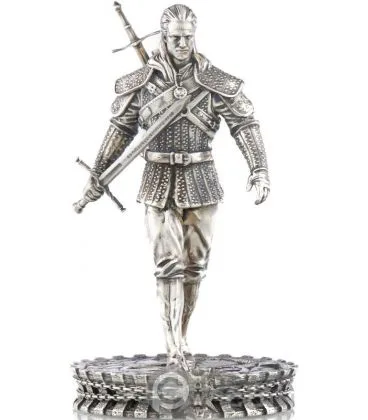
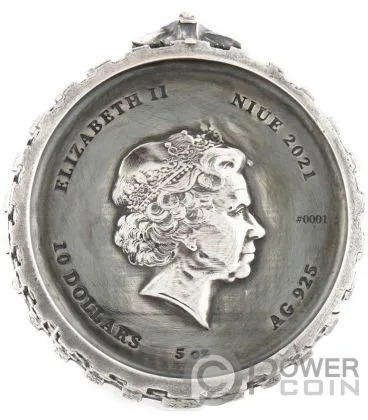
This is not quite a coin in the usual sense: the White Wolf is a silver statuette that nevertheless remains legal tender of Niue. Geralt of Rivia stands on a low pedestal, and the pedestal is precisely what serves as the official side: beneath it are struck the island's coat of arms, the Queen's name, the year, the fineness and weight of the silver, the denomination and the individual number of the piece. Everything else is sculpture, to be viewed all the way round like a bronze in a museum, not a relief on a flat disc. For numismatics this is a threshold: three-dimensional figurines in precious metal had been made before, but they carried no monetary status. The issue of the Mint of Gdańsk (Mennica Gdańska) became the world's first silver legal-tender piece made in the form of a statue, and it opened a large series based on Andrzej Sapkowski's Witcher — twelve statues, one a year: eight volumes of the saga and four of its main characters. The White Wolf is number one in that plan, the 2021 release, and the rest of the figurines line up behind it.
Geralt is the figure with whom the whole saga begins. He is a witcher, that is, a mutant trained from childhood to kill monsters for money; men like him were raised in the mountain fortress of Kaer Morhen, in the School of the Wolf, and after all the trials only a few were left on the Continent. He has a second name — Gwynbleidd, White Wolf in the tongue of elves and dryads, and it has clung to him more firmly than the official one. There is a third, far less flattering: the Butcher of Blaviken, a nickname earned after the slaughter in the market square, which he himself prefers not to recall. Behind all this stands a man whose trade is to go where others will not and to take payment for what the rest refuse. Sapkowski invented him in the mid-1980s, and since then the witcher has become one of the most recognisable heroes of Polish literature, and then of world cinema, games and comics.
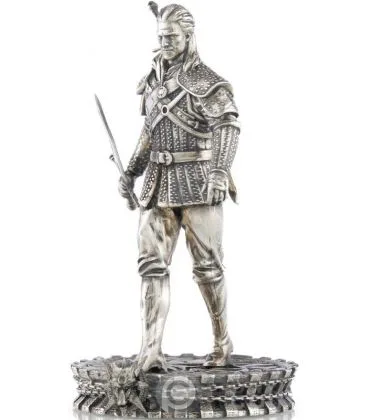
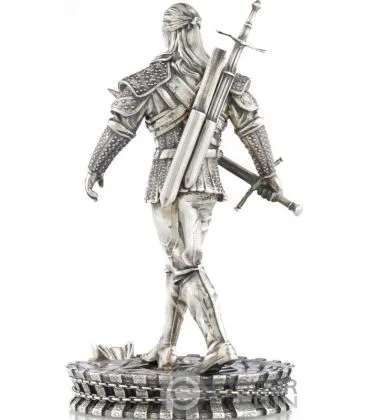
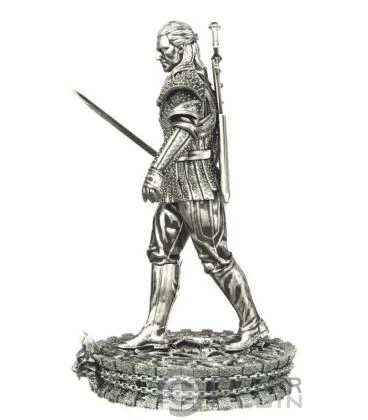
The sculpture follows the books, not the screen adaptations. Geralt is shown in full armour, with a drawn sword in his right hand — the blade is covered in runic script, and this is not ornament but a mark of the trade: witcher swords are inscribed with runes because they are used against beings for whom ordinary steel is useless. Behind his back hangs the second scabbard: a witcher carries two swords, a steel one against men and beasts of flesh and a silver one against the undead and creatures of pure magic. On his chest is the medallion of the School of the Wolf with a wolf's head, which Geralt received after the trials; the medallion serves him both as a badge and as a kind of compass, for it vibrates near strong magic. The pose of the statue is neither ceremonial nor heroic: he stands with his torso slightly turned, ready to move, as if he had just heard footsteps behind him. This is exactly how the books describe him — collected, sparing of words, always on his guard.
The statuette form changes the very way one looks at a coin. A flat disc is held in the hands while two sides are examined; here the object is taken whole, turned, and one studies the folds of cloth, the belts, the buckles, the facets of the armour, the seams on the boots. Antiqued silver with darkening emphasises the volume: recesses grow dark, raised parts grow light, and the figure reads even in dim light. The pedestal, meanwhile, remains a real coin — with coat of arms, legend and number — so that every piece differs from its neighbour: the number is struck on the official side, and by it a collector knows his own specimen. The box contains, along with the statuette, a certificate of authenticity and a special brush with which the sculpture is dusted without leaving marks on the patina. This is a thing for a shelf rather than an album, and the whole series is designed so that twelve figurines will eventually stand side by side. Some English-language dealers mention that the actual striking was carried out by the New Zealand Mint; the Mint of Gdańsk's own materials speak of design and issue, and that mention is worth keeping in mind as trade-side data rather than as an official record.
In the saga Geralt matters not only as a slayer of monsters. His story is about choosing between the lesser and the greater evil, about trying to keep one's own rules in a world where rules are constantly broken. He is bound to Yennefer of Vengerberg, the sorceress to whom a djinn brought him, and to Ciri, the girl obtained by the Law of Surprise — and both of these bonds prove more important than any contract. The White Wolf stands at the beginning of that road: there is no Ciri yet, no war yet, only a witcher with a sword and his trade. That is why the first statue of the series is a portrait of the hero before he became a legend.
Obverse
The official side is hidden beneath the pedestal and faces downwards. In the centre the coat of arms of Niue is struck, and around it runs the legend: ELIZABETH II, NIUE, 2021, then the silver fineness AG 925 and the weight, and below that the denomination, 10 DOLLARS. On a separate line stands the number of the piece in the form #0001: the numbering is individual, so no two obverses in the issue are alike. The portrait of Elizabeth II follows the model by Ian Rank-Broadley, the same sculptor whose profile has appeared on British coins since 1998. The official side is treated as a hallmark: it confirms that this is a coin issued by a state, and does so without decorative play, leaving the artistic part entirely to the figure.
Reverse
The reverse is the figure itself. Geralt stands on the pedestal at full height, in armour, with a sword in his right hand and the second pair of scabbards behind his back; on his chest is the wolf medallion. The relief has no background: the sculpture is fully round, and from every viewpoint a new detail opens up — now a clasp on a belt, now the facet of a vambrace, now the runic notch on the blade. Darkening in the recesses produces the effect of old silver touched by time, which makes the figure look cast rather than struck. There are no inscriptions on the artistic side at all: everything official has been moved onto the pedestal, and this is a deliberate gesture — a statue should read as a statue, not as a coin with a picture on it.