
Panda, 15 g gold (2016)
PDFGeneral information


Description
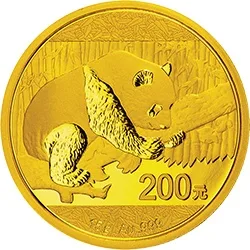
The annual Chinese Panda issue dated 2016 was announced by the People’s Bank of China in autumn 2015. The coin shows a panda in a tree: the animal hugs the trunk and rests on a branch.
The birth of a panda cub is always a small event. The newborn is tiny, blind and nearly bare, and at first the mother keeps it warm and almost never leaves it alone. The cub drinks milk for about a year, then moves on to bamboo, and stays near its mother for another year and a half or two, gradually learning to climb and to find food. This slow cycle is one of the reasons why the population recovers with difficulty.
On the coin of 2016 the panda has settled in a tree, wrapping its arms around the trunk and resting on a branch. For a bear that spends almost all of its time on the ground, a tree is a special place: one can wait out danger, rest and look around. This year was a turning point for the series: the mint gave up troy ounces and moved to the metric system, and buyers used to the ounce coins saw new units that were more natural for China.
Panda coins have been issued since 1982, and over that time several generations of design have changed: there were single animals, pairs, and whole scenes with trees and snow. Every year the artists look for a new angle, but the official side stays the same: the Temple of Heaven, the name of the state and the year. That is why the series is convenient to collect by year, like a calendar in which every issue is tied to its own date and its own scene.
The life of the panda passes in the mist of the mountain bamboo forests of Sichuan, Shaanxi and Gansu, at altitudes between 1,200 and 3,400 metres. The animal prefers solitude: each has its own range, with borders marked by scent, and meetings between adults are rare and short. Pandas climb trunks with confidence, swim fairly well and rest in the shade of trees on warm days.
For a long time scientists argued about where to place the panda: it was considered now a relative of raccoons, now a species of its own. Only genetic research confirmed that it is a true bear, though the most unusual one, almost entirely herbivorous. The Latin name of the species, Ailuropoda melanoleuca, literally means “black-and-white cat-foot”, and the Chinese call the animal the “great bear-cat”.
Scientists explain the black-and-white coat of the panda in several ways: the white areas camouflage the animal in snow, the dark ones help it hide in shade, and the sharp markings on the face serve as signals to other pandas. In China this contrast is traditionally compared with yin and yang, a balance of opposites, which is why the panda is so readily shown as a symbol of peace.
Obverse
The official side shows the Hall of Prayer for Good Harvests in the Temple of Heaven, one of the architectural jewels of Beijing. The round three-tiered roof with blue tiles symbolises the sky; the building was raised in 1420, rebuilt after a fire in 1889, and since 1998 the temple has been protected by UNESCO. The inscription “中华人民共和国” (People’s Republic of China) runs around the rim and the year “2016” is below.
Reverse
A panda in a tree: the animal hugs the trunk and rests on a branch. This is the first issue of the series in the metric system. The markings of the coin are placed beside the picture.