
Panda, 30 g silver (2016)
PDFGeneral information

Description
This coin belongs to the 2016 Chinese Panda set. The People's Bank of China announced it in the autumn of 2015 (announcement No. 32 of 2015), and the set went on sale on 28 October 2015. It consisted of twelve coins — nine in gold and three in silver — and the subject of the year is a panda climbing a tree.
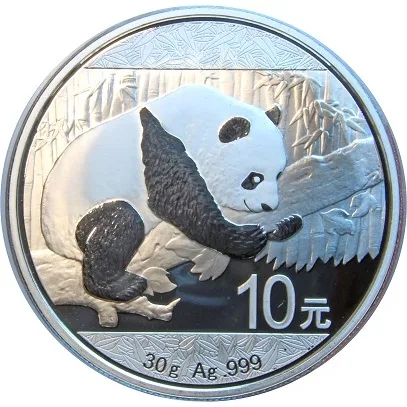
For a panda a tree is shelter, a resting place and a lookout. Adult animals climb trunks confidently, and cubs spend their first months on branches: while the mother feeds below, the little one waits high up where predators cannot reach it. The 2016 design captures exactly this movement: the animal is not sitting and chewing bamboo, as on many other coins of the series, but hugging the trunk and making its way up.
The main event of this issue is a change of measurement system. In all the previous years the silver Panda was struck as a coin of one troy ounce, and catalogues called it the one-ounce piece. With the 2016 set the mint switched to the metric system: the silver Panda became a metric coin, with a neat metric size, and the gold coins received a range of sizes familiar to the Chinese buyer. The previous year had been a preparation for the change: on the 2015 coins the marks of metal content were removed from the design, and now the silver Panda broke with the ounce for good. For collectors this is a dividing line: all the ounce silver Pandas of 1983–2015 stayed in the past, while the metric ones form a separate line that is usually collected year by year.
The value of the silver Panda in yuan remains symbolic. The coin is issued as an investment and a collector piece at the same time: nobody will pay with it in a shop, and its price is set by the silver and by collector demand. In the 2016 set the silver coin is the most accessible one; the gold and the large proof issues are meant for a wealthier buyer, while the silver Panda has traditionally served as the first step for everyone who starts collecting the series.
The giant panda has long been more than a rare animal: it is a national symbol of China and one of the most recognisable images in the world. Since 1961 its silhouette has been the emblem of the World Wide Fund for Nature, and the loan of pandas to zoos in other countries became a special form of “panda diplomacy”. The fate of the species caused concern for a long time: the fourth national survey of 2014 counted about 1,860 animals in the wild. Conservation efforts bore fruit, and in 2016 the International Union for Conservation of Nature moved the panda from “endangered” to “vulnerable”. Pandas are protected by reserves in Sichuan, Shaanxi and Gansu, among them Wolong, founded in 1963.
Bamboo makes up the basis of the panda's diet: shoots and leaves provide almost the whole ration. The food is low in calories, so an adult spends twelve hours a day or more eating. To hold a stem the panda uses a “false thumb” — an enlarged wrist bone that works like a sixth finger. The same grip helps it to climb trees, which the 2016 design recalls.
Coins with the panda have been issued since 1982: gold ones from the very first issue, silver ones from 1983. Over the decades a tradition has formed, which the 2016 set follows as well: the official side with the Temple of Heaven stays unchanged, while the panda subject changes every year. The coins of the set were struck by three mints — Shenzhen Guobao, Shenyang and Shanghai — and distributed by China Gold Coin.
Obverse
The artistic side shows a panda on a tree: the animal climbing a trunk with its paws wrapped around it. The design is in relief on a mirror field, the trunk and branches are given a fine bark texture, and the silhouette of the panda is set off by a matte surface, so the figure reads clearly against the shiny field.
Reverse
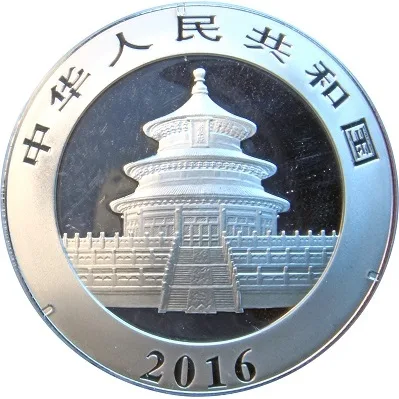
The official side shows the Hall of Prayer for Good Harvests in the Temple of Heaven, one of the great architectural jewels of Beijing. The round three-tiered building under blue glazed tiles was built in 1420 under the Yongle Emperor; after it burned down when struck by lightning in 1889 it was rebuilt to the old plans, and since 1998 the temple has been protected by UNESCO. Here the emperors of the Ming and Qing dynasties prayed to Heaven for a good harvest. The inscription “中华人民共和国” (People's Republic of China) runs around the rim, with the year “2016” below.