
Panda, 8 g gold (2016)
PDFGeneral information

Description
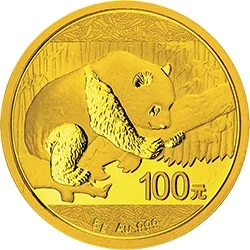
This coin is part of the 2016 Chinese Panda issue, which the People’s Bank of China presented in autumn 2015. The design of the year: a panda in a tree: the animal hugs the trunk and rests on a branch.
For a long time scientists argued about where to place the panda: it was considered now a relative of raccoons, now a species of its own. Only genetic research confirmed that it is a true bear, though the most unusual one, almost entirely herbivorous. The Latin name of the species, Ailuropoda melanoleuca, literally means “black-and-white cat-foot”, and the Chinese call the animal the “great bear-cat”.
Scientists explain the black-and-white coat of the panda in several ways: the white areas camouflage the animal in snow, the dark ones help it hide in shade, and the sharp markings on the face serve as signals to other pandas. In China this contrast is traditionally compared with yin and yang, a balance of opposites, which is why the panda is so readily shown as a symbol of peace.
The design of 2016 is a panda in a tree. For the panda a tree is a refuge, a place to rest and a lookout. Adult animals climb trunks with confidence, and cubs spend their first months on the branches: while the mother feeds below, the little one waits for her up high, where predators cannot reach it. On the coin the animal hugs the trunk and has settled on a branch. This issue was the first in which the series moved from troy ounces to the metric system, and it went down in history as a turning point.
The giant panda has long been more than a rare animal: it is a national symbol of China and one of the most recognisable images in the world. Since 1961 its silhouette has been the emblem of the World Wide Fund for Nature, and the loan of pandas to zoos abroad grew into a special form of “panda diplomacy”: in 1972, after President Richard Nixon’s visit to China, the pandas Ling-Ling and Hsing-Hsing were sent to the National Zoo in Washington.
The fate of the species caused concern for a long time, but the efforts of recent decades have paid off. Pandas are protected by reserves in Sichuan, Shaanxi and Gansu, among them Wolong, founded in 1963. In 2016 the International Union for Conservation of Nature recognised that the situation had improved and downgraded the species from “endangered” to “vulnerable”, and in 2021 the Giant Panda National Park joined scattered protected areas into one system.
Bamboo makes up the basis of the panda’s diet: shoots and leaves provide about ninety-nine percent of its food. The food is low in nutrition, so an adult spends twelve hours or more a day eating and consumes up to thirty or forty kilograms of bamboo daily. To hold a stem the panda uses its “false thumb”, an enlarged wrist bone that works like a sixth finger and gives a secure grip on the shoots.
Obverse
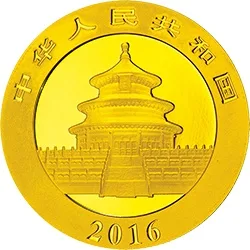
The Temple of Heaven in Beijing: the Hall of Prayer for Good Harvests, common to all coins of the set. The complex was built in 1420 under the Yongle Emperor; here the emperor made offerings to Heaven and prayed for a good harvest, and in 1998 the complex was inscribed on the UNESCO World Heritage List. Around the building runs the inscription “中华人民共和国” (People’s Republic of China), and below it the year “2016”.
Reverse
A panda settled in a tree, its paws wrapped around the trunk. This is the turning-point issue of the series. The markings of the coin are placed next to the picture.