
Apatosaurus (200 Pesos)
PDFGeneral information

Description
The coin is dedicated to Apatosaurus, one of the best-known giants of the Jurassic. It is a large plant-eating sauropod that lived in North America about 152–151 million years ago, and the story of its discovery is regarded as one of the most instructive in palaeontology. The name Apatosaurus means deceptive lizard in Greek: because of the exceptionally long neck and tail the first researchers erred, joining the front and rear parts of the skeleton and taking the tail for the neck.
The first bones were described in 1877 by the American palaeontologist Othniel Charles Marsh, a participant in the Bone Wars, the fierce rivalry with Edward Cope over the right to find and name new fossil giants. Two years later Marsh described Brontosaurus, the thunder lizard, and it was that name that took hold in popular culture. Only in the early twentieth century did it become clear that both names referred to very close animals, and in the 1970s another long-standing error was corrected: reconstructions had mistakenly put on the giants the skull of another sauropod, shorter and heavier than the real one.
Apatosaurus lived on broad floodplains where horsetails, ferns and conifers grew. Its body was carried on four massive pillar-like legs, the head was small and dropped low to crop vegetation at ground level, and the long tail balanced the outstretched neck. For such a giant the main task was to get enough food, and so it spent most of its time feeding, moving unhurriedly along forest edges and shorelines.
The Cuban coin of 1993 turns to it as one of the symbols of ancient life. Dinosaurs as a theme for collector issues were popular in the early 1990s: they attracted both children and collectors interested in nature. Apatosaurus stood at the centre of the Cuban programme: three coins are dedicated to this giant, and its image ties them together.
Interest in dinosaurs does not fade: they embody not only an extinct fauna but the very idea of deep time, when creatures unlike today's lived on the planet. A coin with Apatosaurus turns this image into a collector's object, recalling that the history of the Earth is longer than the human one by hundreds of millions of years.
The scale of this animal is hard to imagine: when museums assemble the skeleton of an Apatosaurus it fills a whole hall, and visitors stand at its feet as at the foot of a mountain. It is precisely this effect, the sense of the enormity of a life long gone, that evokes unfailing interest in dinosaurs.
Obverse
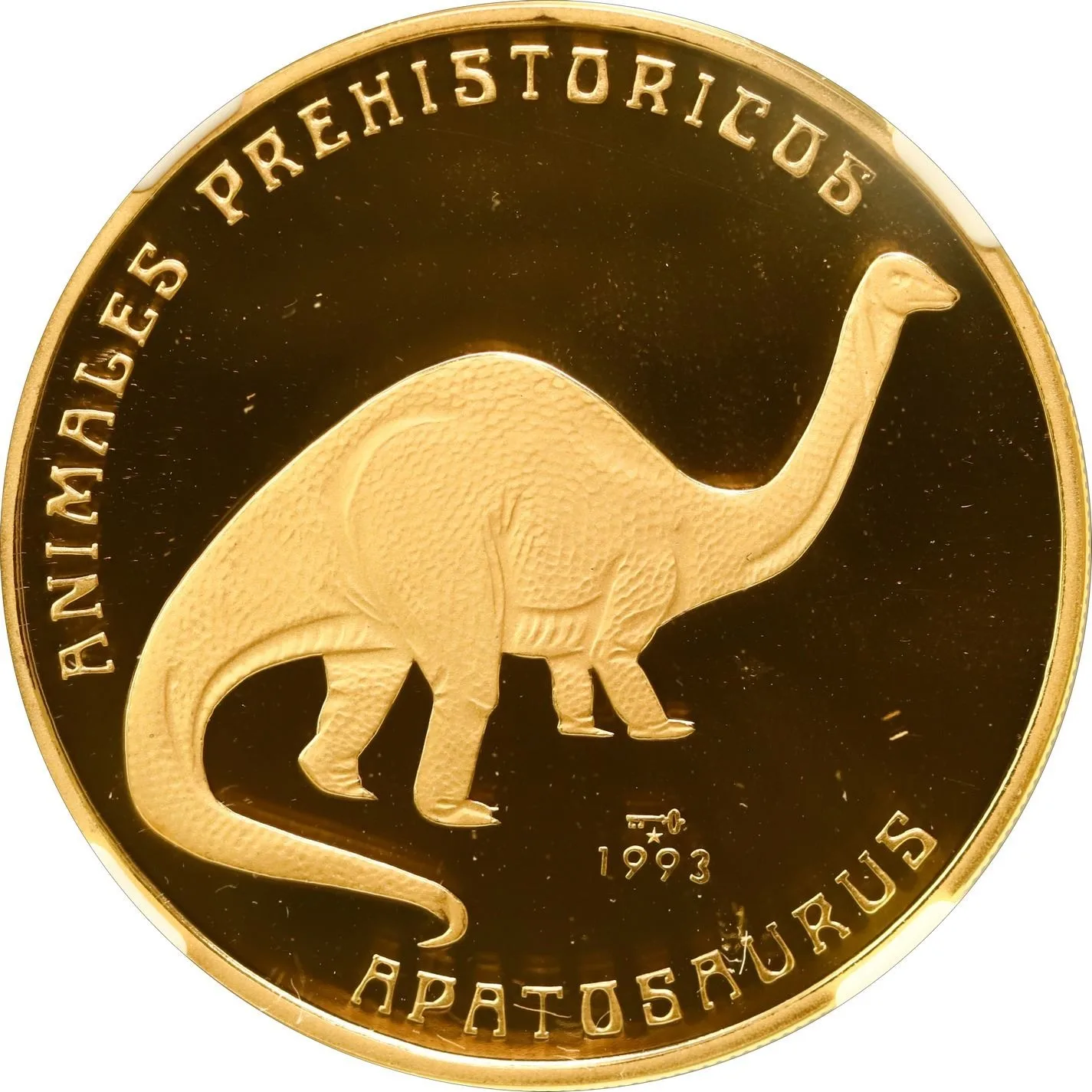
On the artistic side Apatosaurus walks to the right: the long neck is stretched forward, the heavy body rests on pillar-like legs and the tail trails behind. The name of the theme runs in an arc above the drawing, with the animal's name, the year and the mint mark beside it. The composition is rendered in relief only, without colour. The drawing was made by Elena Delgado Álvarez and the engraving by Ridoberto Peláez Alcázar.
Reverse
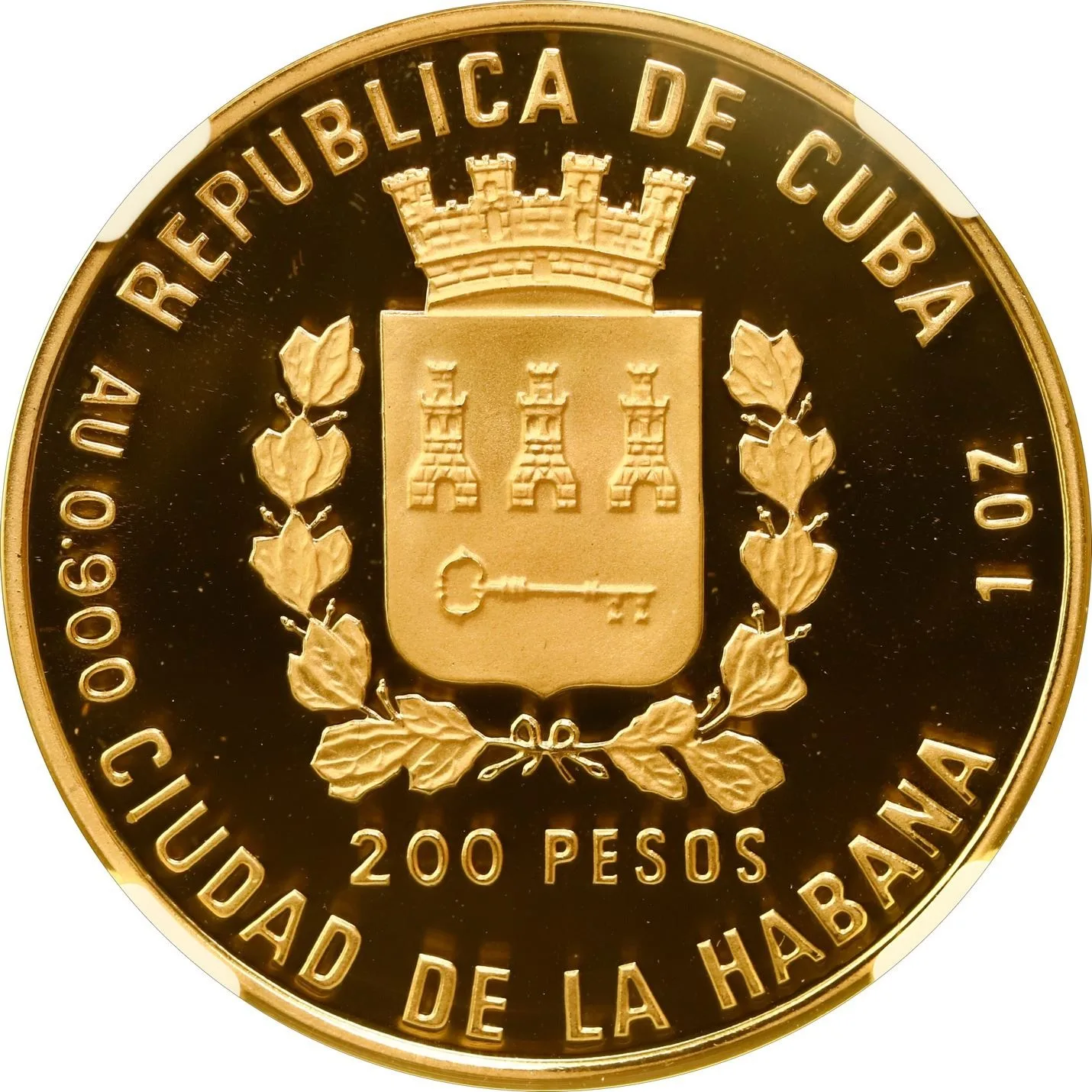
The official side bears the coat of arms of the city of Havana with inscriptions naming the state and the city. This is a special case among Cuban issues, where this role is played now by the arms of the republic and now by the city arms of the capital.