
Brown Pelican (1 Peso)
PDFGeneral information

Description
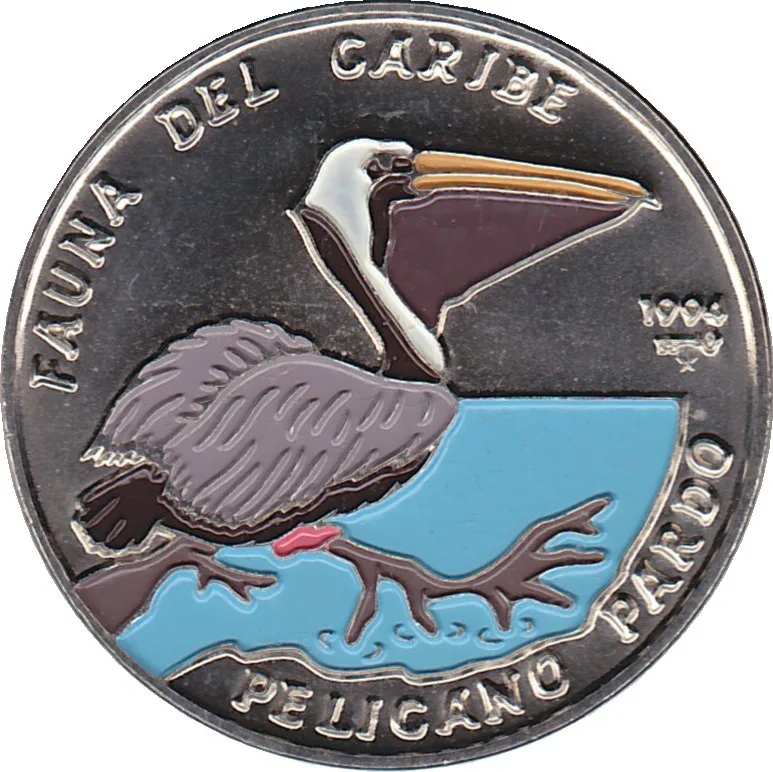
The brown pelican, which Cubans call "alcatraz", is one of the most familiar birds of the Caribbean coast: it sits on piers, soars over the waves and plunges for fish so that the water shudders at the impact. It is the bird shown on the 1994 coin from the Cuban collectible programme, with the legend FAUNA DEL CARIBE along the arc, PELICANO PARDO below, and the year and the mint's mark at the right. The engraver of the design was Rigoberto Peláez Alcázar.
The brown pelican (Pelecanus occidentalis) is the smallest of the world's eight pelican species. Its body reaches about 137 cm in length, it weighs about 4.5 kg and its wingspan is roughly two metres. It is the only pelican (together with the closely related Peruvian) that catches fish by diving from a height: spotting prey, the bird folds its wings and enters the water head first, often turning in the air almost 180 degrees. The usual height of a dive is three to ten metres, but attacks from 20–30 metres are known.
The impact with the water is cushioned by air sacs beneath the skin of the breast and neck. The throat pouch, the largest of any bird, holds up to three gallons of water and fish: the bird catches its prey, then tilts its head and drains the water, leaving the fish. In the Caribbean the diet consists of small schooling fish, such as scaled sardines, anchovies and sardinellas. An adult's wingspan is about two metres and it lives up to about forty years.
In Cuba the "alcatraz" is common along the shores and by coastal cays, and is often seen at Varadero and other resorts of the island. Pelicans nest in colonies on mangrove islets and cays, build nests of sticks and twigs, incubate their eggs and feed the chicks on partly regurgitated fish. In the twentieth century the species was seriously threatened by pesticides that thinned eggshells, but after the ban on DDT and protection of nesting sites its numbers recovered.
The pelican is a bird hard to mistake for another: a massive figure with a long bill and a pouch beneath it, visible from afar. Cubans are used to its clumsy look on land and its precise plunge in the air, and in this contrast lies the main charm of the image. For people walking along the Malecón and the beaches, the pelican is as much a sign of the shore as palms and gulls, and the coin catches exactly this familiarity.
Few animals so accurately justify the word "fisher": the pelican watches the water keenly, and it is enough for a shoal of small fish to flash near the surface for the bird to fold its wings and plunge down. The sight fascinates tourists and locals alike, and it is why the artist chose it for the coin as an image of the Caribbean shore.
Obverse
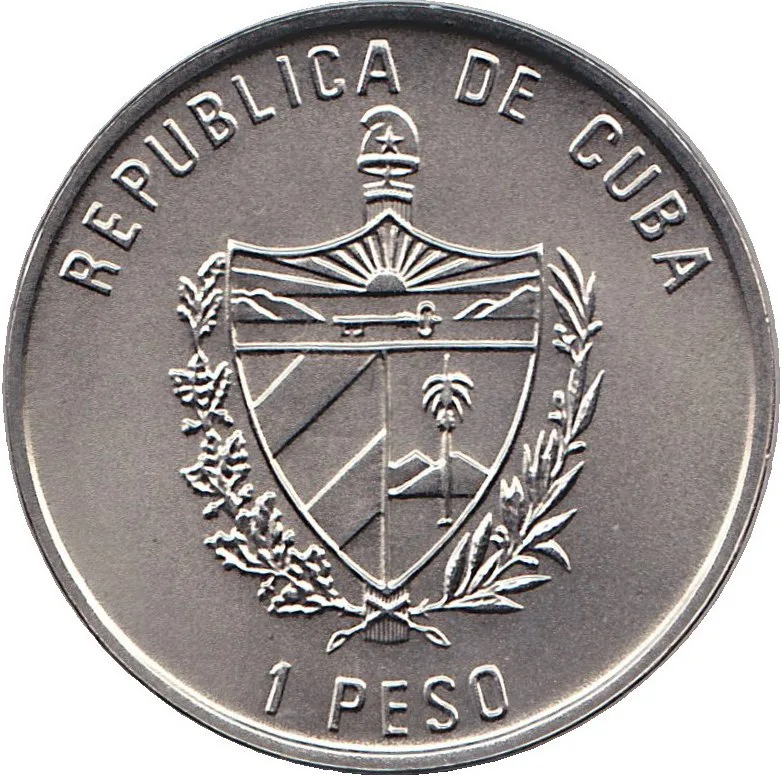
The coat of arms of the Republic of Cuba: a shield with a rising sun, a key, a palm tree and mountain peaks, framed by laurel and oak branches; above it, along the arc, REPUBLICA DE CUBA, and below the value, 1 PESO. The design of the arms on Cuban coins goes back to the American engraver Charles Edward Barber.
Reverse
A brown pelican against the sea, its large bill with the throat pouch standing out on a pale background; the legend FAUNA DEL CARIBE runs along the upper arc, PELICANO PARDO below, and the year 1994 and the mint's mark are at the right. The colouring is applied by hand: the brown, grey and white tones of the plumage differ slightly on each specimen, and a glint on the water gives the scene life.