
Dolphins (1 Peso)
PDFGeneral information

Description
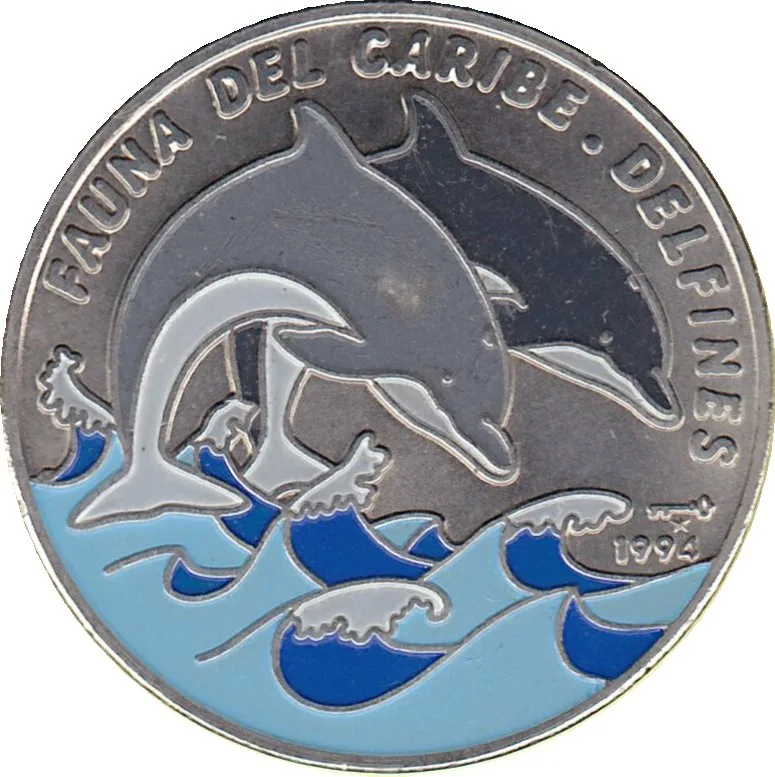
The dolphin is one of the few sea creatures that people know to be clever, friendly and curious, which is why it became the subject of a 1994 Cuban coin from the collectible programme Fauna del Caribe. The reverse shows two dolphins leaping from the waves. The engraver of this design was the Cuban artist Gianna Díaz Suárez; the legend FAUNA DEL CARIBE — DELFINES runs along the arc, with the year and the mint's mark below.
The dolphins on the coin are almost certainly bottlenose dolphins (Tursiops truncatus). This is the best-known member of the dolphin family and, according to surveys of Cuba's marine mammals, the only cetacean that stays in the archipelago's coastal waters all year round. Cubans call it "delfín nariz de botella" and "tonina".
Adults usually reach 2.3–3 m in length, occasionally 3.6 m, and generally weigh 150–300 kg, with males larger than females. The bottlenose is dark brown or grey above and pale beneath. Its recognisable look comes from a short beak clearly set off from the rounded forehead and a tall, sickle-shaped dorsal fin. In murky water dolphins find their way by echolocation: clicks sent out by the animal return as echoes and let it "see" prey and obstacles.
Bottlenose dolphins live in stable communities, readily recognise one another by voice and cooperate closely: they hunt together, help the injured and look after calves. They breed slowly, with a pregnancy of about a year; the calf is born around a metre long and stays with its mother for years. They live at least forty years, and some females reach sixty.
Globally the species is rated Least Concern by the IUCN (2018 assessment), though some populations, in the Mediterranean, the Black Sea and New Zealand, face greater threats. For a Cuban collectible coin the dolphin is not only a handsome but a symbolically accurate subject: the animal links people with the sea on which the island stands and recalls the fragility of coastal ecosystems.
The coin belongs to a Cuban programme in which fish and birds of the island stand beside the dolphin, and the neighbourhood is natural: Cuba is an island, and for its people the sea is a source of food, a road and a matter of pride. Dolphins leaping from the water are one of the most recognisable images of the tropical coast, familiar to residents and to visitors to resorts such as Varadero.
Obverse
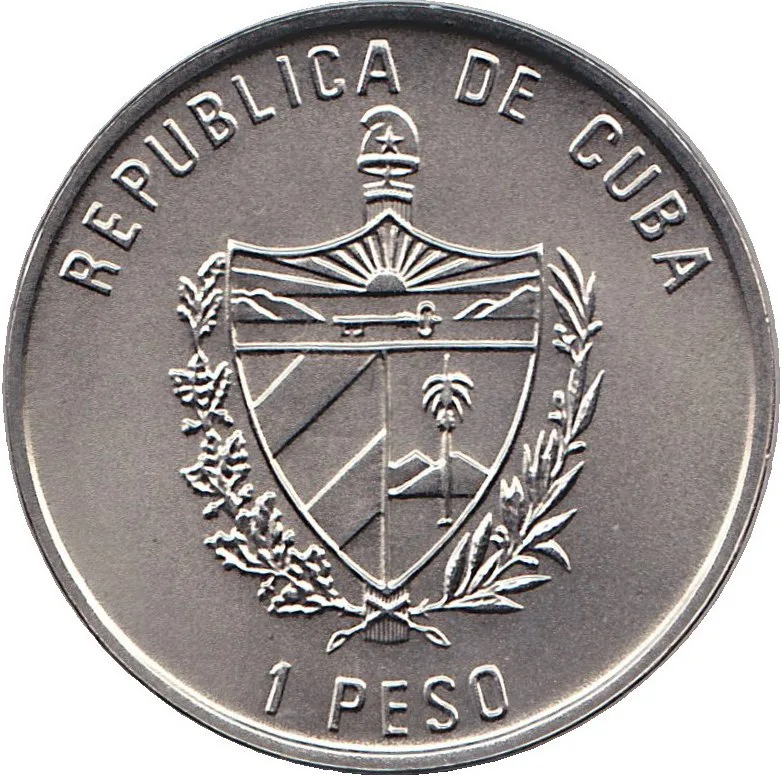
The coat of arms of the Republic of Cuba: a shield with a rising sun, a key, a palm tree and mountain peaks, framed by laurel and oak branches; above it, along the arc, REPUBLICA DE CUBA, and below the value, 1 PESO. The design of the arms on Cuban coins goes back to the American engraver Charles Edward Barber.
Reverse
A colour image of two dolphins leaping from the waves; along the upper arc runs the legend FAUNA DEL CARIBE — DELFINES, with the year 1994 and the mint's mark at lower right. The paint on the relief was applied by hand, so the play of blue and grey differs slightly on every specimen; the movement of the bodies is shown mid-leap, as water streams from the animals' sides.