
Flamingos (1 Peso)
PDFGeneral information

Description
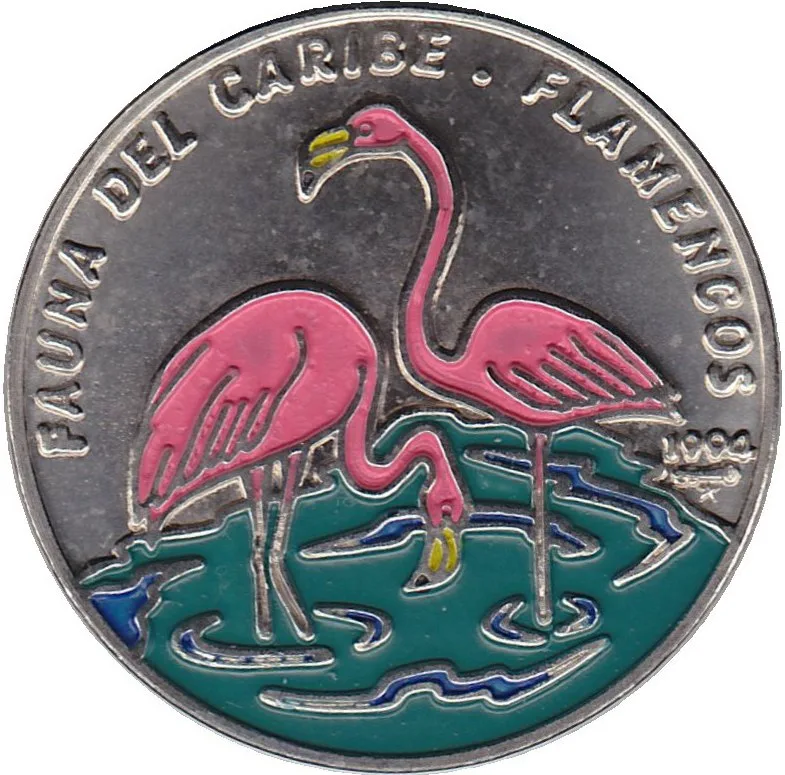
Among the six subjects of the Caribbean Fauna programme the flamingo has a special place: the birds wade in the shallows, and the picture itself seems wonderfully peaceful. On the 1994 coin the inscription FAUNA DEL CARIBE · FLAMENCOS and the year run around the rim, with the mint's mark at the right. The engraver was the Cuban medallist Alejandro Ramos Figueredo, who also made the grouper design of the same programme.
The flamingo is the most elegant bird of Cuba's lagoons, and it is no accident that the list of the six subjects of the programme ends with it. Cubans call it "flamenco", while scientists call it the American, or Caribbean, flamingo (Phoenicopterus ruber). It inhabits shallow saline lagoons and mangrove coasts of the Caribbean, and Cuba is one of its most important strongholds: the island's largest nesting colonies are in protected areas of Camagüey province and in the south of the country.
The pink plumage is not an innate colour but a result of diet. Chicks are born grey and turn pink only by the end of their first years: the pigments, carotenoids, are contained in the small crustaceans, algae and molluscs on which the flamingo feeds. To eat, the bird lowers its head into the water upside down and strains silt through the horny plates of its bill, while its thick tongue works like a piston.
The flamingo's recognisable pose is standing on one leg. Ornithologists explain it as heat saving: the tucked leg does not lose warmth to the water. Flamingos live in colonies of thousands of birds, and their courtship rituals, with synchronised head turns, wing flicks and marches of the whole group, look like a collective dance. The nest is a low cone of mud in which the female lays a single egg; the chick is fed with "crop milk", a nutritious secretion from the parents' crop.
Flamingos face many threats: coastal development, loss of lagoons and disturbance at nesting sites. Preserving such places in Cuba has long been part of national nature-protection policy, and the bird can be seen in reserves where it is assured of peace.
Flamingos have long been a symbol of the tropics, but on the coin they are shown without deliberate exoticism, as ordinary dwellers of the shallows going about their business. It is this restraint that makes the subject convincing: the viewer sees not a postcard but a piece of the island's living nature. Next to the other coins of the programme the flamingos strike a calmer, almost watercolour note.
Obverse
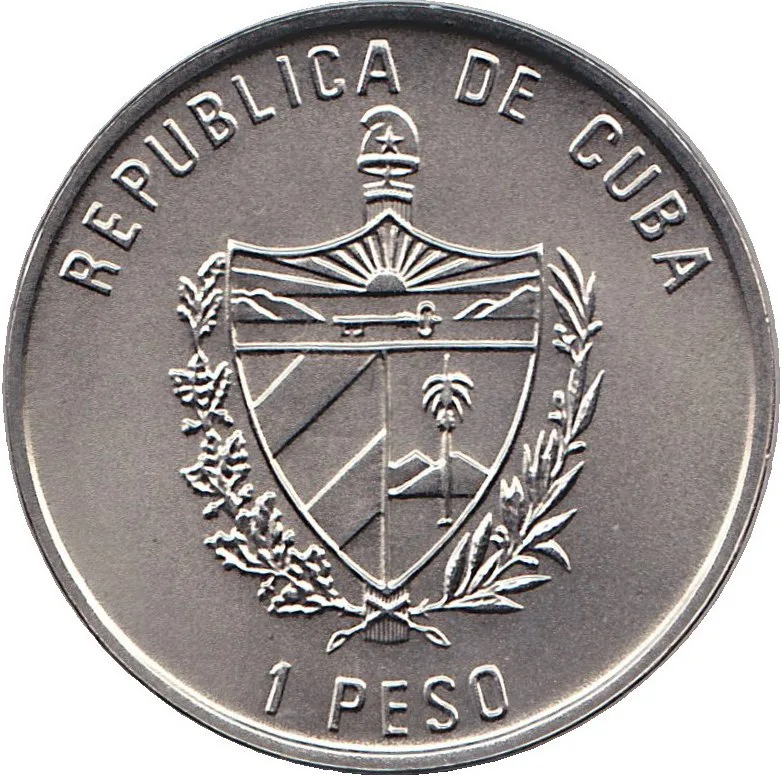
The coat of arms of the Republic of Cuba: a shield with a rising sun, a key, a palm tree and mountain peaks, framed by laurel and oak branches; above it, along the arc, REPUBLICA DE CUBA, and below the value, 1 PESO. The design of the arms on Cuban coins goes back to the American engraver Charles Edward Barber.
Reverse
Flamingos wade in the shallows: long thin legs are reflected in the water, necks are bent in the characteristic S-curve, and the plumage is rendered in pink and white tones. FAUNA DEL CARIBE · FLAMENCOS runs around the rim, with the year 1994 and the mark of the Empresa Cubana de Acuñaciones mint at the right. The colouring is applied by hand, and the shade of pink differs a little on each specimen.