
Flamingos (10 Pesos)
PDFGeneral information

Description
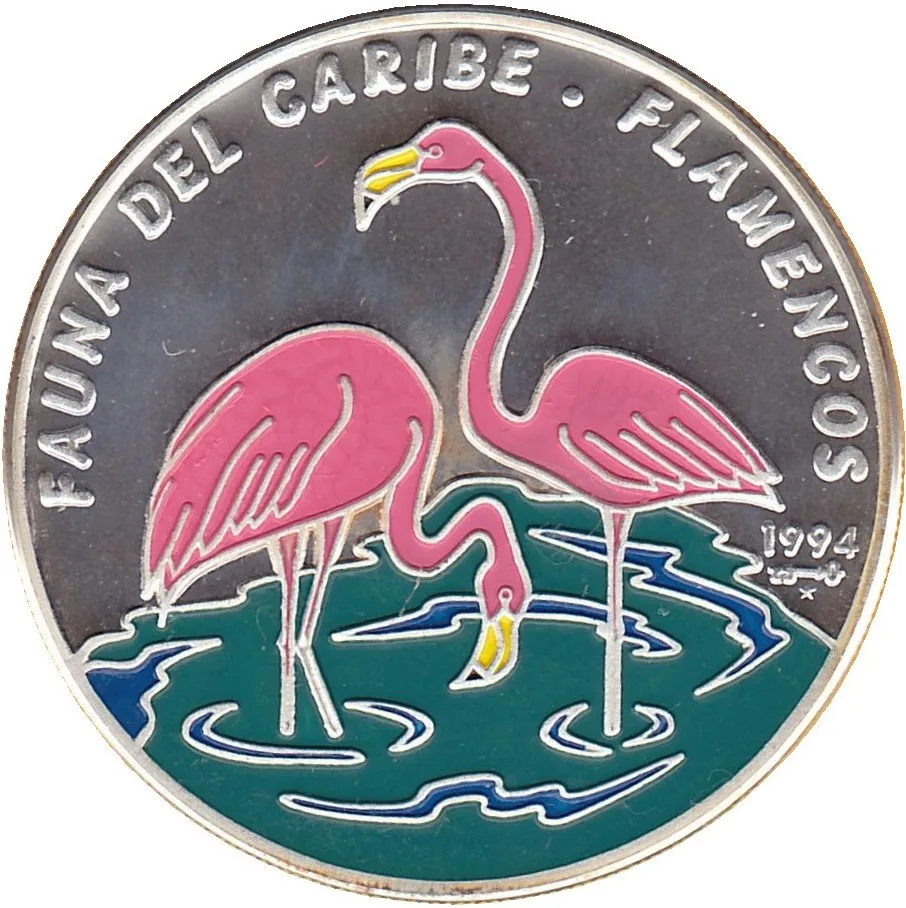
The flamingos of Cuba are birds about which legends have been told: pink flocks against the sunset, dancing colonies, long-legged silhouettes in lagoons. On the silver coin of 1994 from the Caribbean Fauna series these birds are shown in the shallows; the inscription FAUNA DEL CARIBE · FLAMENCOS runs around the rim, with the year 1994 and the mint's mark. The design was made by the Cuban medallist Alejandro Ramos Figueredo.
The scientific name of the species is Phoenicopterus ruber, the American flamingo. It is the largest of the birds nesting in Cuba in such numbers, and the brightest: its colour comes from carotenoids that the bird gets with its food of small crustaceans, algae and insect larvae. When food is scarce the plumage fades, and brighter birds are more attractive in courtship.
The flamingo's breeding season is a sight for which birdwatchers come to Camagüey. A flock of hundreds and thousands gathers in the shallows, and the birds turn their heads, spread their wings and march at the same moment, forming a living wave. Such synchrony helps males and females find a mate and agree on the timing of nesting.
The flamingo's nest is a low cone of mud raised above the water level so that the egg is not flooded. The single egg is incubated by both parents in turn; the grey chick that hatches is fed with "crop milk". After several weeks the chicks gather in "crèches" of hundreds under the watch of a few adults, and the pink colour comes only in the second or third year.
Cuba seeks to preserve the habitats of such birds: marshy lagoons and mangrove coasts are not only nesting grounds but important nodes of migration routes. The coin reminds us that the wealth of the Caribbean lies not only in the sea but in its shallows.
A peculiarity of the flamingo is the bill bent at an angle: it works as a sieve, and the bird feeds with its head upside down. In this way it gets food in shallows where most other birds cannot hunt, and this is the secret of its success. Adult birds stand more than a metre tall, and the long legs let them go to depths inaccessible to other waders. On the coin these proportions are conveyed by a clean silhouette on a mirror ground. The considered rhythm of the figures creates a sense of movement of the whole flock and not only of individual birds.
Obverse
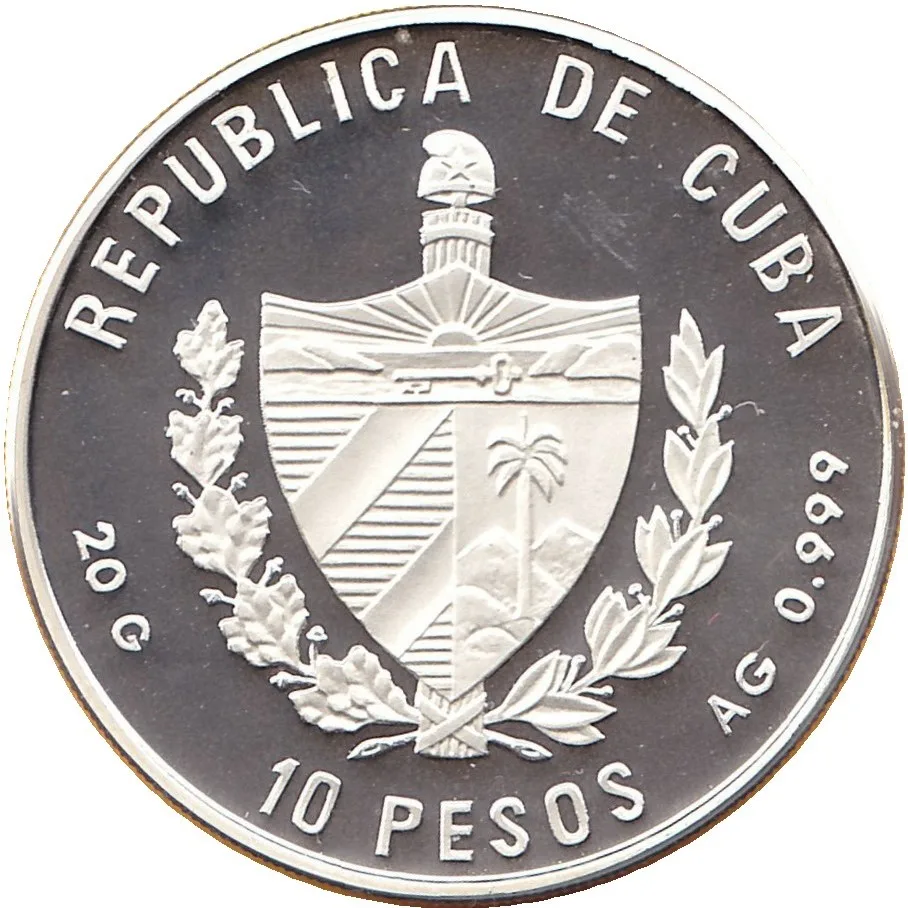
The official side carries the national arms of Cuba: a shield with the sun over the sea, a palm and mountains, a key and branches of laurel and oak. The arc above reads REPUBLICA DE CUBA, with 10 PESOS beneath. The pattern of the arms for Cuban coins was made by Charles Edward Barber, chief engraver of the US Mint.
Reverse
Flamingos wade in the shallows, reflected in the water; FAUNA DEL CARIBE · FLAMENCOS runs around the rim, with the year 1994 and the mark of the Empresa Cubana de Acuñaciones mint at the right. The pink and white colouring is applied by hand, so shades differ slightly on each specimen; the mirror ground makes the silhouettes of the birds contrasting.