
Fokker Dr.I (10 Pesos)
PDFGeneral information

Description
The red triplane is one of the most recognisable silhouettes of the First World War. The Fokker Dr.I appeared in 1917 as the German designers’ answer to the British Sopwith Triplane, which that spring surprised Kaiser’s army pilots with its manoeuvrability. Anthony Fokker, having examined a captured machine, instructed the engineer Reinhold Platz to build a triplane of their own. The prototype took off on 5 July 1917, and in the autumn the first production aircraft began to reach the front. In all about three hundred and twenty were built — not many, but among them was the one that entered history.
Three wings on a small span gave the Dr.I exceptional climb and the ability to make very tight turns: in close combat it turned faster than almost any opponent. The price was low speed and a cautious character in a dive. In the autumn of 1917, after wing failures, flights were suspended for a time and the structure was strengthened; after modification the aircraft returned to service. Pilots valued it for its light handling but not for its speed, and in 1918 faster fighters began to take its place.
But it is this triplane that is forever linked with the name of Manfred von Richthofen — the “Red Baron”, the most successful fighter pilot of the First World War. His red triplane became a symbol of German aviation, and the squadron he commanded earned the nickname “Flying Circus” for the bright colours of its machines. On 21 April 1918 Richthofen was killed in action over the Somme valley while flying a Dr.I. That date became one of the most famous in the history of aviation.
In 1994 the Cuban mint issued for collectors the series “Famous Aircraft”: six coins with three subjects — two First World War fighters and an Italian flying boat, each in two versions. The Fokker triplane opens the programme as the most recognisable. The coins did not enter circulation and were demonetised in the year of issue; their designs were painted by hand.
The red colour of the aircraft became part of the legend: Richthofen chose it so that both friends and foes would recognise him, and soon other pilots of the squadron also began to paint their machines in bright tones. This is how a custom arose thanks to which the air battles on the Western Front are remembered as clashes not of faceless machines but of people with names and characters. A coin showing this triplane in colour brings back exactly that memory of the war of individual pilots.
Obverse
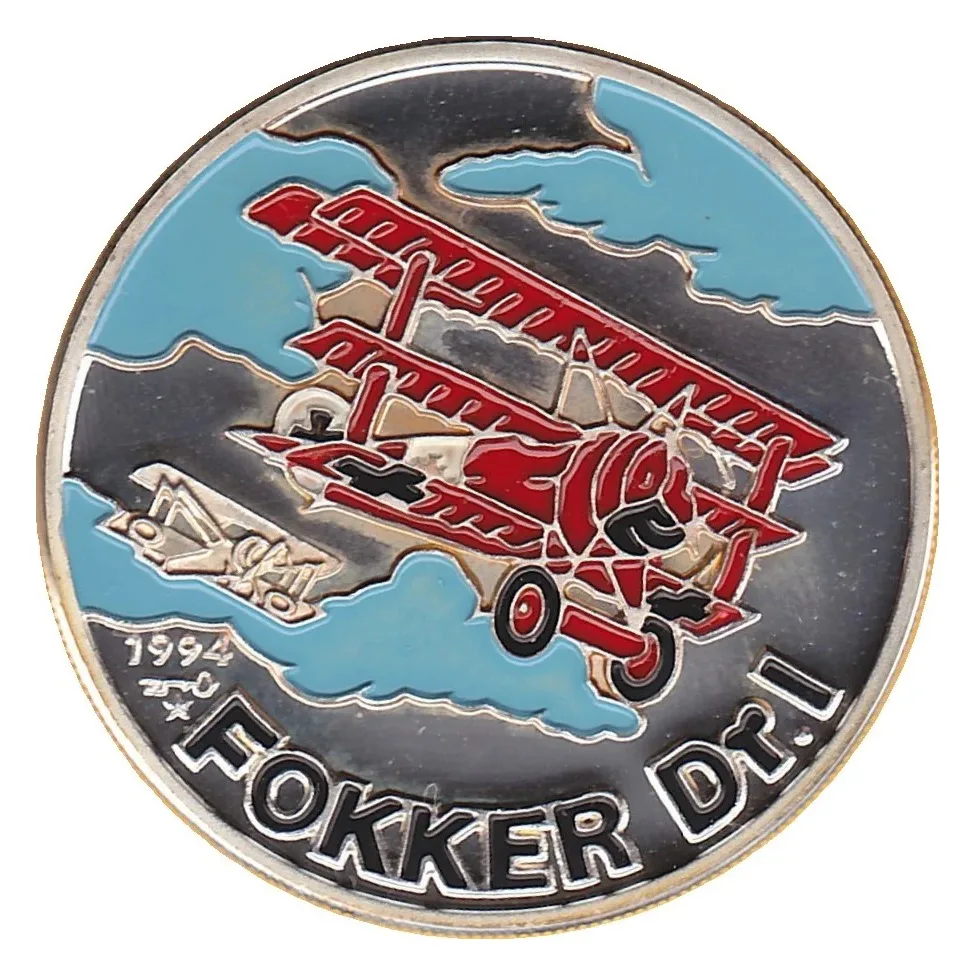
The artistic side is devoted to the triplane: the red machine is shown in banking flight against a hand-painted pale-blue sky with cloud outlines. Along the lower arc runs the name FOKKER Dr.I, with the year 1994 and the mint mark below. The relief of the aircraft stands out over the painting, and the three wing planes read as distinctly as in photographs of Richthofen’s squadron. A small line drawing of the triplane in the lower part repeats its silhouette in a graphic manner.
Reverse
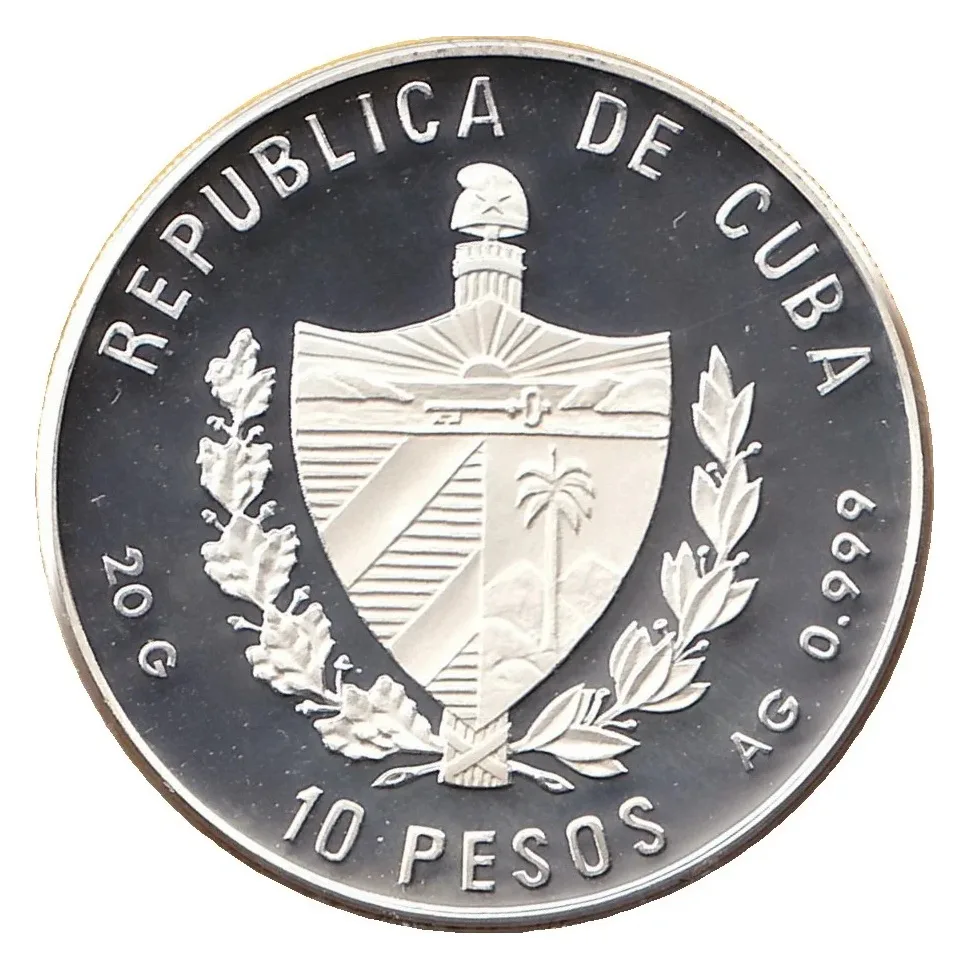
The reverse is the official side common to all coins of the “Famous Aircraft” series: the national arms of the Republic of Cuba in a drawing that goes back to Charles Edward Barber’s work. A shield with a landscape, a key, a royal palm and a rising sun is surrounded by oak and laurel branches and topped with a fasces bearing a Phrygian cap and a star. The inscription REPUBLICA DE CUBA runs along the upper arc, and below the arms the coin’s denomination is marked. The strict heraldry balances the bright painted scene on the other side.