
Sailfish (1 Peso)
PDFGeneral information

Description
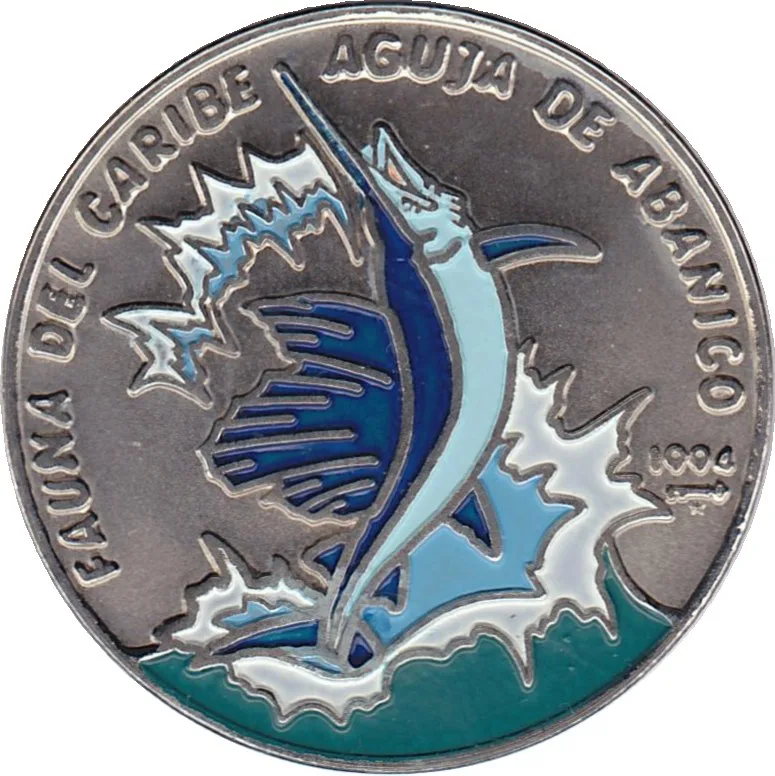
The sailfish is one of the fastest and most spectacular fish of the ocean, and it is no wonder that it found its way into the Cuban coin programme on the fauna of the Caribbean. On the reverse of the 1994 coin the sailfish leaps from the water with its "sail", the first dorsal fin, raised high; the legends FAUNA DEL CARIBE and AGUJA DE ABANICO run around the rim, with the year at the right. The design was made by the engraver Elena Delgado Álvarez.
The sailfish is the only genus Istiophorus in the billfish family (Istiophoridae). The Atlantic population used to be treated as a separate species, Istiophorus albicans, but genetic and morphological studies did not confirm species differences from the Indo-Pacific I. platypterus, and sailfish are now more often considered a single circumglobal species; in the Atlantic the fish are on average smaller. The length reaches about three and a half metres, and in sport fishing fish are recorded up to about a hundred kilograms.
The "sail" is the first dorsal fin of 42–49 rays, taller than the body is deep; its dark blue membrane is dotted with small black spots. The back is dark blue, the belly silvery white, and up to twenty vertical bars of pale blue round spots run along the sides. In fast swimming the sail folds into a groove on the back and is raised when the fish is excited. The Cuban name aguja de abanico literally means "fan needle" and stresses precisely this feature of the species, the spread fin.
Sailfish hunt schooling fish, especially sardines, and often act as a group: individuals take turns attacking a school, driving the prey towards the surface. They have no swim bladder and compensate for negative buoyancy with the asymmetry of the body and muscle work. In the tropics spawning goes on all year in batches, and a female may release millions of eggs.
For Cuba the fish is part of maritime tradition, and memories of it are linked with Ernest Hemingway, who lived on the island and fished for big game off Havana. An international billfish tournament in his name, billfish being the family that includes both sailfish and marlins, has been held in Havana waters since 1950, and since 1997 it has run on a catch, tag and release basis.
The sailfish is often called the fastest fish of the ocean, but the exact value of its speed remains a matter of dispute: the classic estimate gives about a hundred kilometres an hour, while later physiological work gives far more modest figures. It is therefore more honest to say that the sailfish is one of the fastest marine predators. On the coin this speed is conveyed by the pose itself: the fish tears out of the water, sail spread and body arched, a frozen moment of a dash.
Obverse
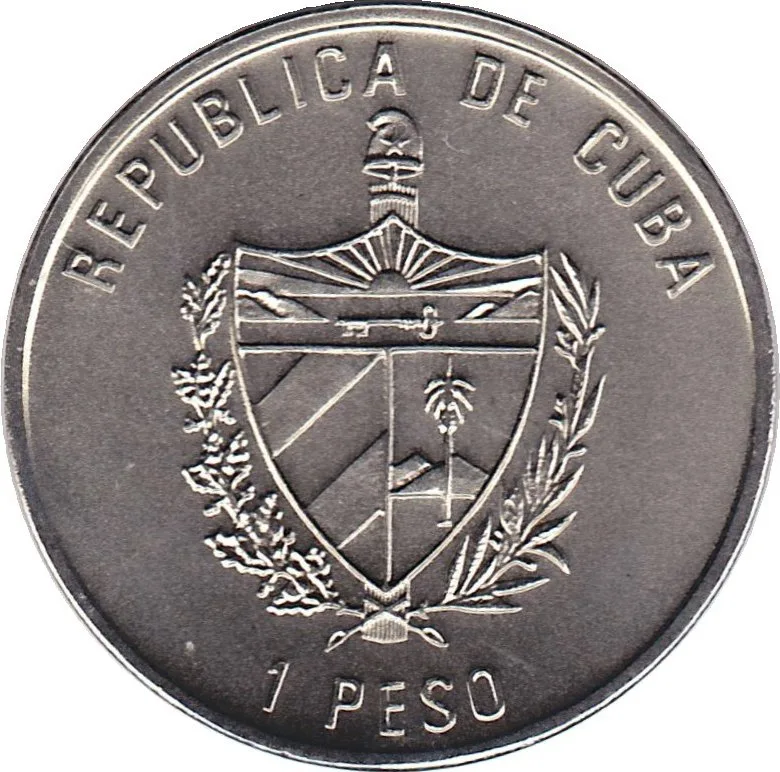
The coat of arms of the Republic of Cuba: a shield with a rising sun, a key, a palm tree and mountain peaks, framed by laurel and oak branches; above it, along the arc, REPUBLICA DE CUBA, and below the value, 1 PESO. The design of the arms on Cuban coins goes back to the American engraver Charles Edward Barber.
Reverse
A sailfish leaps from the water with its dark blue sail raised high; the body and long bill are rendered in pale blue and silver, with spray and waves at the base. FAUNA DEL CARIBE and AGUJA DE ABANICO are engraved around the rim, with the year 1994 and the mint's mark at the right. The painting is applied by hand, so shades of blue differ noticeably from specimen to specimen.