
Sailfish (10 Pesos)
PDFGeneral information

Description
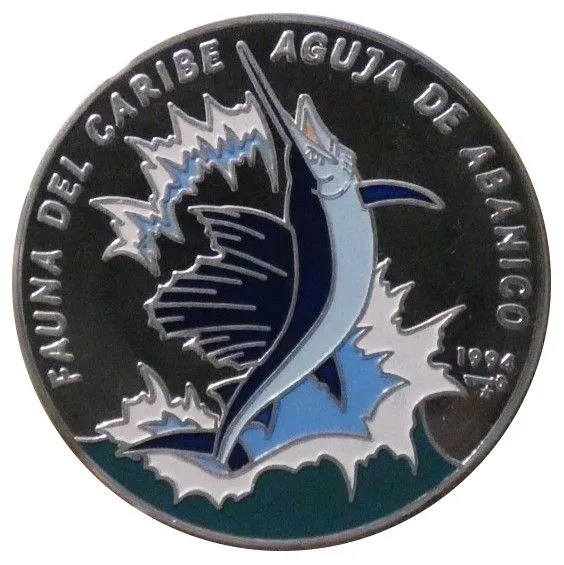
The sailfish, the "fan needle" in Cuban, is a subject in which speed, beauty and nature are joined in one image. On the reverse of the 1994 coin the sailfish leaps from the water with the dark blue sail of its first dorsal fin raised high; the body and long spear-like bill are rendered in pale blue and silver, and stylised spray is shown beneath the fish. The circular legends FAUNA DEL CARIBE and AGUJA DE ABANICO frame the picture. The engraver was Elena Delgado Álvarez.
The sailfish (genus Istiophorus, family Istiophoridae) lives in warm and temperate waters of all oceans. In the Atlantic its population was long treated as a separate species, Istiophorus albicans, but modern genetic and morphological work finds no basis for splitting Atlantic and Indo-Pacific sailfish into two species, and it is more correct to speak of a single species, I. platypterus, with regional differences in size.
The main mark of the species is a very long first dorsal fin of 42–49 rays, rising higher than the body's depth: a dark blue sheet with small black spots. The back is dark blue, the belly silvery white, and up to twenty vertical bars of pale blue spots run along the sides. The spear, the elongated upper jaw, is used to stun prey with side-to-side blows.
Speed: legend and reality. The sailfish is often called the fastest fish in the ocean. The classic estimate rests on trials at Long Key in Florida, where a fish supposedly covered 91 metres in three seconds, about a hundred kilometres an hour. Later physiological work gives far more modest values of sustained speed, explaining the earlier figures by measurement methods. So the correct wording is that the sailfish is one of the fastest marine predators, but the absolute value of its "record" remains a matter of debate.
Besides its streamlined body, the fish is adapted to fast swimming by the absence of a swim bladder. Sailfish hunt schooling fish and cephalopods, often in groups. In the 2022 global IUCN assessment the sailfish is rated Vulnerable, chiefly because of bycatch in tuna longline and purse-seine fisheries.
On the coin the fish is not so much a trophy as a symbol of the sea: swift, bright and out of reach. Cubans know the image of the sailfish from literature, from fishermen's tales and from the famous boats at Havana's quays where sport anglers came. What matters to a collector is that the engraver did not simplify the fin: the thin rays of the sail are drawn so that they can be seen with the naked eye.
Obverse
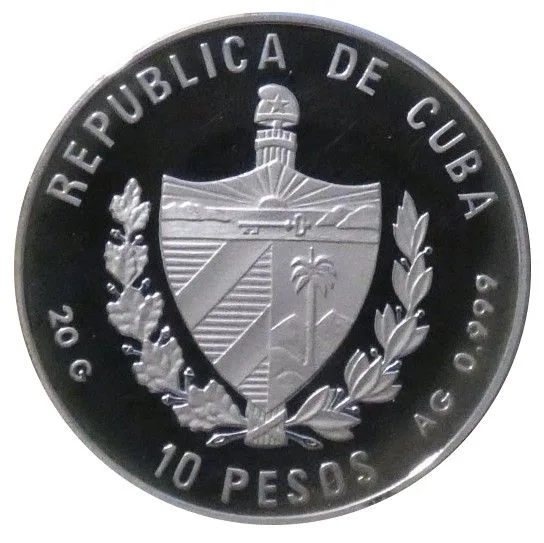
The official side carries the national arms of Cuba: a shield with the sun over the sea, a palm and mountains, a key and branches of laurel and oak. The arc above reads REPUBLICA DE CUBA, with 10 PESOS beneath. The pattern of the arms for Cuban coins was made by Charles Edward Barber, chief engraver of the US Mint.
Reverse
A sailfish leaps from the water with its sail raised high; stylised spray lies beneath the fish. The legends FAUNA DEL CARIBE and AGUJA DE ABANICO run around the rim, with the year 1994 and the mint's mark at the right. On the mirror field the colour painting looks contrasty: the blue sail, pale blue body and silvery belly convey tones that differ slightly between specimens.