
Sailfish (50 Pesos)
PDFGeneral information

Description
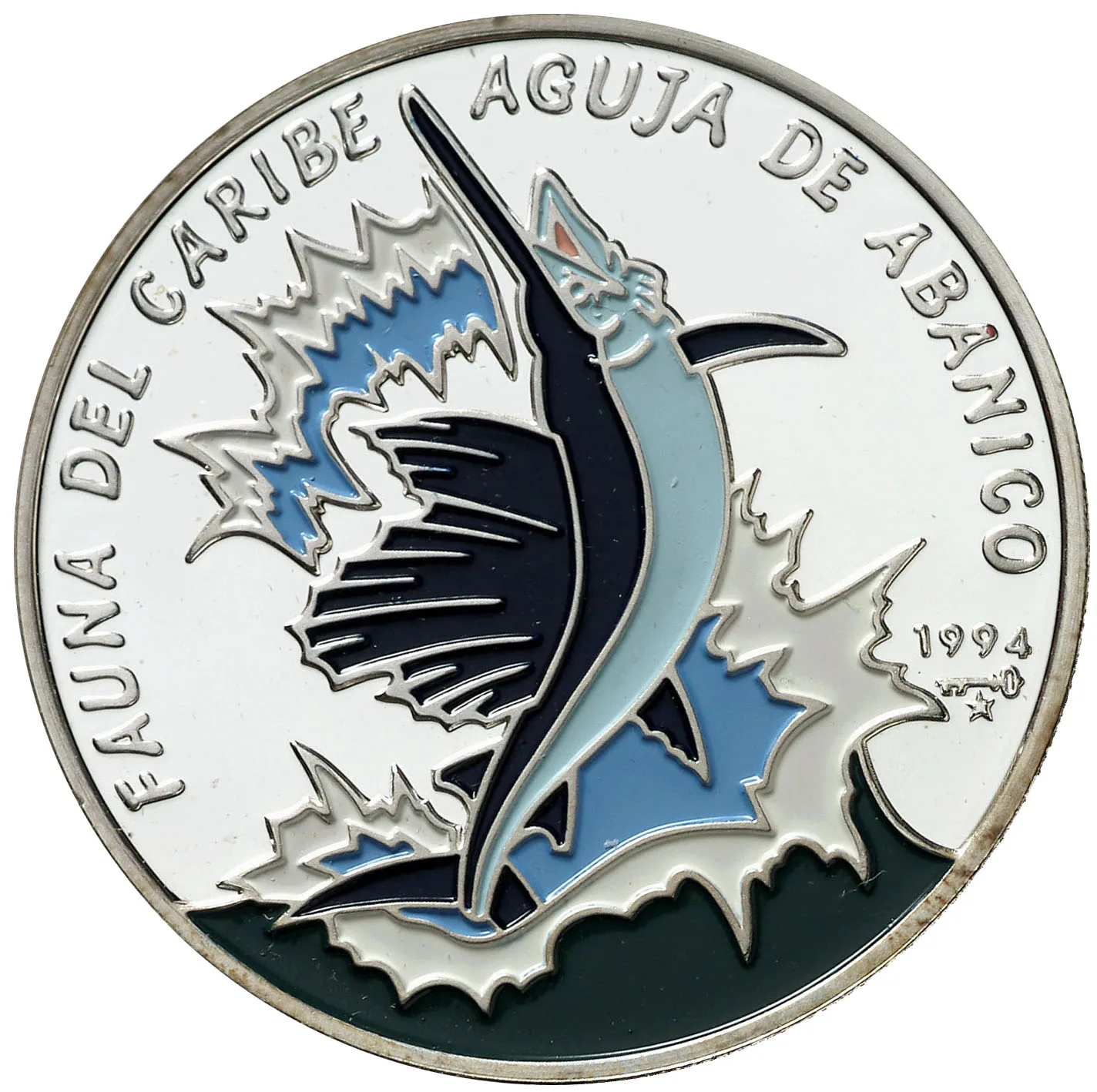
The waters around Havana became the place where Cuban sailfish are known to the whole world. Here, off the island's coast, the first International Billfish Tournament in Ernest Hemingway's name was held in 1950: some three dozen boats took part, and the writer himself won the first three. In 1960 victory went to Fidel Castro, to whom Hemingway personally handed the cup. On the 1994 coin the subject recalls this history: the sailfish leaps from the water with its sail raised, with FAUNA DEL CARIBE and AGUJA DE ABANICO around the rim.
Since 1997 the tournament has run on a catch, tag and release basis, and the practice is directly linked with conservation of billfish. In the 2022 global IUCN assessment the sailfish is rated Vulnerable with a declining population, chiefly because of bycatch in tuna longline and purse-seine fisheries, although regional references for the Caribbean had earlier indicated a better status.
The sailfish itself (Istiophorus platypterus) is a fish with a long spear and a sail as tall as its body. It reaches about three and a half metres in length, and its burst speed far exceeds that of most marine fish, though precise records remain debatable. The fish folds the sail at speed and raises it while hunting, helping to herd a school of small fish into a tight ball.
The Cuban name aguja de abanico, "fan needle", conveys the image exactly: a thin spear and a broad spread fin. For Cubans the sailfish is not only an object of sport fishing but part of a national epic of sea stories in which fishermen and writers alike have a share. The large coin let the engraver show the spray, the curve of the body and the pattern on the sail in more detail than on the smaller coins of the design.
Where on the other coins of the design the sailfish appears as a dynamic drawing, here it becomes a large colour picture: spray, wave and translucent sail make up a scene with both depth and motion. For lovers of the marine theme it is one of the most expressive coins of the Cuban programme.
The sailfish lives in the warm waters of all oceans and travels long distances along currents, and off Cuba it is found all year, though the peak of fishing falls in the warm season. The female is prolific and releases millions of eggs in a season; the larvae grow quickly and within the first years of life become full predators. It is precisely this blend of speed, size and beauty that made this sea dweller an ideal hero for a collectible coin.
Obverse
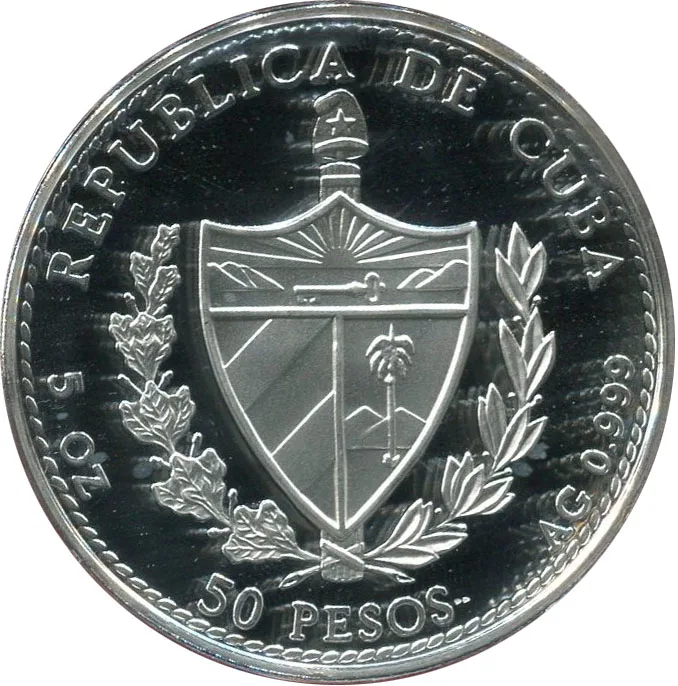
The obverse bears the country's arms, a shield with key, palm, mountains and rising sun among laurel and oak branches; REPUBLICA DE CUBA arcs above and 50 PESOS stands below. The design of this emblem as used on Cuban coins is credited to Charles Edward Barber.
Reverse
A sailfish leaps from the water with its dark blue sail raised high; the body and spear are rendered in pale blue and silver, with spray below. The legends FAUNA DEL CARIBE and AGUJA DE ABANICO run around the rim, with the year 1994 and the mint's mark at the right. The painting is applied by hand, and shades differ between specimens; the broad disc left the engraver room for detailed work on the fins.