
Spotted Eagle Ray (1 Peso)
PDFGeneral information

Description
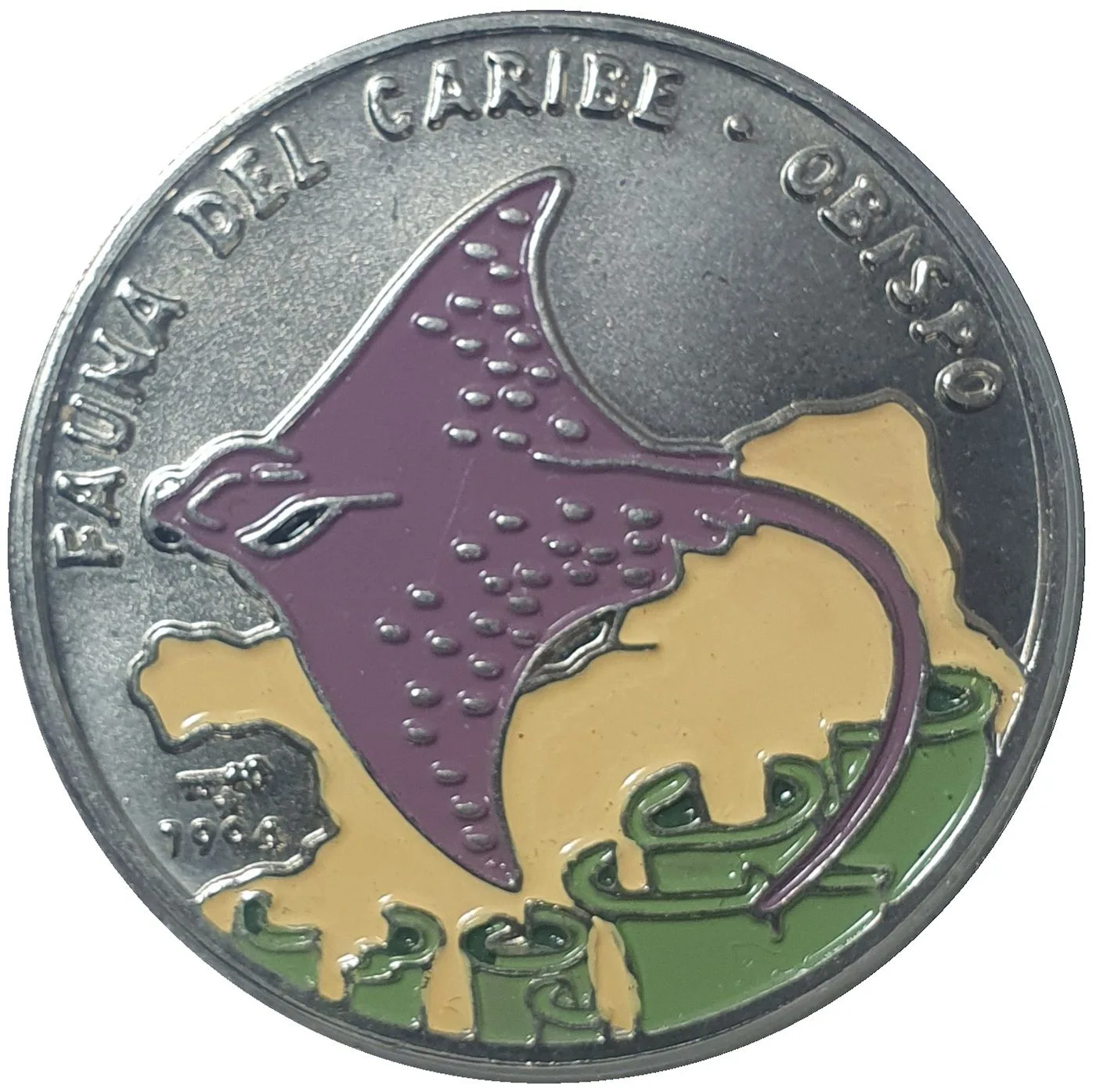
A ray gliding over the seabed like a bird in the air is the subject of the 1994 Cuban coin "Obispo". The reverse shows a spotted eagle ray swimming to the left; along the arc runs the legend FAUNA DEL CARIBE — OBISPO, with the year and the mint's mark lower left. The design was made by the Cuban engraver Alberto González Pereztol, who is also the author of the eagle-ray design on the other two coins.
The spotted eagle ray is Aetobatus narinari, a species described in 1790 as Raja narinari. A large ray of the order Myliobatiformes, it belongs to the family Aetobatidae (older literature placed it in Myliobatidae). The genus name comes from the Greek aetos, "eagle", and batis, "ray": when the ray beats its wing-like fins the likeness to a soaring eagle is obvious.
The diamond-shaped disc reaches up to three metres across and is dark, from bluish-black to almost black, with many white spots and rings; the pattern is individual, like a fingerprint, and the underside is white. The snout is flat and resembles a duck's bill, the tail is long and whip-like, without a caudal fin, and carries two to six serrated venomous spines behind a small dorsal fin.
The Cuban name of the ray is obispo, "bishop". It is explained by the small dorsal fin at the base of the tail, which resembles a bishop's mitre; in Spanish-language literature the species is also known as chucho pintado and raya águila. This play on words, a "bishop" of the sea, shows how Cubans are used to giving animals human names.
The eagle ray keeps to coastal shallows: bays, estuaries, sandy and muddy bottoms and coral reefs. It feeds on molluscs, crustaceans, worms and small fish, often digging up the bottom with its snout. It reproduces by ovoviviparity: the female carries the eggs inside her body and gives birth to miniature copies of the adult. This coin introduces one of the most beautiful and least known inhabitants of the Caribbean Sea.
The eagle ray swims close to the surface and can leap out of the water; outside the breeding season it forms schools. Snorkellers often see it over reefs: the ray glides above the bottom, slowly beating its fins, with the long tail trailing behind. The species is also notable because since 2021 the IUCN Red List has classed it as Endangered: a decline of half or more over three generations is suspected because of fishing and bycatch, although the position of local populations in Caribbean waters is judged better. So the ray's image on the coin also reminds us that a beautiful animal needs protection.
Obverse
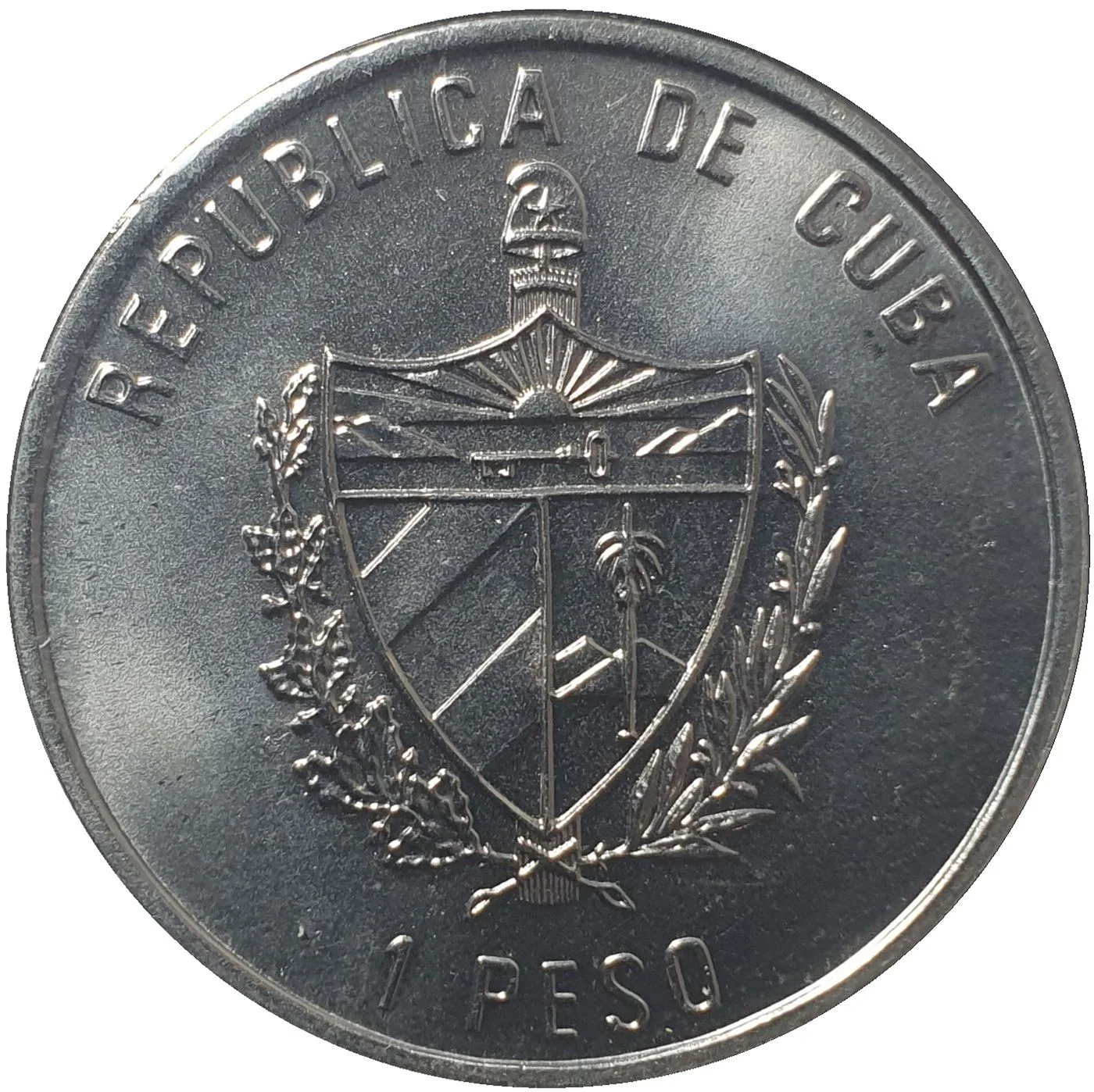
The official side carries the national arms of Cuba: a shield with the sun over the sea, a palm and mountains, a key and branches of laurel and oak. The arc above reads REPUBLICA DE CUBA, with 1 PESO beneath. The pattern of the arms for Cuban coins was made by Charles Edward Barber, chief engraver of the US Mint.
Reverse
A spotted eagle ray swimming left; along the top arc is the legend FAUNA DEL CARIBE — OBISPO, with the year 1994 and the mint's mark lower left. The wing-like fins and the white spots on the dark back are rendered by hand-painting that differs slightly from specimen to specimen, while the whip tail trails around the coin's curve.