
Spotted Eagle Ray (50 Pesos)
PDFGeneral information

Description
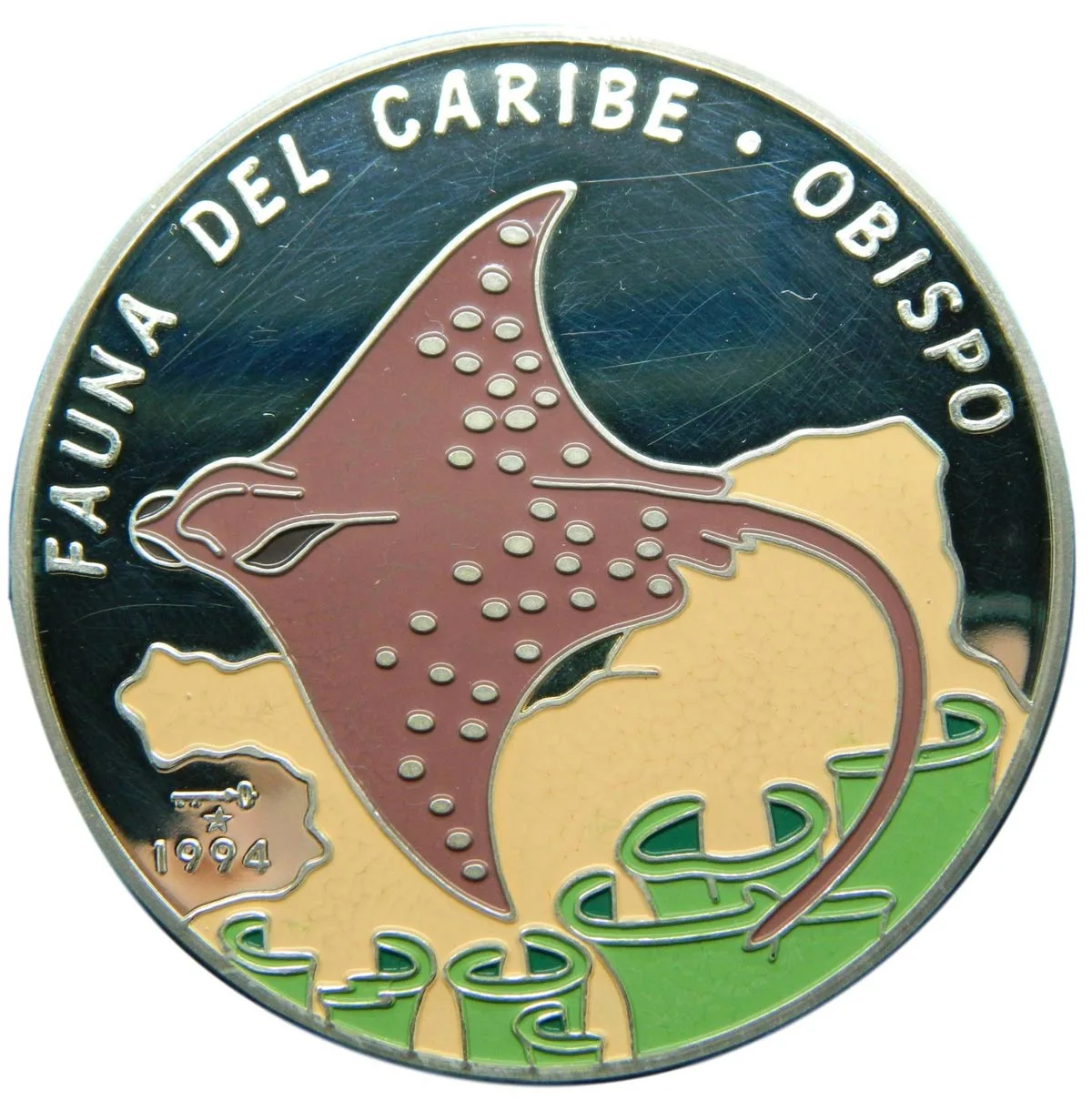
Among the six designs of the 1994 Cuban programme the eagle ray is easily the most unusual: it has neither bright plumage nor a fish's colour, but it has strict graphics, white spots on black. On the reverse of this heavy coin the ray swims to the left, the legend FAUNA DEL CARIBE — OBISPO runs along the arc, and the year stands lower left. The engraver of the design was Alberto González Pereztol.
The ray's scientific name is Aetobatus narinari (Euphrasen, 1790). It is a large member of the order Myliobatiformes, family Aetobatidae; older literature placed it in Myliobatidae together with mantas. The diamond-shaped pectoral disc, up to three metres across, bears white spots and rings on a dark back forming an individual pattern; the underside is white. Some individuals reach about 230 kg. The tail is long, without a caudal fin, armed with two to six serrated venomous spines behind a small dorsal fin.
The species inhabits coastal shallows of the tropical Atlantic: from North Carolina and Bermuda through the Gulf of Mexico and the Caribbean to Brazil. Indo-Pacific and eastern Pacific populations, formerly combined with it, are now treated as separate species, A. ocellatus and A. laticeps, so the "true" eagle ray is the Atlantic, Caribbean one. For Cuba it is a local ray, long familiar to fishermen.
On the IUCN Red List the species has since 2021 had a global status of Endangered (criterion A2bd): a decline of 50–79% over three generations, about thirty years, is suspected because of fishing and bycatch. In the waters of the United States and the Caribbean islands the local assessment remains favourable, while for central and northern South America the species is considered near threatened. The difference between global and regional assessments shows well that protecting a species is a task for many countries.
Cubans link the name obispo, "bishop", with the small dorsal fin that resembles a bishop's mitre; elsewhere the ray is known as chucho pintado, raya águila and, in English, spotted eagle ray and bishop ray. For a collection the coin is interesting as a portrait of a rare and beautiful animal that is far from an everyday sight in Cuba.
On a large coin the engraver had room to show more detail: the curve of the fins, the texture of the back, the transition from dark to white, and this gives the image of the ray added gravitas.
Obverse
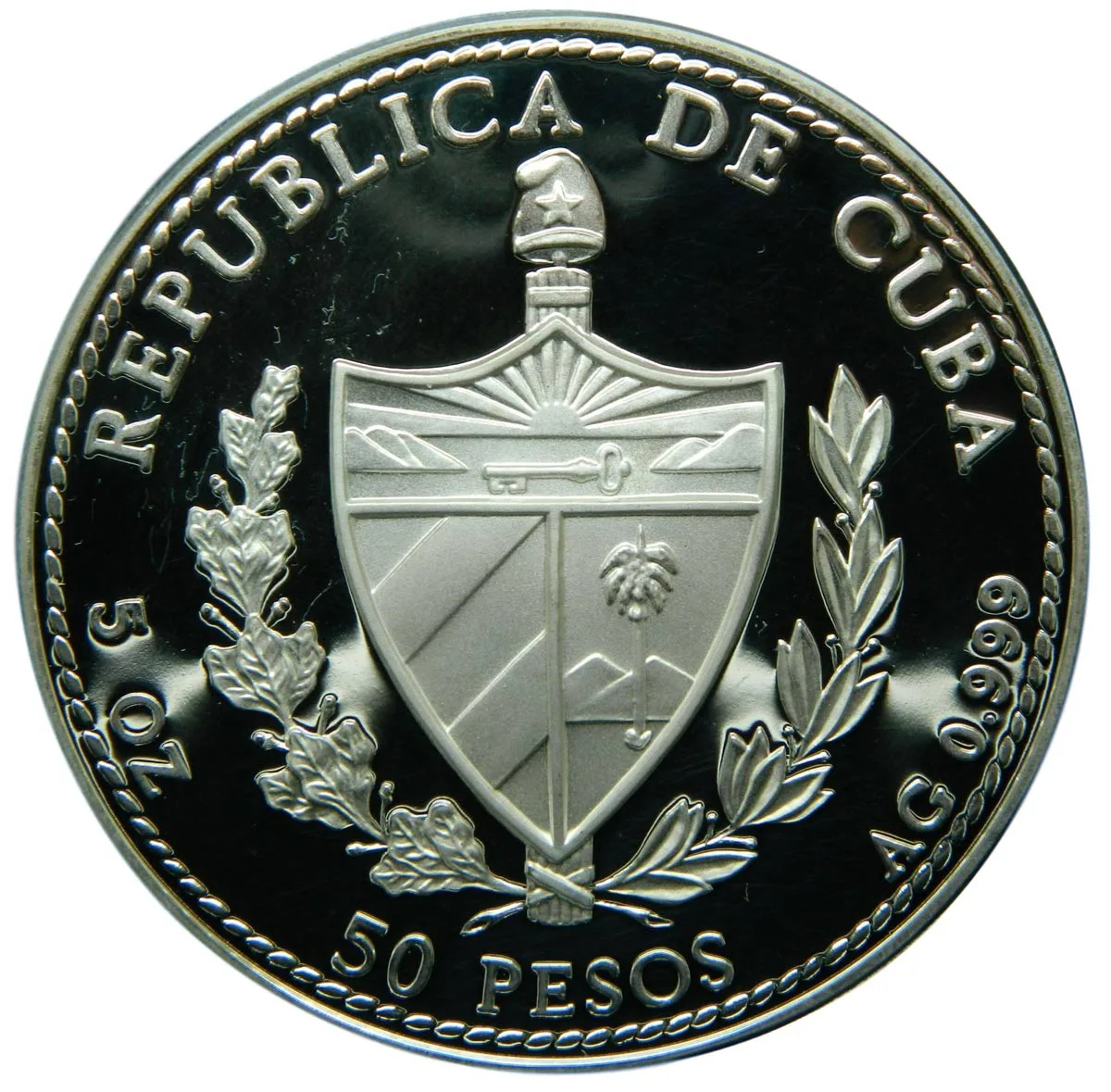
The coat of arms of the Republic of Cuba: a shield with a rising sun, a key, a palm tree and mountain peaks, framed by laurel and oak branches; above it, along the arc, REPUBLICA DE CUBA, and below the value, 50 PESOS. The design of the arms on Cuban coins goes back to the American engraver Charles Edward Barber.
Reverse
The reverse: a spotted eagle ray with a long tail swimming left; along the top arc runs the legend FAUNA DEL CARIBE — OBISPO, with the year 1994 and the mint's mark at lower left. On the broad field of the large coin the white spots on the dark back read clearly, and the hand painting gives each specimen its own tone; the reflective ground heightens the contrast.