
Spotted Eagle Ray (10 Pesos)
PDFGeneral information

Description
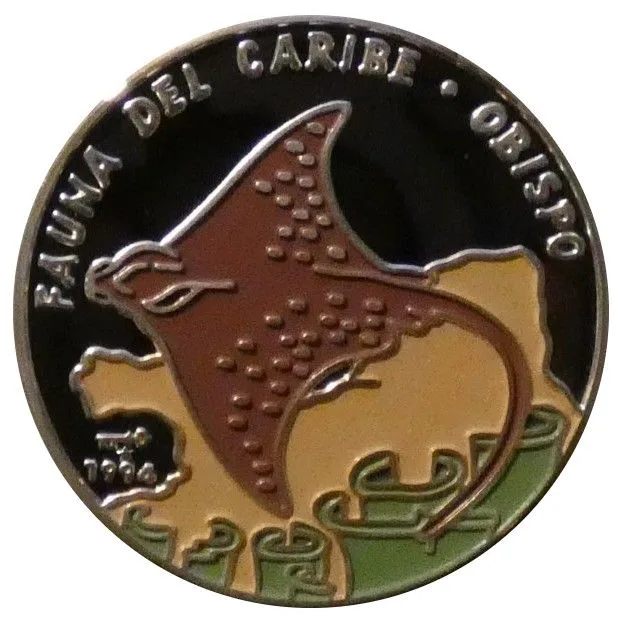
The eagle ray is one of those reef dwellers seen rarely but remembered for a long time: a dark diamond with white spots hovering over the shallows and a long whip tail. On this 1994 Cuban coin the ray swims to the left, and the inscription FAUNA DEL CARIBE — OBISPO runs along the arc. The design was made by the engraver Alberto González Pereztol, who repeated it on three coins of different sizes.
The way of life of the spotted eagle ray (Aetobatus narinari) is tied to shallow, warm waters. It lives in bays, estuaries, shoals near beaches and coral reefs, from North Carolina and Bermuda through the Gulf of Mexico and the Caribbean Sea to Brazil, and the whole Cuban shelf lies within this range. The ray swims near the surface and often leaps out of the water; outside the breeding season it gathers in schools.
The eagle ray feeds mainly on molluscs, crustaceans, worms and small fish, digging up the bottom with its snout: the flat "duck-bill" snout works like a spade, and hard plates in the mouth crush shells. The long, whip-like tail carries two to six serrated venomous spines at its base; they serve as defence and are dangerous to a careless person. The white spots and rings on the dark back form a pattern unique to each individual, by which scientists tell animals apart.
The ray reproduces by ovoviviparity: the female carries the eggs inside her body and the young are born fully formed and similar to their parents. Fertility is low, with few young born and slow maturation, so populations cope poorly with fishing pressure. The species' range in the modern sense is the Atlantic; Indo-Pacific and eastern Pacific populations have since the late 2010s been treated as separate species.
Cubans call the ray obispo, "bishop": the name is linked with the shape of the small dorsal fin, which resembles a bishop's mitre. English has a corresponding name too, bishop ray. For a coin whose colour side is hand-painted this is one of the most expressive subjects: the contrast of dark and white is conveyed in paint.
What sets this subject apart is that the ray is shown not hunting or attacking but in calm motion: as if gliding along the reef, ignoring the viewer. That is how tourists and divers in Cuba see eagle rays: their swimming is considered one of the most entrancing sights at the corals, and an encounter with a school stays in the memory for a long time.
Obverse
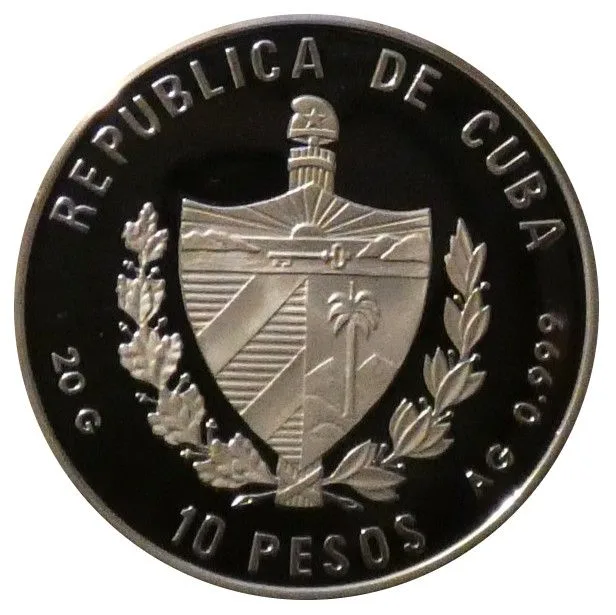
The obverse bears the country's arms, a shield with key, palm, mountains and rising sun among laurel and oak branches; REPUBLICA DE CUBA arcs above and 10 PESOS stands below. The design of this emblem as used on Cuban coins is credited to Charles Edward Barber.
Reverse
The reverse: a spotted eagle ray swimming left, with the legend FAUNA DEL CARIBE — OBISPO along the arc; at lower left are the year 1994 and the mint's mark. Against the shiny mirror ground the matt dark body and white spots look especially contrasty, and the hand-applied painting makes every specimen unique; the long tail completes the composition at the rim.