
Lucky Luke (mini medal)
PDFGeneral information

Description
Lucky Luke is a classic cowboy: wrapped in an aura of mystery, fearless and beyond reproach, resolutely solitary. With his faithful horse Jolly Jumper he roams the states of America, from chance encounters to government missions, and everywhere he is known: his unrivalled marksmanship has made him a legend that runs ahead of him across the whole Wild West (the Monnaie de Paris description). The hero's trademark title is “the man who shoots faster than his shadow”, and the blade of grass in his mouth, the yellow shirt and the red neckerchief have become one of the most recognisable silhouettes of Franco-Belgian comics. The last panel of every album is the rider leaving into the sunset on Jolly Jumper.
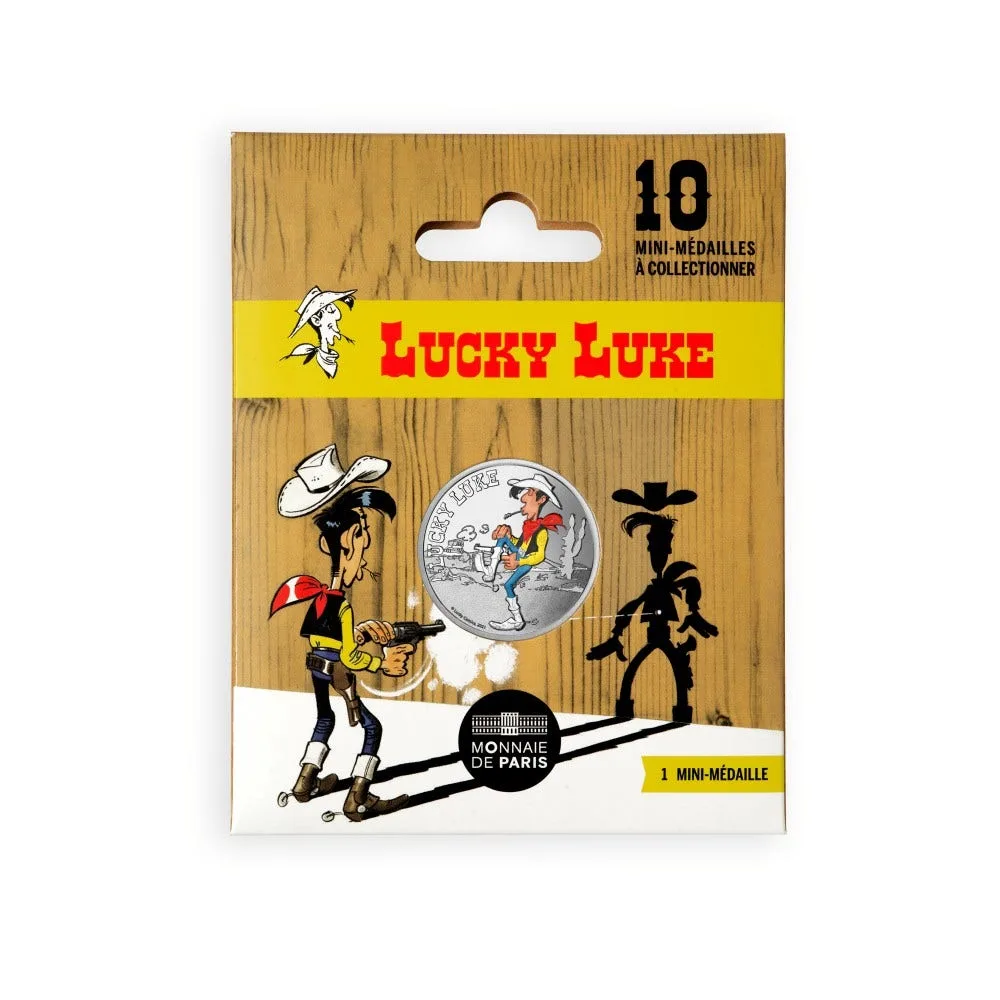
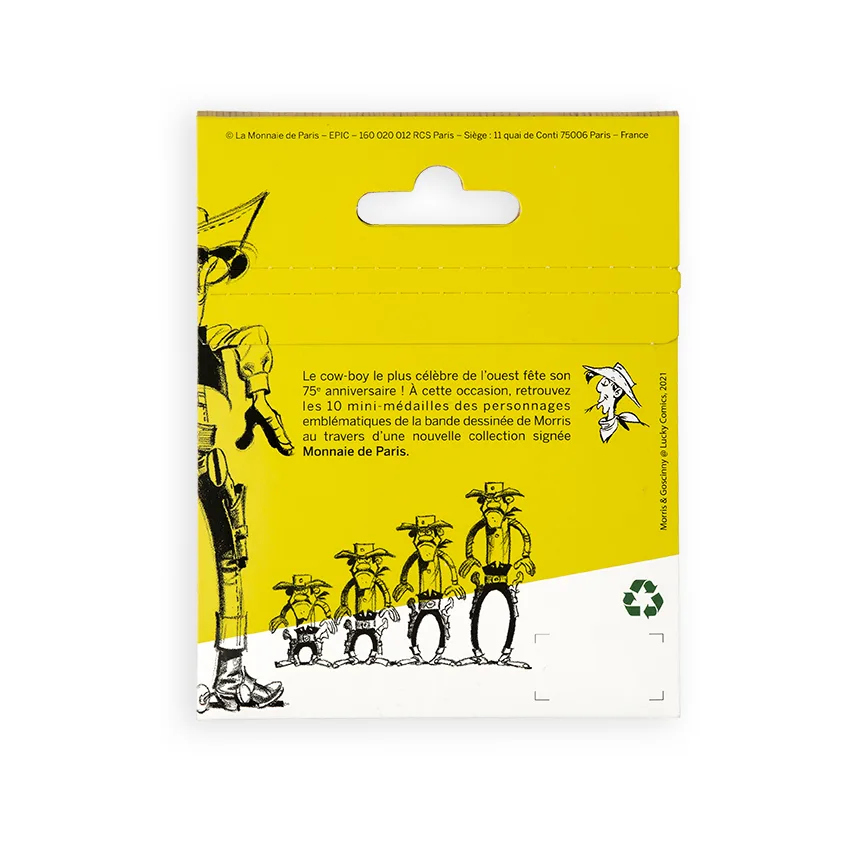
The mini medal is struck in cupronickel, 34 mm in diameter, weighing 17.7 g, in circulation-type (“courante”) quality, with a mintage of 20,000 pieces per character according to the Monnaie de Paris. The nine-character collection was released in three waves during 2021 (with the following ones in April and June after the launch); each medal is packed in a cardboard “cartelette” with elements of the Lucky Luke universe, and the mint offered a collector album for storing the whole collection, with an exclusive “Morris” medal.
The Lucky Luke series is a Belgian humorous western created by the artist Maurice De Bevere, known as Morris. The first story, “Arizona 1880”, appeared in L'Almanach Spirou 1947, the annual issue of Dupuis's Spirou magazine; the hero's birthday is counted from 7 December 1946. In 1948 Morris travelled to the United States with Jijé and André Franquin to see the settings of the Wild West and to meet American comics artists; he stayed there for about six years while continuing to send pages to Spirou. The first album, “La Mine d'or de Dick Digger”, came out in 1949 on a script by his brother Louis De Bevere.
After Morris's death on 16 July 2001 the drawing of the series has been handled by Achdé (Hervé Darmenton, born 30 July 1961 in Lyon); the scripts are written by Jul and the colours done by Mel. New albums are published by Lucky Comics with Dargaud, and stories have again appeared in Spirou magazine since 2010. By 2021 the series counted 80 albums, and according to French Wikipedia total sales exceeded 300 million copies in dozens of languages. In French and Belgian society the very name “Lucky Luke” has become a synonym for speed — the hero is said to shoot faster than his own shadow.
From the ninth story onward Morris worked with a number of scriptwriters, the most famous of whom was René Goscinny, co-creator of Asterix and Le Petit Nicolas. Their collaboration lasted about twenty years and is considered the golden age of the series: under Goscinny Jolly Jumper acquired a character of his own and the main heroes found their recognisable comic manner. The magazine carrying the stories changed over time: Spirou from 1946 to 1967, then Pilote, later Tintin, Spirou again and Pif Gadget. A series that started as a string of simple visual gags became a parody of the western genre full of references to American history.
Obverse
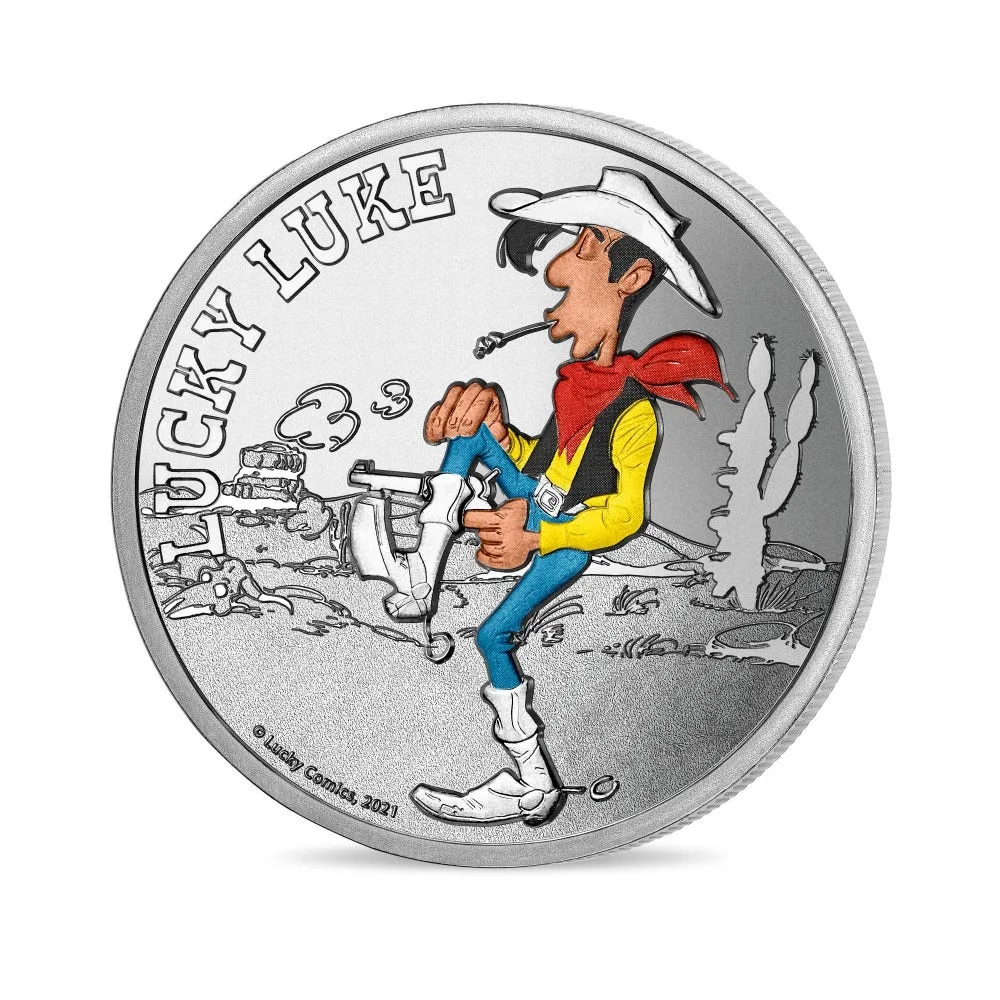
The obverse shows Lucky Luke in colour in a relaxed pose with a blade of grass in his mouth: white hat, red neckerchief, yellow shirt, dark vest, blue trousers and white boots. The background is an engraved desert landscape with a cactus and a skull; the inscription “LUCKY LUKE” runs along the top and “© Lucky Comics, 2021” along the bottom.
Reverse
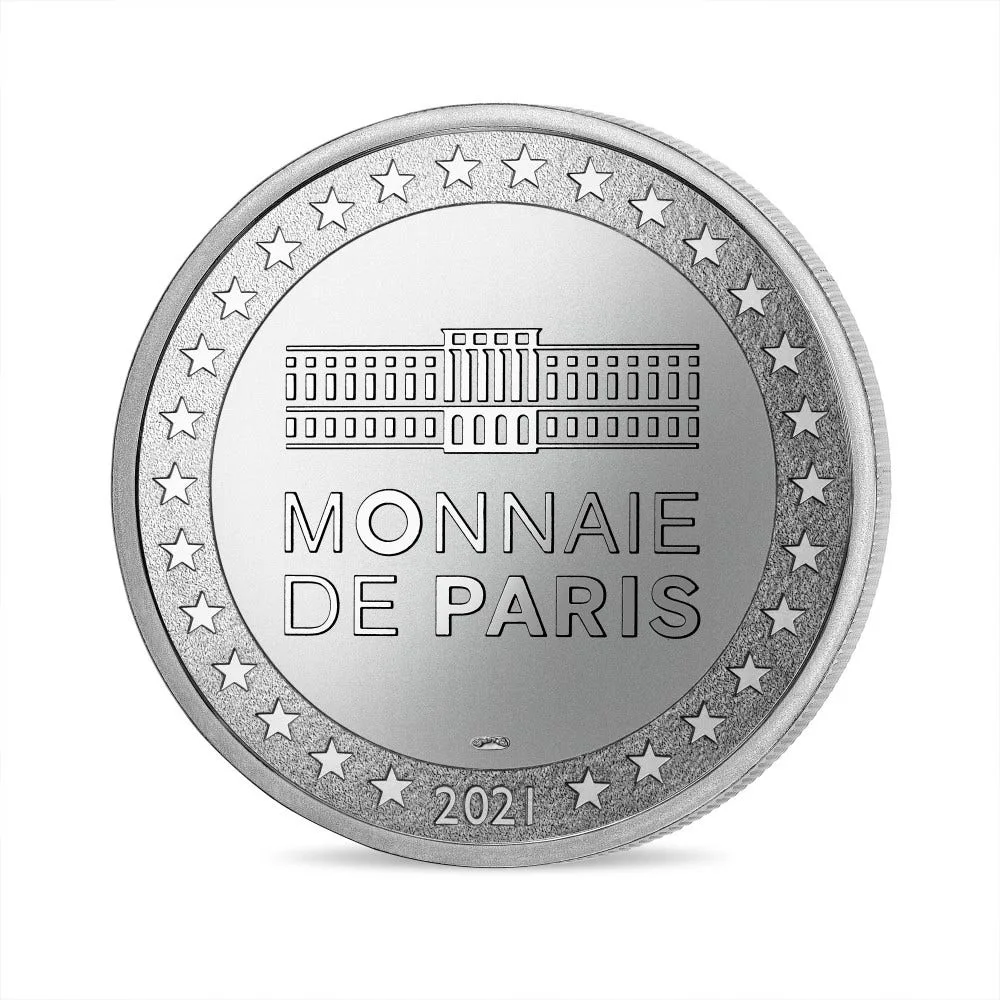
The reverse is the same on every medal of the collection: the Monnaie de Paris building in the centre, ringed by twenty-eight stars interrupted by the year of issue; the design echoes the official side of euro coins and underlines that the medal was struck at the state mint.