
Heimdall
PDFGeneral information


Description
When the gods built their fortress they understood that there would always be enemies nearby. So at the entrance to Asgard, at the edge of the rainbow bridge Bifrost, they placed a watchman who does not need to sleep. Heimdall is the one who sees and hears furthest; it is said that he can make out the sound of grass growing in a meadow and wool on the back of a sheep. These details seem amusing at first glance, but there is meaning in them: the watchman fears not great events but small signs by which he understands that the world has changed.
Bifrost joins the sky and the earth as a rainbow bridge, and the sons of the fiery lands will one day ride across it to storm the gods. The Prose Edda foretells that when Surtr with his flaming sword rides out of Muspelheim, the bridge will collapse under the hooves of his warriors. Heimdall is the one who will see it first. He takes the horn Gjallarhorn and blows it so that it is heard in all the worlds: the gods wake, Odin goes for counsel to the head of Mimir, and Yggdrasil begins to hum.
Events then move quickly. The dead come out of Hel, and Loki sails in a ship built from the nails of the dead. Fenrir tears his chains, Jormungandr rises from the sea and floods the land. The gods march onto the field of Vigrid. Thor goes against the serpent, Odin against the wolf, Freyr against Surtr, and Heimdall against Loki. The Eddic tradition reports that the watchman and the trickster will kill each other. For Norse poetry this is a complete motif: two enemies who stood against each other all their lives depart together.
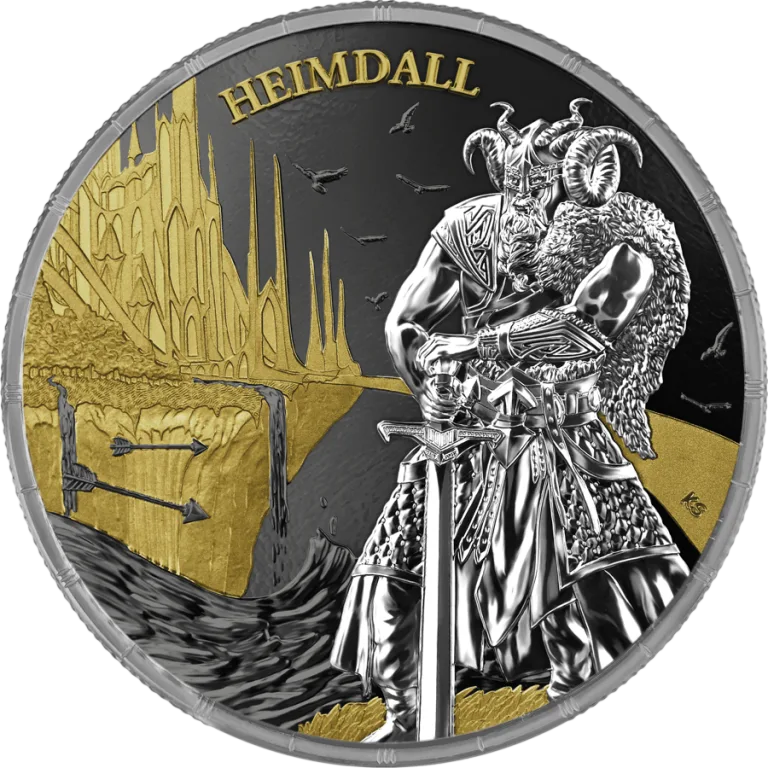
The image of the watchman of the gods was beloved in northern culture because it embodies not victory but fidelity. One who knows he is fated to die yet does not leave his post earns respect precisely because he has no illusions. The coin shows Heimdall at the moment when the waiting is over but the fight has not yet begun.
In the Thrymskvida Heimdall appears in a scene that is often forgotten. When Thor's hammer was stolen the gods did not know how to recover Mjolnir, and the watchman, the whitest of the Aesir, who like the Vanir sees far ahead, suggested dressing Thor as a bride. Thor resisted, Loki persuaded, and the plan worked. Heimdall here acts as a counsellor whose foresight rescues the gods, and this side of the image is seldom visible against the background of his formidable role as watchman. The coin, however, shows him in another light: as one who must be ready for any turn of events.
Obverse
On the obverse Heimdall is shown ready for battle: a figure in a fighting stance on a dark field, with golden details emphasising clothing and weapon. The silver relief of face and hands gives the image concentration, and the inscription with the hero's name and runes completes the composition.
Reverse
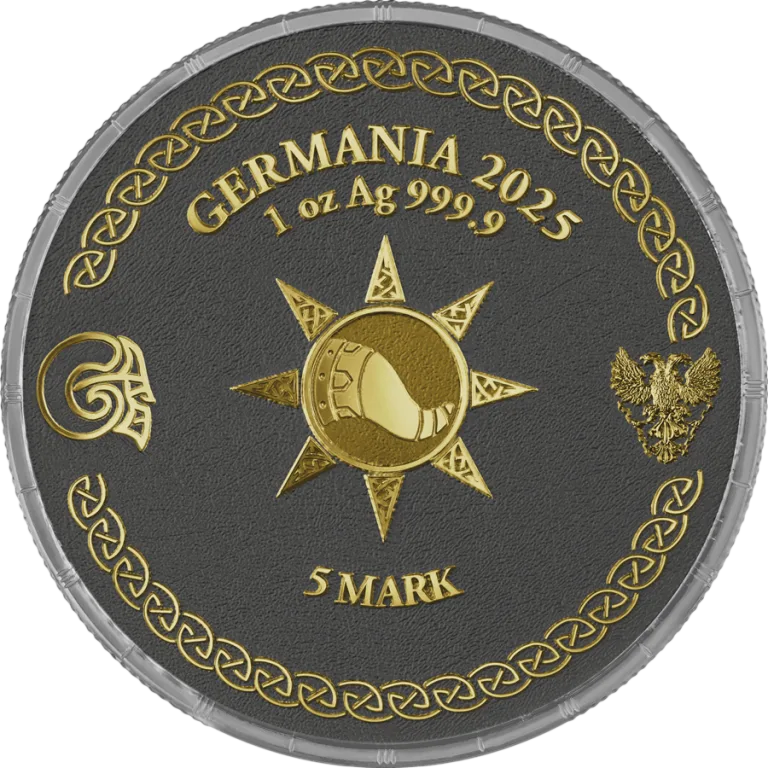
The reverse shows the horn of Heimdall and the double-headed eagle of the Germania Mint. This side forms a pair with the reverse of the Loki coin, and together they show the opponents side by side. The design is by Kinga Sabatowicz.