
Loki and Heimdall
PDFGeneral information

Description
While the gods feast and the world still stands, Loki and Heimdall seem to be mere neighbours in Asgard. But the Edda remembers their enmity from the very beginning. Once Loki stole Freyja's necklace, the famous Brisingamen, and vanished. Heimdall, turning into a seal, caught up with the thief on the sea rock Singasteinn. The two beasts fought for a long time, and in the end the watchman overcame the trickster and returned the jewel to its owner. Here for the first time it is clear that their strengths are equal: deceit is powerless against vigilance, and vigilance cannot abolish cunning once and for all.
The enmity gains strength after the death of Baldr. Loki guided the hand of blind Hodr and destroyed the brightest of the gods, and then, because of a cruel jest, lost his freedom. The gods found him in the shape of a salmon, caught him in a net and chained him with the entrails of his own son beneath a serpent whose venom runs onto his face. Since then the world lives with a sense of approaching retribution: sooner or later the fetters will fall, and everything Loki has stored up will come down on the gods.
In the Voluspa the picture of the finale unfolds vividly. Fimbulwinter begins: three winters in a row without summer, people kill each other, oaths are broken. Fenrir and Loki break free. Jormungandr rises from the sea, the dead sail on the ship Naglfar, Surtr rides from the south with his flaming sword. Heimdall blows Gjallarhorn for the last time. The gods march onto the plain of Vigrid, and each has a destined opponent. Odin draws Fenrir, Thor draws Jormungandr, Freyr draws Surtr, and Heimdall draws Loki.
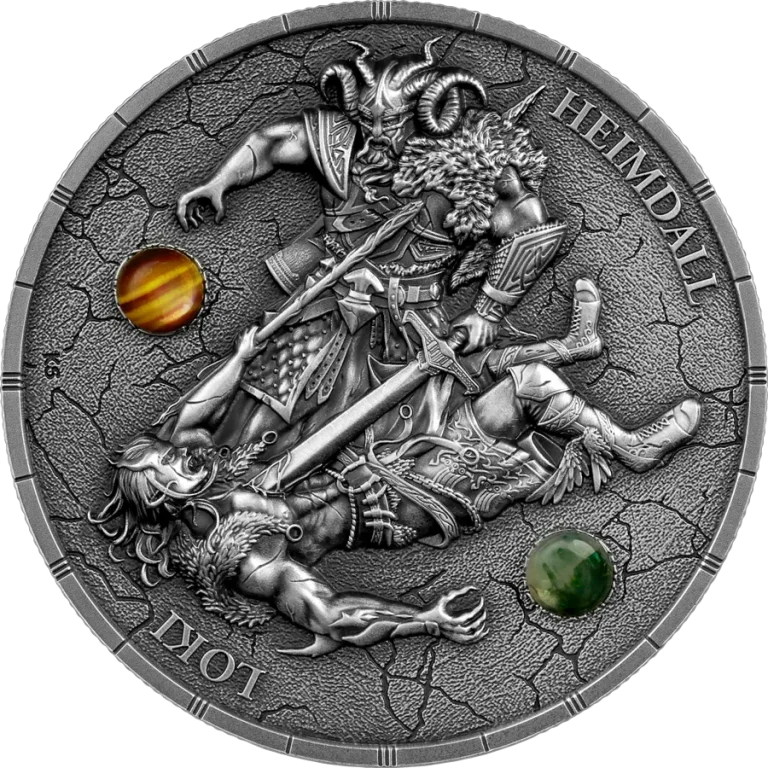
The Prose Edda stresses: Heimdall and Loki will kill each other. The motif of double death is rare in epic plots, where usually one hero defeats the other. Here both are given the same end, and this produces a sense of justice of a higher order than victory or defeat. A coin with two heroes united in one composition is therefore especially fitting: it at once shows a bond that cannot be broken.
It matters to the reader of the Eddas that after the last battle the world does not vanish. From the waves a new green earth rises, surviving gods return, fields yield harvests without sowing, and two humans hidden in the branches of Yggdrasil become the ancestors of a new humankind. The duel of Heimdall and Loki is a link in a cycle, not its end.
The sources differ in detail. The Voluspa names Heimdall and Loki among those who go out to the last battle but does not say directly who kills whom. Their mutual death is recounted by the prose of the Prose Edda, relying on poetic tradition. Such difference in versions is typical of Scandinavian mythology, which was written down late from scattered tales. But for that very reason the image of the duel is so fluid: each poet could add his own, and on the coin it looks not like an illustration of one stanza but a generalisation of how the Norse imagined the last fight.
Obverse
The obverse shows heroes whose many wounds testify to the cruelty of the battle. The gods are accompanied by stones of power, moss agate and tiger's eye, which this time brought no comfort. Under an ultraviolet torch their weapons will glow brightly, and the cracked ground beneath them will begin to pulse with a red light.
Reverse
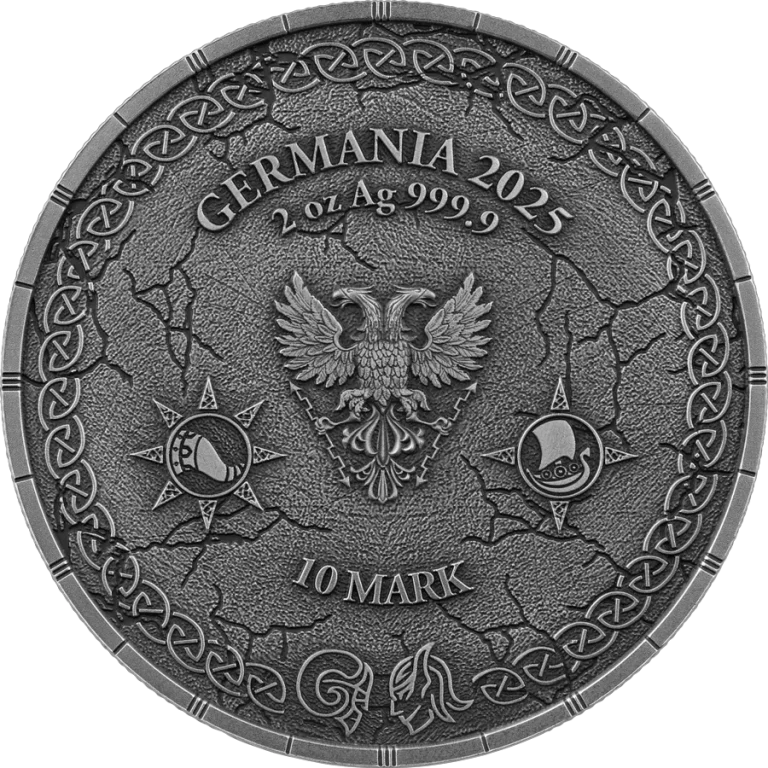
The reverse shows the symbols of Heimdall and Loki, their artefacts, a ship and a horn, as well as the cracked Earth on the brink of destruction. The double-headed German eagle, emblem of the Germania Mint, is present. The design is by Kinga Sabatowicz.