
10 Years of Tenge — Argali
PDFGeneral information
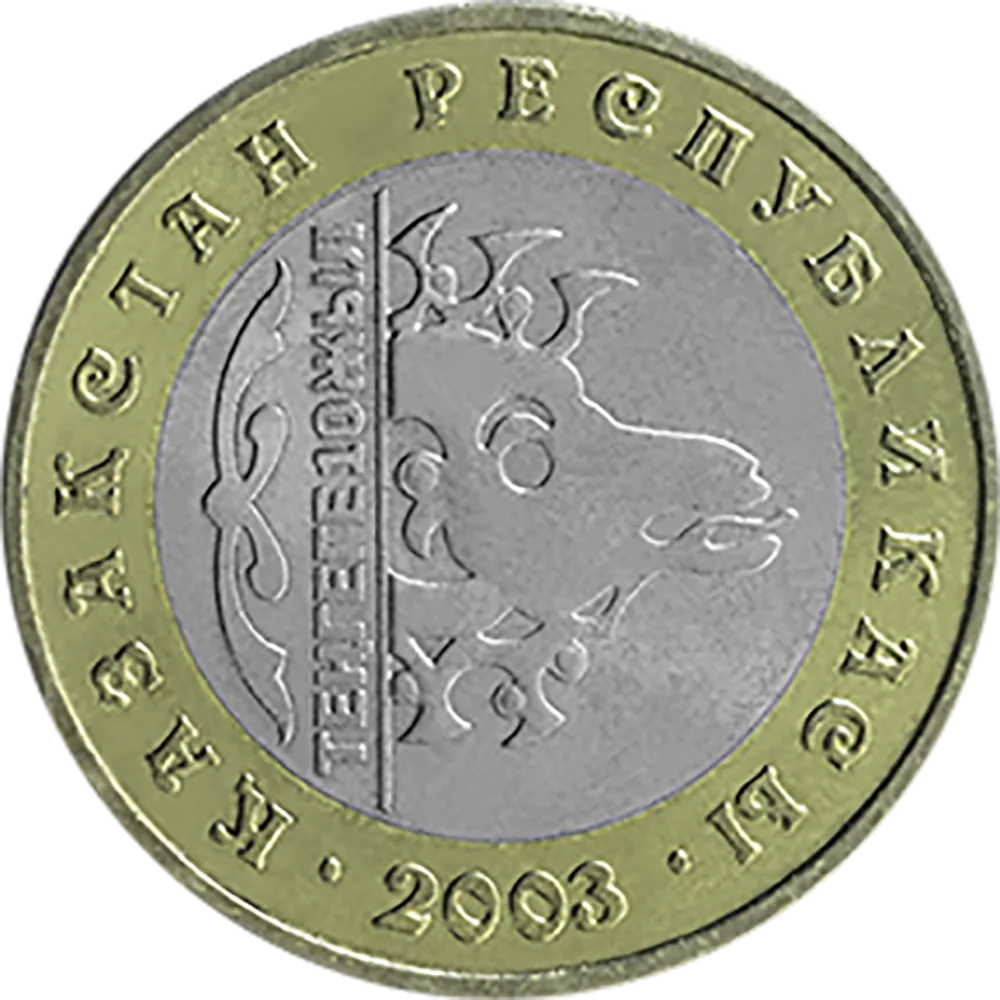



Description
The argali, a wild mountain sheep, opens the “10 Years of the Tenge” set issued by the National Bank of Kazakhstan on 1 October 2003. The subject is taken from the very first coin range of the independent country: the profile of this animal adorned the 1-tenge coin of 1993, the smallest of the series at the time. Ten years later the Bank returned the image to a new collector coin and thereby linked two dates: the appearance of national money and its first jubilee.
The argali is a large mountain sheep that lives in the high mountains of the Tien Shan and the Dzungarian Alatau, as well as in some other mountain regions of Kazakhstan. Its massive curled horns are recognisable from afar, and its ability to hold on to steep slopes has made it a symbol of endurance and freedom. For the nomadic culture of the steppe the mountain sheep was not only game but also an important image: argali horns appeared on ornaments more than once, and the animal is still associated with the wild nature of the country. Choosing such a subject for the smallest coin of the first range shows how national symbolism was built on the images of Kazakhstan's living nature.
The tenge was introduced on 15 November 1993: the decree “On the Introduction of the National Currency of the Republic of Kazakhstan” was signed on 12 November, and three days later the new unit, one hundred tiyn to a tenge, pushed out the rouble. The name goes back to the Turkic “tanga”, the word for a coin in the steppe. The first money was made abroad, and production was later moved to Kazakhstan. Coins are struck by the Kazakhstan Mint in Ust-Kamenogorsk.
For the first round date the National Bank prepared a whole programme: six collector coins came out in 2003. Four two-coloured coins forming a set repeat the images of animals from the country's first coins, the argali, the snow leopard, the wolf and the mythical bird, and two silver coins are devoted to state symbols. The argali coin stands apart in this set: it was with this smallest coin that the history of Kazakh coinage began.
For the collector the argali coin is also interesting because it shows continuity: it reveals the link between the very first series of national coins and the jubilee programme of the tenth anniversary. The two-colour execution makes it possible to set off the animal's relief against a contrasting field, and the many examples that remained in private collections in near-original condition have still not become rare. The coin will suit those who collect fauna themes or want a complete set of the four coins of the 2003 jubilee.
Obverse
The artistic side reproduces the head of an argali, the wild mountain sheep that adorned the smallest coin of the 1993 range. The relief figure of the animal occupies the centre; to its left are an element of national ornament and the inscription “ТЕҢГЕГЕ 10 ЖЫЛ” (“10 years of the tenge”) in Kazakh. Around the circumference run the name of the state “ҚАЗАҚСТАН РЕСПУБЛИКАСЫ” and the year “2003”; the inscriptions are separated by dots and are done in sunken relief on a wide rim.
Reverse
The official side is shared by all coins of the set: in the centre, against a ribbed circle, is a two-line inscription “100 ТЕҢГЕ”, and around the circumference are three elements of national ornament separated by an octagonal rosette. To the left of the ornament is the abbreviation “NBK” (National Bank of Kazakhstan) and to the right the trademark of the Kazakhstan Mint. The coin is two-coloured: a white centre is framed by a yellow ring.