
10 Years of Tenge — State Flag
PDFGeneral information


Description
The State Flag of the Republic of Kazakhstan decorates the second silver coin of the “10 Years of the Tenge” jubilee, issued by the National Bank on 1 October 2003. If the neighbouring coin with the emblem speaks the language of heraldry, this one speaks the language of colour: the blue cloth with a golden sun and eagle is read instantly, and paired with the country's first money it tells how, in the early 1990s, Kazakhstan acquired almost simultaneously both its state symbols and its national currency.
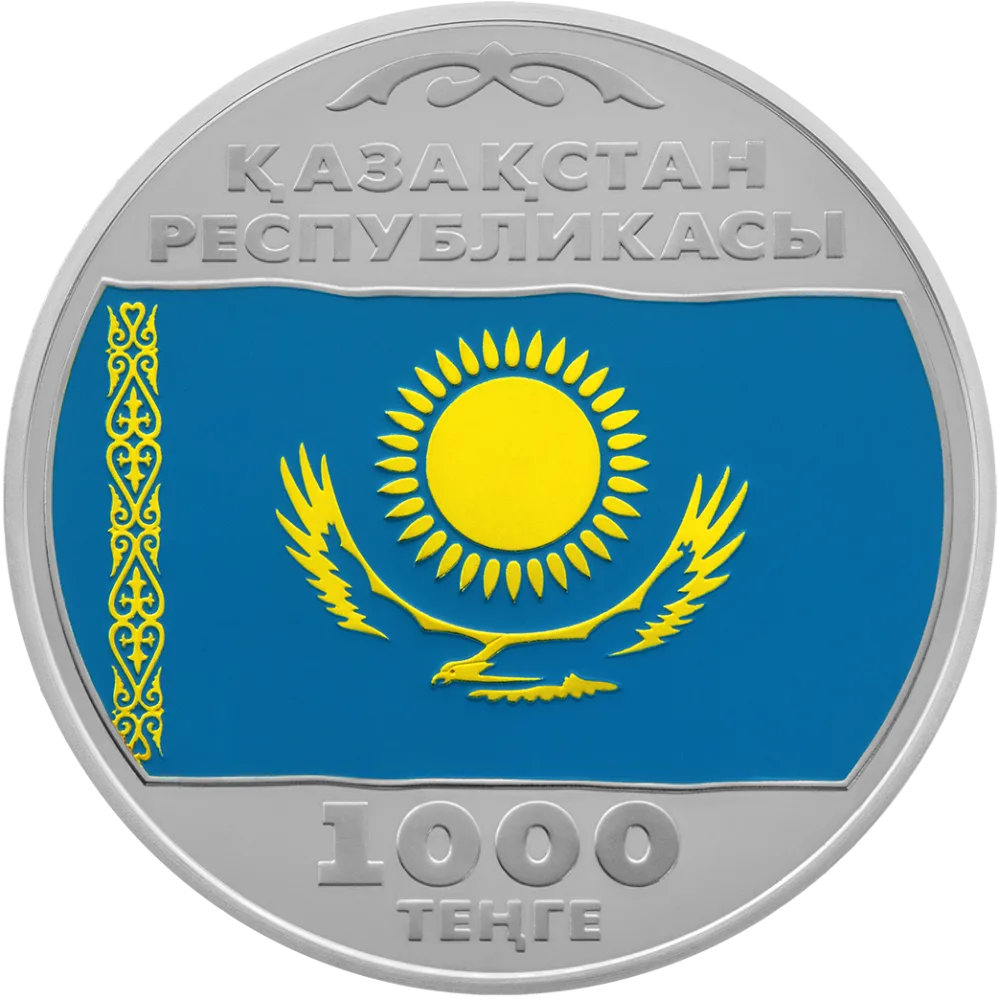
The flag was approved on 4 June 1992, and its author is the artist Shaken Niyazbekov. On a sky-blue field there is a sun with rays, a steppe eagle soaring beneath it, and a pattern of national ornament along the hoist. In the Turkic tradition blue stands for the sky, eternity and purity of intent; the sun for life and energy, the eagle for strength, keen sight, freedom and independence. The pattern at the hoist is the “koshkar muiz”, the horns of a ram, a motif repeated in many Kazakh ornaments. On the coin all the details are gathered in reduced form, and the surface of the flag is multi-layered, so that the cloth seems to ripple.
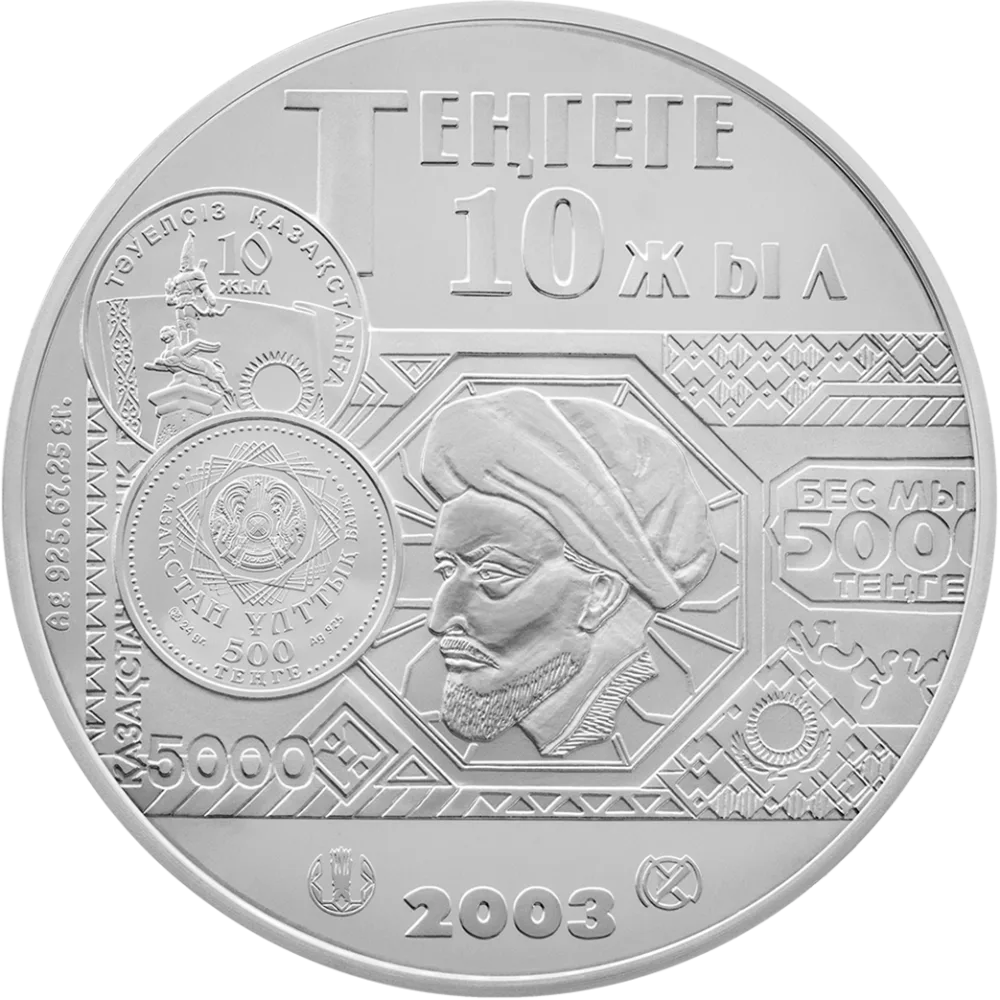
Around the portrait placed on the obverse are the country's first money. At the centre is al-Farabi, a medieval scholar and thinker whose portrait adorned the 1-tenge banknote of 1993; around him run images of coins and banknotes. The choice is not accidental: al-Farabi, a native of Central Asia, is regarded as one of the greatest thinkers of his age, and his image on the first banknote was meant to recall the ancient cultural roots of the young state.
The tenge was introduced by a decree of 12 November 1993, from 15 November it replaced the rouble, and there are one hundred tiyn in a tenge. By the tenth anniversary the country was summing up its first decade: the National Bank issued six coins, four two-coloured ones with animals and two silver ones. The flag is the most colourful coin in this row, and it is in works like this that one can see how collector numismatics turns state symbolism into a work of applied art.
The flag coin is good also because it combines two types of images: the portrait of a scholar on the artistic side and a state symbol on the official one. Al-Farabi, whom the East called the “Second Teacher” after Aristotle, embodies the intellectual tradition of the region, and the flag embodies modern statehood. This combination makes the coin one of the most meaningful commemorative issues of the national currency and explains why it is often chosen for thematic collections about the country's symbols.
Obverse
The artistic side is assembled from images of the first money of the national currency: in the centre is a relief portrait of al-Farabi, who adorned the 1-tenge banknote of 1993, and around it are images of the first Kazakh coins and banknotes, with a ship, with a monument, with the inscriptions “ТЕҢГЕ 20” and “500 ТЕҢГЕ”. On the left rim runs the inscription “ТЕҢГЕГЕ 10 ЖЫЛ” (“10 years of the tenge”); at the bottom are a large inscription “1000 теңге” and the service markings. The composition is kept in outline relief.
Reverse
The official side reproduces the State Flag of the Republic of Kazakhstan: on a blue field a sun, a soaring eagle and national ornament along the hoist. The sun and the eagle are golden, and the blue field conveys the colour of the real banner. Above and below the flag are the inscriptions “ҚАЗАХСТАН РЕСПУБЛИКАСЫ” and the marking of the value; the field of the coin is mirror-like.