
10 Years of Tenge — State Arms
PDFGeneral information


Description
The State Emblem of the Republic of Kazakhstan is the main theme of the silver coin of the “10 Years of the Tenge” jubilee, issued by the National Bank on 1 October 2003. It is the most elegant issue of that jubilee: beside the emblem the coin brings together the first money of the independent country, while the official side itself is given over to a symbol of the state. The idea is obvious: in the ten years since the introduction of the tenge Kazakhstan acquired both its own currency and its own state symbols, and it is natural to mark the anniversary of one with the image of the other.
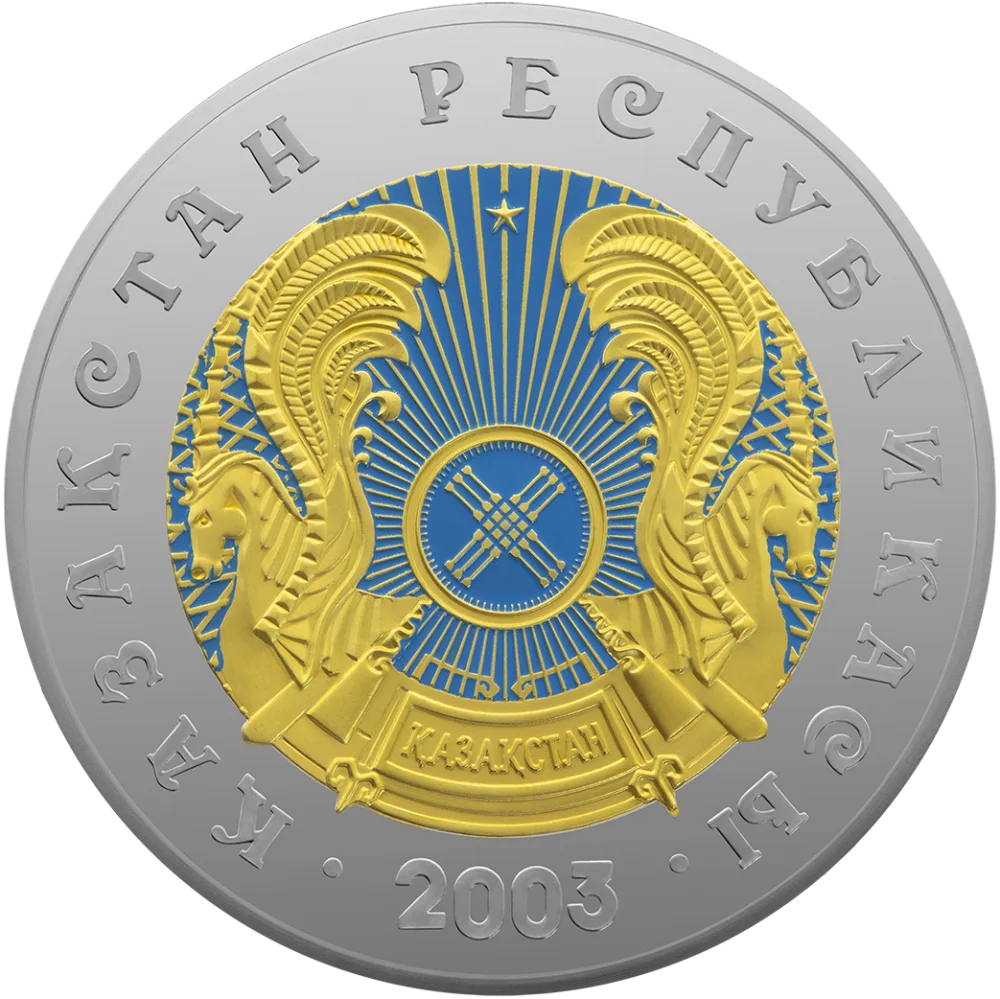
The State Emblem was approved in 1992, and its authors are named as the architects Zhandarbek Malibekov and Shot-Aman Ualikhanov. At the centre of the composition is the shanyrak, the crown of a yurt, which symbolises the family hearth, home and the unity of the people; the poles of the yurt, the uyk, radiate from it, and on the sides are winged tulpars, mythical horses embodying striving forward and loyalty. Above is a star, below the word “ҚАЗАҚСТАН”. The blue of the emblem repeats the colour of the flag and points to the sky, while the gold points to wealth and abundance. On the coin the emblem keeps all this symbolism, turning a small disc into a miniature state standard.
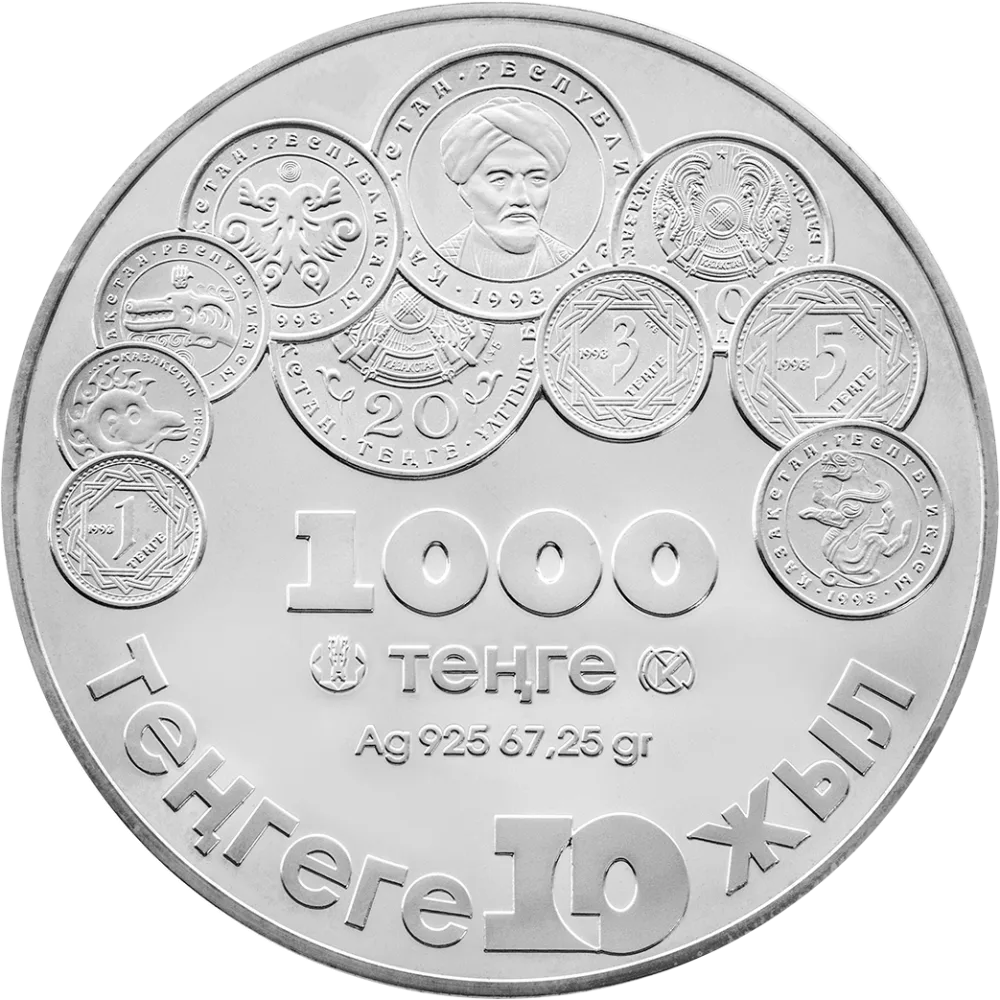
Beside the emblem the coin presents the history of money. Around it run relief images of the coins of 1993, with the argali, the snow leopard, the wolf and the mythical bird, as well as coins with a portrait and with a monument. The tenge was introduced by a decree of 12 November 1993 and from 15 November replaced the rouble; one hundred tiyn make a tenge, and the word itself goes back to the Turkic “tanga”, which meant a coin. In ten years, therefore, the country acquired both a monetary unit and an emblem.
For the first jubilee the National Bank prepared six coins: four two-coloured ones with animals and two silver ones, with the emblem and with the flag. The coins with state symbols are meant for the most demanding collectors and naturally remain in private and museum collections rather than in circulation. For a collector of the “National Currency of Kazakhstan” series the emblem is one of the two main pieces of 2003.
The silver coins of 2003 are also notable because they show the aesthetics of Kazakhstan in the early 2000s: outline relief, a restrained palette, strict symmetry. The emblem on the coin is not a picture but a “quotation” from a state document, so the engravers sought to convey every detail without liberties. It is because of this precision that the coin is regarded as exemplary for the theme of state symbols in Kazakh numismatics, and the large disc makes it possible to examine the shanyrak, the tulpars and the star in every detail.
Obverse
The artistic side is devoted to the first money of independent Kazakhstan: around the circle are relief images of the coins of 1993, with the argali, the snow leopard, the wolf and the mythical bird, as well as coins with a portrait and with a monument. The layout is closed by a composition of coins with the inscriptions “20 ТЕҢГЕ” and “3 ТЕҢГЕ”. At the bottom are a large inscription “1000 теңге” and the service markings, and on the rim is the inscription “ТЕҢГЕГЕ 10 ЖЫЛ” (“10 years of the tenge”) in Kazakh.
Reverse
The official side bears the State Emblem of the Republic of Kazakhstan, the shanyrak flanked by winged tulpars, in blue and golden tones. Around the circumference are the inscription “ҚАЗАҚСТАН РЕСПУБЛИКАСЫ” and the year “2003”; the field of the coin is mirror-like and the relief of the emblem is matt.