
Keloğlan (blister)
PDFGeneral information


Description
If one lists what any child in Turkey knows about Keloğlan, the result is a familiar set: a poor widow or a poor family, a son who looks lazy, a donkey, the sultan's riddles and giants beaten by cunning. The hero's name literally means "bald boy": he is born without hair, and this flaw is one the tale turns into a virtue. Appearances deceive: behind the simple look lies intelligence, and each time it turns out that those who laughed at him were wrong. The hero does not boast and seldom receives the reward he dreamed of: the tale values the deed itself, not the loot.
Folklorists identify main types of Keloğlan stories in Turkish tales, and familiar plot moves recur in them. In some Keloğlan sets out to seek his fortune and finds a magic table that lays itself at the words "Open, O Table"; in others he rescues his neighbours from a giant, feeds a traveller, helps an old man and unexpectedly turns out to be the bridegroom of the sultan's daughter. Each time the narrator holds the listener in suspense, and then the resolution arrives with a smile. Such stories were passed down orally for centuries and written down in the twentieth century, and the hero entered books, stage productions and cartoons.
His tales are loved in Kazakhstan too: Turkic plots are felt there as one's own, and the figure of the resourceful poor man is one of the most popular in folklore. Meskhetian Turks have lived in Kazakhstan since the middle of the last century, and the tale of the resourceful bald boy sounds particularly meaningful in their families: it is about how poverty does not prevent a person from winning by wit and a kind heart.
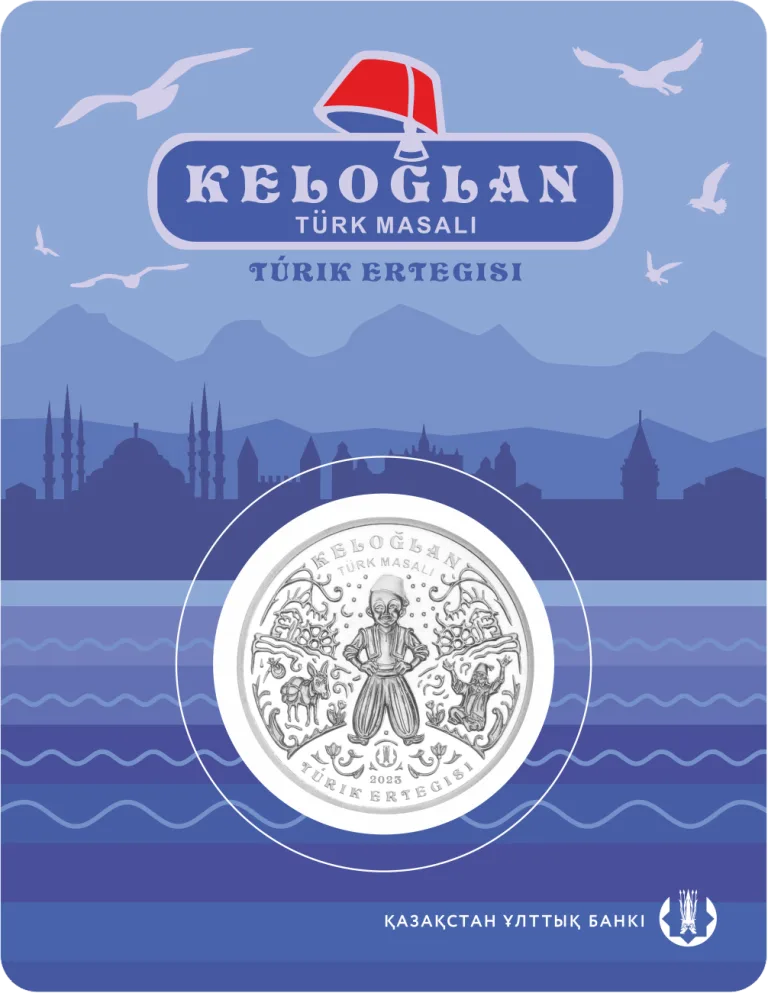
The cupronickel 200-tenge coin went into circulation on 13 December 2023 and is sold in a blister, a gift package in which it is kept and displayed. The blister is designed as a small illustration: it shows the silhouette of a city against mountains and a sky with birds, a fez at the top, and the title of the tale in Latin script and in Kazakh; the coin can be examined without taking it out of the package. This version suits those who are choosing a present: it looks complete, needs no extra wrapping and at once gives an idea of the tale. For the collector the blister is a way to keep the coin in perfect condition, and the packaging itself becomes part of the collection. The design on the coin is the same as on the silver 500-tenge coin and on the nickel-silver 200-tenge coin issued in rolls; the differences lie not in the subject but in who the issue is addressed to and how.
Obverse
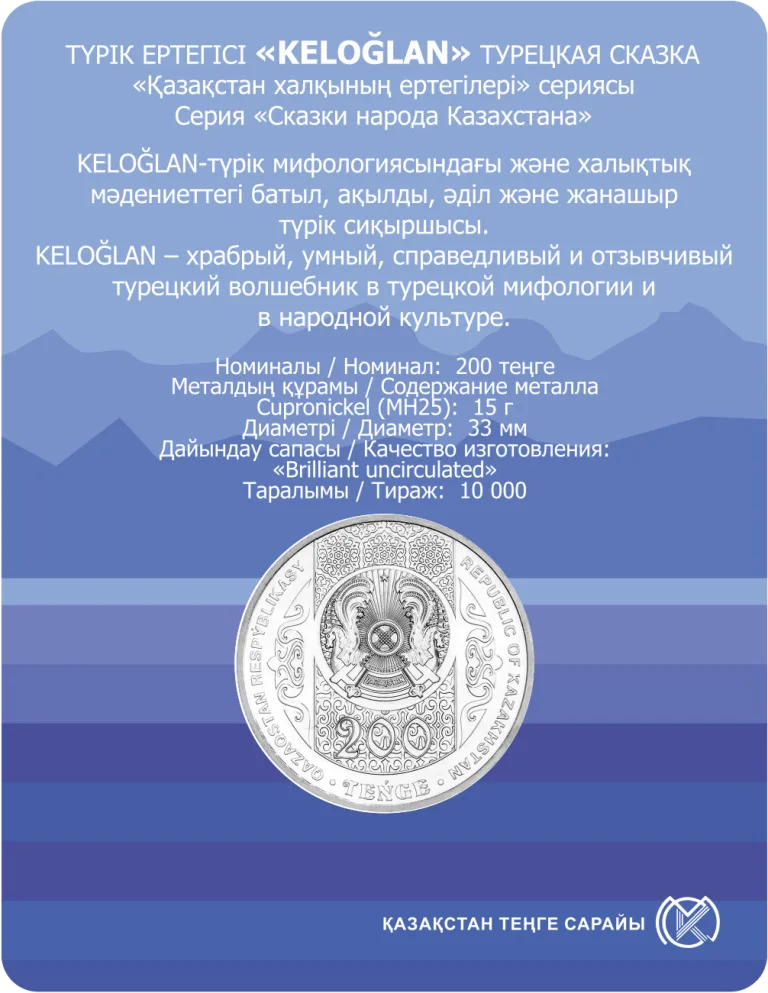
The official side is set in the Latin script that the National Bank uses on its most recent issues. In the centre is the emblem of the Republic of Kazakhstan in a circle, with a star shining above the shanyrak. On the left along the arc is the inscription "QAZAQSTAN RESPÝBLIKASY", on the right "REPUBLIC OF KAZAKHSTAN". The denomination "200" stands large at the bottom, with the word "TENGE" beneath it. The free field is filled with fine curling ornament, and vertical cartouche ribbons run down the sides.
Reverse
The coin in its blister is best viewed through the composition of the story side: in the centre stands Keloğlan with his hands on his hips, in a small cap and wide trousers, looking straight at the viewer. On the left walks a donkey with a pack, on the right sits a bearded old man in a tasselled cap with raised hands. Around them are tulips, curling shoots and rosettes of small dots. Along the upper arc is "KELOĞLAN" and below it "TÜRK MASALI", along the lower "TÜRIK ERTEGISI", and at the bottom the year "2023". The design is the same as on the other two coins with this subject.