
Keloğlan (silver)
PDFGeneral information


Description
Keloğlan, "the bald boy", is one of the best-loved heroes of Turkish folk tales. He appears in the folklore of Turkic peoples, and his kinship with other clever heroes is obvious: he is poor, unprepossessing and at first glance clumsy and lazy, but as events unfold he proves resourceful, brave and skilful. He usually appears as the son of a poor couple, of a poor widow, or as the grandson of an old woman. His main traits are honesty, courage, helpfulness, cunning and sometimes gullibility, and in this figure the people recognise themselves: an ordinary Anatolian lad who is lucky precisely because he demands nothing.
Tales of Keloğlan are countless. The Turkish scholar Tahir Alangu identified fifteen main plot types, and since then there have been many more, because any author can tell a new story by calling the hero Keloğlan. Among the known titles are "Keloğlan and the Bald Man", "Open, O Table", "Keloğlan Buys Nothing" and "Keloğlan and the Giants". The hero defeats giants, outwits greedy rich men, solves the sultan's riddles and often receives as a reward the hand of a beauty or a chest of gold. But the reward is not the point: the tale prizes quick wits and a kind heart.
The figure long ago left the pages of books. Plays for children are staged from the tales, and a Turkish children's television channel aired the cartoon series Keloğlan Masalları from 2008 to 2016. The French folklorist Paul Delarue observed that Keloğlan corresponds to a Western hero called Le Teigneux, a youth of low station who saves the day. The hero is known among many Turkic peoples under different names: in Azerbaijan he is Keçel, in Turkmenistan Kelcebatyr, among the Altai people Tas, and in Kazakhstan Tazsha bala.
The silver 500-tenge coin with Keloğlan went into circulation on 13 December 2023 and is the senior issue among the three coins of this design. It is intended for the collector who wants the subject in its most expressive form: it is supplied in souvenir packaging with a certificate, and the mirror-like field sets off the relief of the boy, the donkey and the old man. The other two coins of the same design, the cupronickel and the nickel-silver 200-tenge coins, serve other purposes: the first is sold in a blister as a gift version, the second in rolls of twenty for the mass collector. The silver coin is the only one of the three with a face value of five hundred tenge, and it is the convenient place to begin getting to know the subject: here it is shown with the greatest care.
Obverse
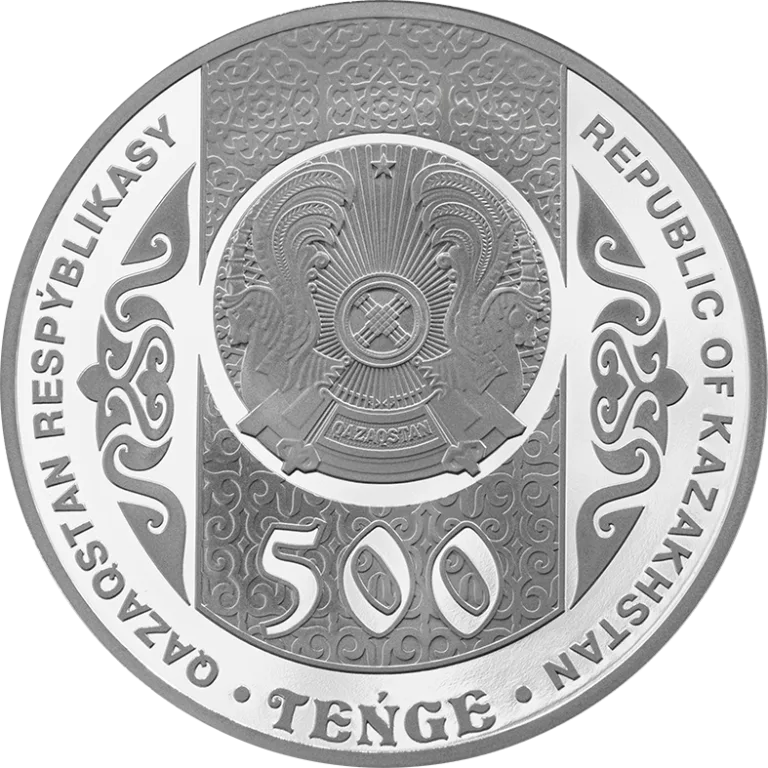
The official side is set in the Latin script that the National Bank uses on its most recent issues. In the centre is the emblem of the Republic of Kazakhstan in a circle, with a star shining above the shanyrak. On the left along the arc is the inscription "QAZAQSTAN RESPÝBLIKASY", on the right "REPUBLIC OF KAZAKHSTAN". The denomination "500" stands large at the bottom, with the word "TENGE" beneath it. The free field is filled with fine curling ornament, and vertical cartouche ribbons run down the sides.
Reverse
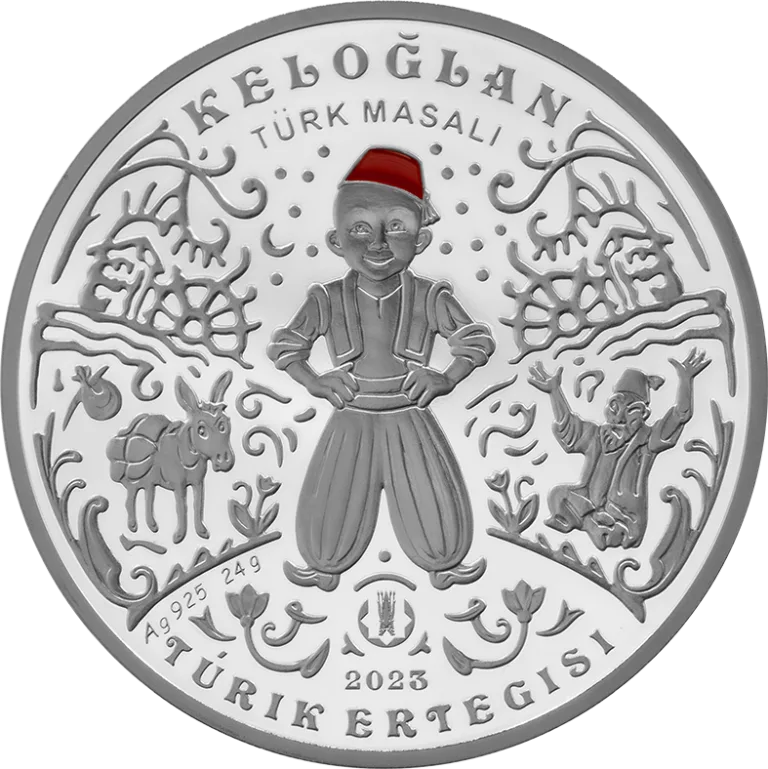
On the story side Keloğlan stands in the middle of the scene with his hands on his hips and a broad grin; large ears and big eyes give him the look of a mischievous, quick-witted lad. He wears a waistcoat over a shirt and wide trousers, and on his head a fez with a tassel. On the left walks a donkey with a patterned pack, on the right a bearded old man in a headdress and robe sits on the ground and throws up his hands in amazement; beside him grows a tulip-like flower. The field is filled with stylised trees with flowering crowns, and an ornamental band runs along the bottom. Along the upper arc is "KELOĞLAN", below it "TÜRK MASALI", along the lower arc "TÜRIK ERTEGISI", and at the very bottom the year "2023".