
Keloğlan (nickel silver)
PDFGeneral information


Description
Keloğlan is a character with as many names as there are peoples speaking Turkic languages. In Anatolia he is Keloğlan and Keleşoğlan, in Azerbaijan Keçel or Keçel Memed, in Turkmenistan Kelcebatyr, in Crimea Tazoğlan, among the Altai people Tas, and in Kazakhstan he is called Tazsha bala. They share one thing: the hero is bald from birth and poor, and therefore seems a failure, but at the decisive moment proves braver and cleverer than the rest. In this way folklore reminds us that appearance is no measure of a person.
Keloğlan's role in the tales is to be the one from whom no heroics are expected. He is given the hardest tasks: to visit a giant, to find a cure for the sultan, to drive the cattle up into the mountains. He is lazy only in appearance; when it comes to the point, his quick wits help him where strength would not. Among the known stories are "Keloğlan and the Bald Man", "Open, O Table", "Keloğlan Revives the Dead" and "The Giant and Keloğlan". These tales are funny and kind at once: victory goes not to the wicked or the greedy, but to those who know how to think and to share.
In modern times the hero has moved from the storytellers to the screen and the stage: in 1989 a comic strip about him was printed in a newspaper, in 1991 a book appeared in which he must choose between the rules and his own principles, and from 2008 to 2016 a Turkish children's channel aired the cartoon series Keloğlan Masalları. Each generation reinterprets the hero in its own way, but the essence does not change: he remains a symbol of popular ingenuity.
The base-metal 200-tenge coin in nickel silver appeared on 13 December 2023 and is sold in rolls of twenty. This is the most widely available version of the subject: the roll is a familiar form for those who collect several examples, give coins as presents, use them as souvenirs at events or swap with other collectors. Coins from a roll have no individual packaging, but it is convenient to take many at once, and each remains legal tender. Their design is the same as on the silver 500-tenge coin and the cupronickel coin in a blister, and that is the whole point of the issue: that the tale of Keloğlan be available in every form, from collector's silver to an ordinary coin in the pocket. Whoever collects all three versions sees one story in different guises; the rolls are for those who want not a single example but the chance to share the tale with friends and family.
Obverse
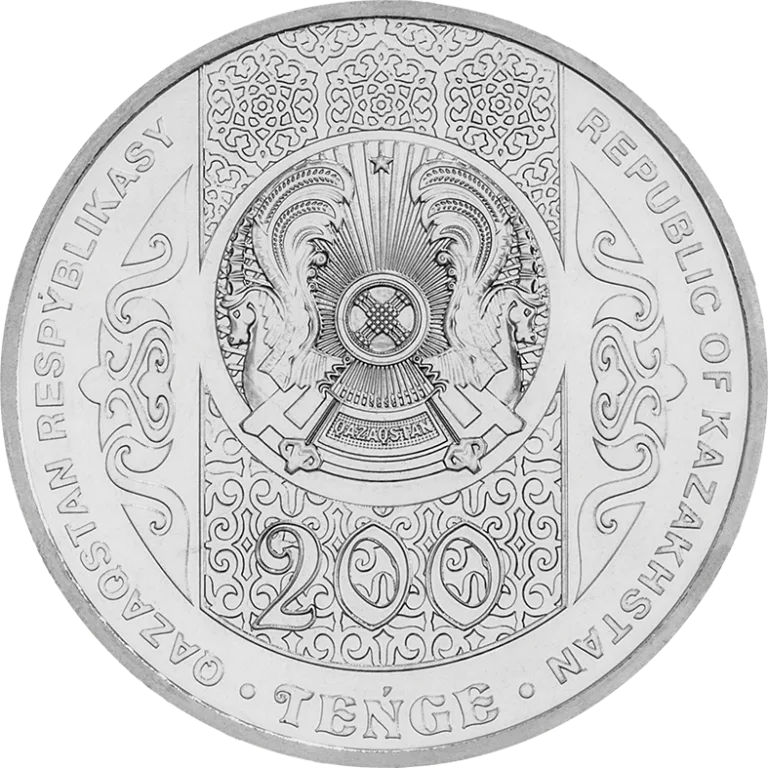
The official side is set in the Latin script that the National Bank uses on its most recent issues. In the centre is the emblem of the Republic of Kazakhstan in a circle, with a star shining above the shanyrak. On the left along the arc is the inscription "QAZAQSTAN RESPÝBLIKASY", on the right "REPUBLIC OF KAZAKHSTAN". The denomination "200" stands large at the bottom, with the word "TENGE" beneath it. The free field is filled with fine curling ornament, and vertical cartouche ribbons run down the sides.
Reverse
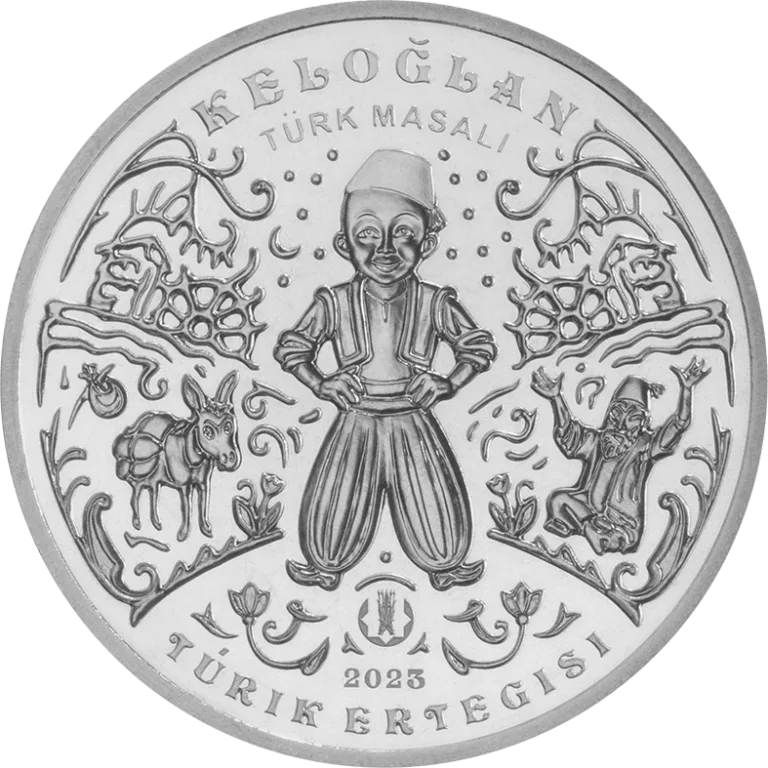
The story side is built as a small scene from village life. In the centre stands Keloğlan, a young man in a small cap, a shirt and very wide trousers gathered at the ankles; he has his hands on his hips, and his face is open and a little mocking. On the left a loaded donkey walks along a stony ridge, on the right a bearded old man sits cross-legged in a tall tasselled cap and throws up his palms in amazement. The whole field is covered with a pattern of tulips, curls and dotted rosettes, and stylised flowers grow along the bottom edge. The upper arc carries "KELOĞLAN" with "TÜRK MASALI" beneath it, the lower "TÜRIK ERTEGISI", and at the very bottom stands the year "2023".