
Legend of Tangun (nickel silver)
PDFGeneral information


Description
If one looks for the tale with which the Koreans' history begins, it is this one: about a heavenly prince, about an animal who became human, and about the child who grew into the first ruler. The Lord of Heaven, Hwanin, saw that his son Hwanung gazed at the earth with longing, and let him go down. Hwanung descended onto the summit of Mount Taebaek beneath a sacred tree, bringing three thousand companions, and settled where the City of God soon rose. Beside him lived and worked his ministers, the Lords of Wind, Rain and Clouds, who watched over harvests, illness and the affairs of people.
It was then that a bear and a tiger came to the mountain. They asked to be made human, and Hwanung set a condition: to sit for a hundred days in a cave without seeing the sun, eating only mugwort and garlic. The tiger gave in sooner and fled into the forest, while the bear held out and took the form of a woman, Ungnyeo. But human life without a family seemed empty to her, and every day she prayed beneath the tree for a child. Hwanung heard her, and they had a son, Tangun, who became king and the founder of the state later called Gojoseon. Tradition dates his reign to 2333 BC.
The legend is recorded in the medieval chronicle Samguk Yusa, which quotes still earlier works. Over the centuries the figure of Tangun has not faded into the past: in the twentieth century he became one of the pillars of national consciousness, and the founding of the state is celebrated in autumn, on 3 October. The legend has many interpretations: some see in it an echo of struggle between tribes, others the story of the arrival of agricultural culture, others simply a beautiful tale of patience. The bear who endured a hundred days is understood by any listener without translation, while the tiger who could not wait reminds us what impatience costs.
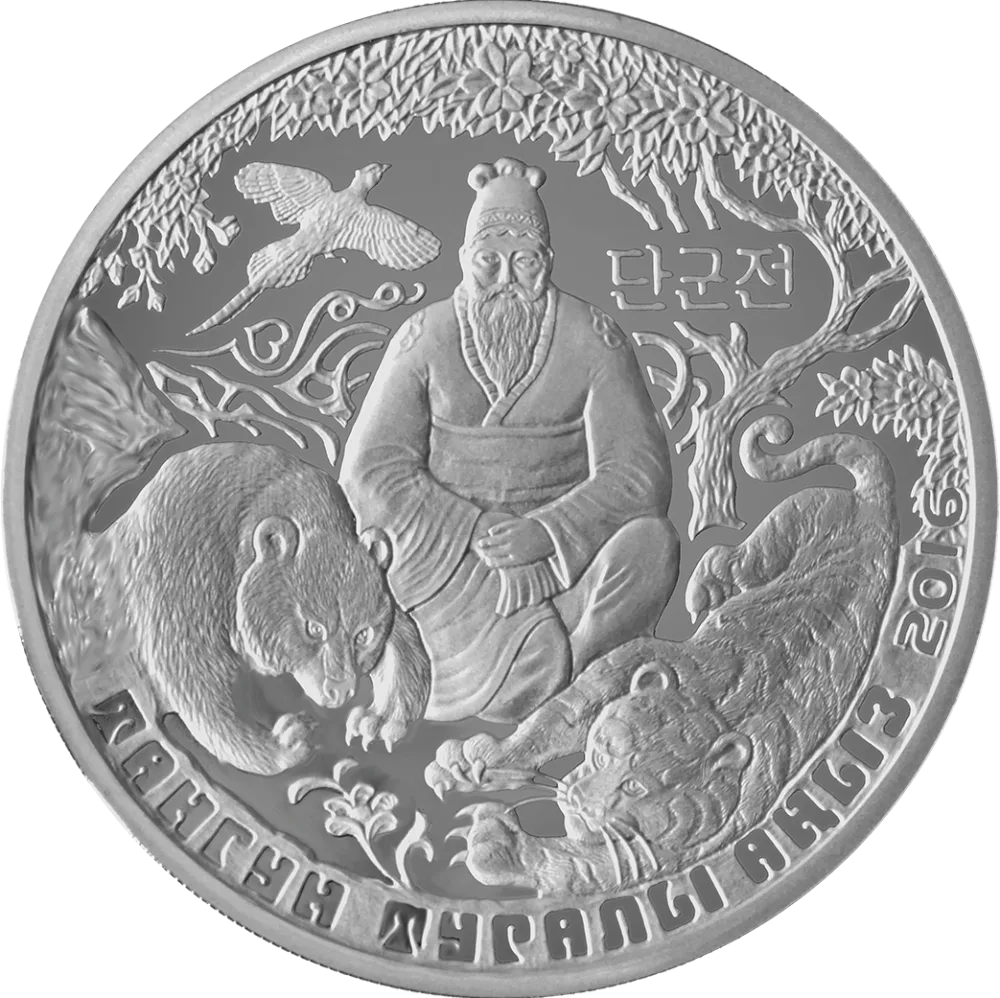
The base-metal 100-tenge coin entered circulation on 16 September 2016, at the same time as the silver one. It is addressed to the mass collector: it was issued in noticeably greater quantity so that anyone interested in Eastern fairy tales could get to know the subject and so that such a coin could simply be given as a gift. Kazakhstan's Korean community knows this legend well: Koreans were resettled from the Far East in 1937 and preserved here their native language, cuisine and oral tradition, and the story of Tangun is part of school texts, songs and dances. The composition on this coin is built differently from the silver one: Tangun sits cross-legged, while the bear and the tiger are placed symmetrically on either side of him, like guardians at a throne. This arrangement makes the coin a convenient introduction to the subject: all three heroes are visible at once.
Obverse
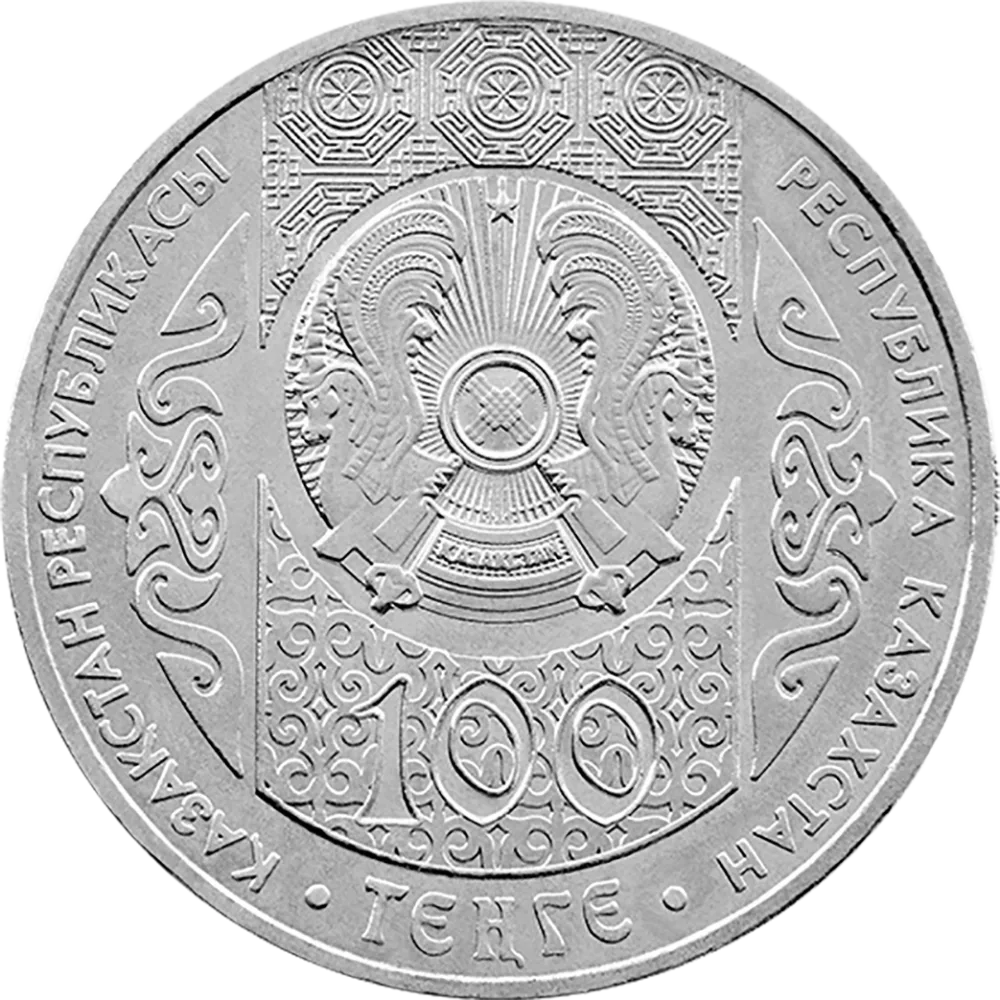
The official side is designed in the style common to the issue. In the centre is the State Emblem of the Republic of Kazakhstan with the shanyrak and winged horses beneath a star; around it run the inscriptions "QAZAQSTAN RESPÝBLIKASY" and "REPUBLIC OF KAZAKHSTAN". At the bottom, in an ornamental frame, is the denomination: the figure "100" and the word "TENGE". The free field around the emblem is covered with mirrored curls of Kazakh ornament forming a dense pattern.
Reverse
On the story side Tangun sits in the centre, a white-bearded old man in a traditional headdress and a wrap-over robe, legs crossed and hands resting calmly on his knees. On either side of him are a bear on the left with its head lowered and a tiger on the right stretched out at full length. Behind the old man rise pine branches, and over his shoulder flies a long-tailed bird. In the upper part of the right field is the Korean inscription "단군전", along the lower arc is the title of the legend in Kazakh, below it stands the year "2016", and all the free space is filled with plant ornament.