
Legend of Tangun (silver)
PDFGeneral information

Description
The Korean legend of Tangun tells of the heavenly origin of the first state on the Korean peninsula. The oldest known record of the tale is in the Samguk Yusa, a thirteenth-century work that cites even earlier chronicles, now lost. According to it, the Lord of Heaven, Hwanin, had a son named Hwanung who yearned for life among the valleys and mountains. His father allowed him to descend to earth, and Hwanung came down on Mount Taebaek with three thousand followers. There he founded the City of God, appointed ministers of clouds, rain and wind, laid down laws and moral rules, and taught people farming, crafts and healing.
A she-bear and a tigress came to Hwanung and begged to be turned into humans. Hwanung gave them twenty cloves of garlic and a bundle of mugwort and told them to eat only this food and to stay out of the sunlight for a hundred days. The tiger could not endure it and left the cave after about twenty days, while the bear stayed and became a woman named Ungnyeo. Lonely, Ungnyeo prayed under a sacred tree for a child; Hwanung took her as his wife, and she bore a son who was named Tangun Wanggeom. He founded the city of Asadal and called the state Joseon, which scholars call Gojoseon, "Ancient Joseon", and by traditional reckoning he came to the throne in 2333 BC.
Historians see in the bear and the tiger two tribes that competed for the favour of the heavenly prince: one managed to pass the test and became the foundation of a new people. The image of Tangun combines the features of a ruler, a culture hero and a deity: he is credited with founding the state, with laws, and even with the development of traditional medical practices. Koreans celebrate the founding of Gojoseon on 3 October as a national holiday, National Foundation Day. The legend lives on in school textbooks, in songs and family stories, and the figure of the she-bear who endured a hundred days in order to be transformed has become a symbol of patience and faithfulness to one's word.
For Kazakhstan this story is not foreign. The Korean diaspora is one of the notable communities in the country; its history in Central Asia is tied to the resettlement of Koreans from the Far East in 1937, and since then Koreans have preserved here their language, cuisine and traditions. The silver 500-tenge coin, released on 16 September 2016, became a gift to this community and at the same time an invitation for everyone else to get to know an ancient legend. It is a collector's issue in souvenir packaging with a numbered certificate, aimed at those who appreciate expressive relief and take their time: the figures of the old man, the she-bear and the tiger are modelled with high plasticity, and the mirror-like field makes the scene stand out. It is the senior partner of the base-metal 100-tenge coin: both issues appeared on the same day, but the design is composed differently on each, and anyone who wants the full picture will find it worthwhile to look at both.
Obverse
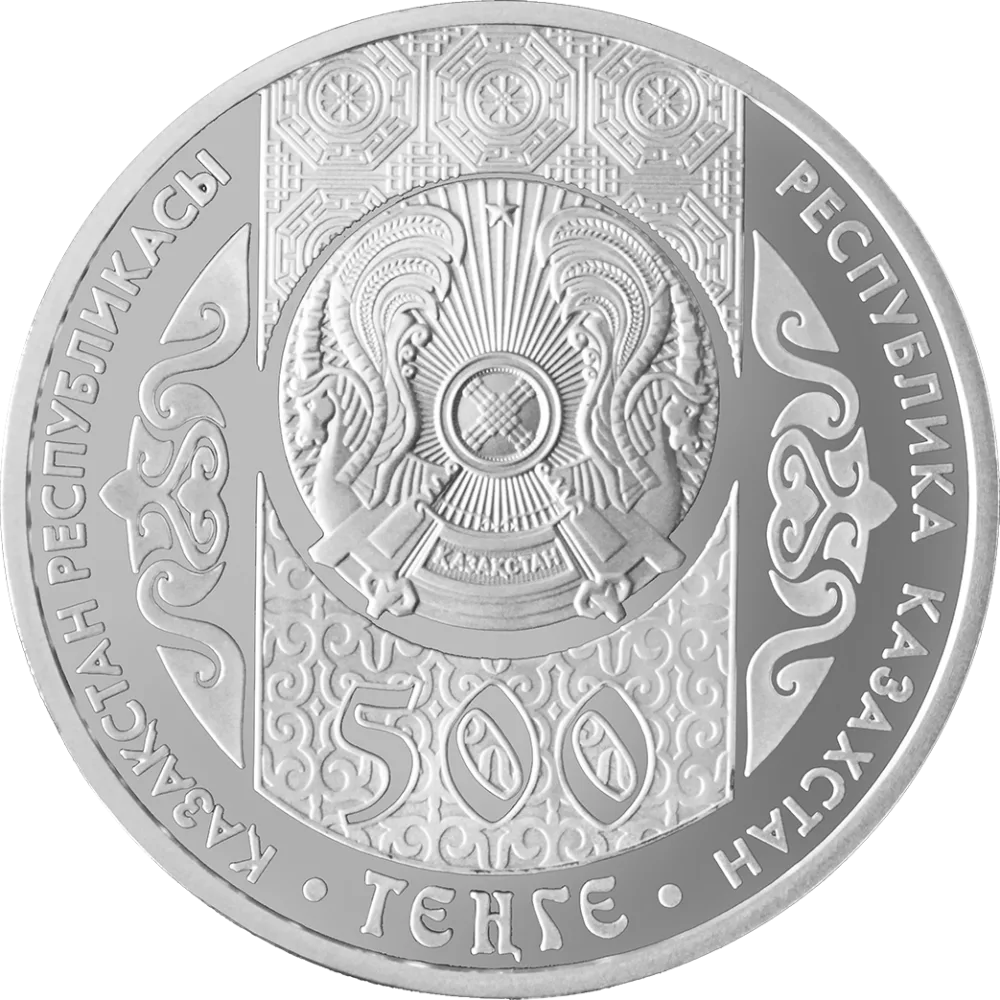
The official side bears the State Emblem of the Republic of Kazakhstan with the shanyrak and its poles, winged horses, rays and a star. The ornamental background around the emblem is made up of Kazakh and Korean patterns, linking the two cultures in one design. At the bottom are the figure "500" and the word "TENGE", with a mirrored element of national ornament at each side. Around the rim run the inscriptions "QAZAQSTAN RESPÝBLIKASY" and "REPUBLIC OF KAZAKHSTAN".
Reverse
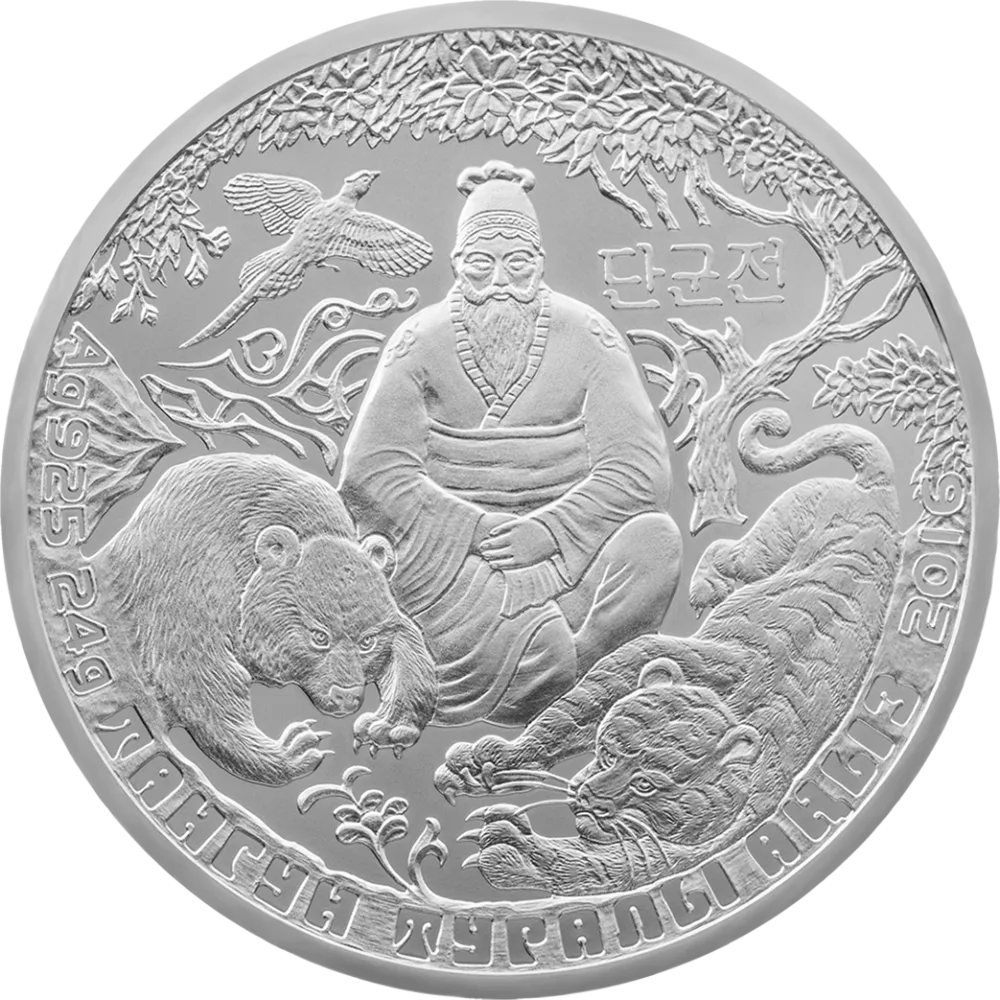
On the story side Tangun, a white-bearded old man in a Korean headdress and a long robe, sits beneath the canopy of a tree; one hand is open towards the animal. From the left a she-bear approaches with her head lowered, while on the right a tiger lies with its tail curled in a ring. Branches with leaves spread over the figure and a long-tailed bird flies in the sky; the field is filled with stylised clouds and shoots. At the top is a cartouche with the Korean inscription "단군전", in which the name of Tangun can be read, along the lower arc is the title of the legend in Kazakh, and at the lower right is the year "2016".