
FC Lokomotiv
PDFGeneral information
Description
Lokomotiv is a Moscow football club and one of the oldest in Russia. Its roots go back to the railway team Kazanka, which appeared in 1922 at the Moscow–Kazan Railway: the first mentions of the “Circle of Footballers of the Kazan Railway” appear in a 1922 Moscow football handbook. The club officially names 23 July 1922 as its founding date, while, as Wikipedia notes, supporters celebrate the team’s birthday twice a year — the second time on 12 August, close to Railway Workers’ Day. In 2022 the club and Russian Railways even brought in historians to clarify the exact date.
The road to the present name was not a short one: Kazanka, then the October Revolution Club (KOR), which played in 1922–1930, then Kazanka again in 1931–1935. The team of masters under the All-Union sports society Lokomotiv took shape in 1936 — the year the USSR championships began. It was Lokomotiv that opened the first national championship on 22 May 1936: in a match against Leningrad Dynamo, Viktor Lavrov scored the first goal of the competition, but the Muscovites lost 1–3. In the same year, however, the “railwaymen” won the first USSR Cup in history, beating Dynamo Tbilisi in the final.
The club took its second USSR Cup in 1957. In the final at Luzhniki, which drew 103,000 spectators — a national record at the time — Lokomotiv beat Spartak thanks to a goal by captain Valentin Bubukin. The team was then being built by Boris Arkadyev, and its ranks included two future European champions of 1960, Vladimir Maslachenko and Valentin Bubukin. In 1959 Lokomotiv won a silver medal in the USSR championship, but in 1963 it dropped out of the top division. In 1988, after seven years in the First League, the club returned to the elite under Yuri Syomin, and in 1990 it reached the USSR Cup final.
The most successful era began in 1992, when Valery Filatov became club president and the team was coached by the tandem of Yuri Syomin and Vladimir Eshtrekov. In the first Russian championship Lokomotiv finished fourth, in 1994 it won its first bronze of the Russian era, and in 1995 silver. In 1995 the Muscovites won 1–0 in Munich against Bayern in the UEFA Cup, and in 1998 and 1999 they reached the semi-finals of the Cup Winners’ Cup twice. From 1999 to 2001 the club took silver in the championship three times in a row, each time finishing behind Spartak.
The golden age arrived in 2002: in the “golden match” against CSKA the only goal was scored by Dmitri Loskov, the future captain and legend of the club, and Lokomotiv became champion of Russia for the first time. In the same year the Lokomotiv football stadium opened. The second title came in 2004, when Shinnik was beaten in round 30. In the seasons 2001–2004 the club played in the main round of the Champions League; remembered are the 2–0 win over Real Madrid in 2001/02, the draw at the Santiago Bernabeu and the 3–0 rout of Inter in 2003/04. In 2005 the team won the CIS Cup and the Russian Super Cup.
Difficult years followed, but trophies kept coming. Lokomotiv won the Russian Cup in 2007, in 2015 (a 3–1 final against Kuban) and in 2019, when Ural was beaten in the final — that trophy was the club’s eighth in the competition. In the 2017/18 season the club became Russian champion for the third time: on 5 May 2018, after a win over Zenit with a late goal by Eder, the title was secured in round 29. That same season the club reached its best result in the Europa League, getting to the round of 16. Today Lokomotiv counts three championships, eleven national cups (two Soviet and nine Russian) and three Russian Super Cups.
The club’s home ground is RZD Arena on Bolshaya Cherkizovskaya Street in the Preobrazhenskoye district; it holds 27,320 spectators and during UEFA and FIFA matches is simply called “Lokomotiv”. The club’s general sponsor is Russian Railways, and the railway theme runs through the whole club culture: the nicknames “railwaymen”, “steam engines”, “red-greens” and “loko”. The anthem, written by Avgust Krepak, leader of the fan group Reactive, was first heard in February 2005 at the “Golden Year of Lokomotiv” ceremony at the Olimpiyskiy arena, and it is now played before every home match.
Obverse
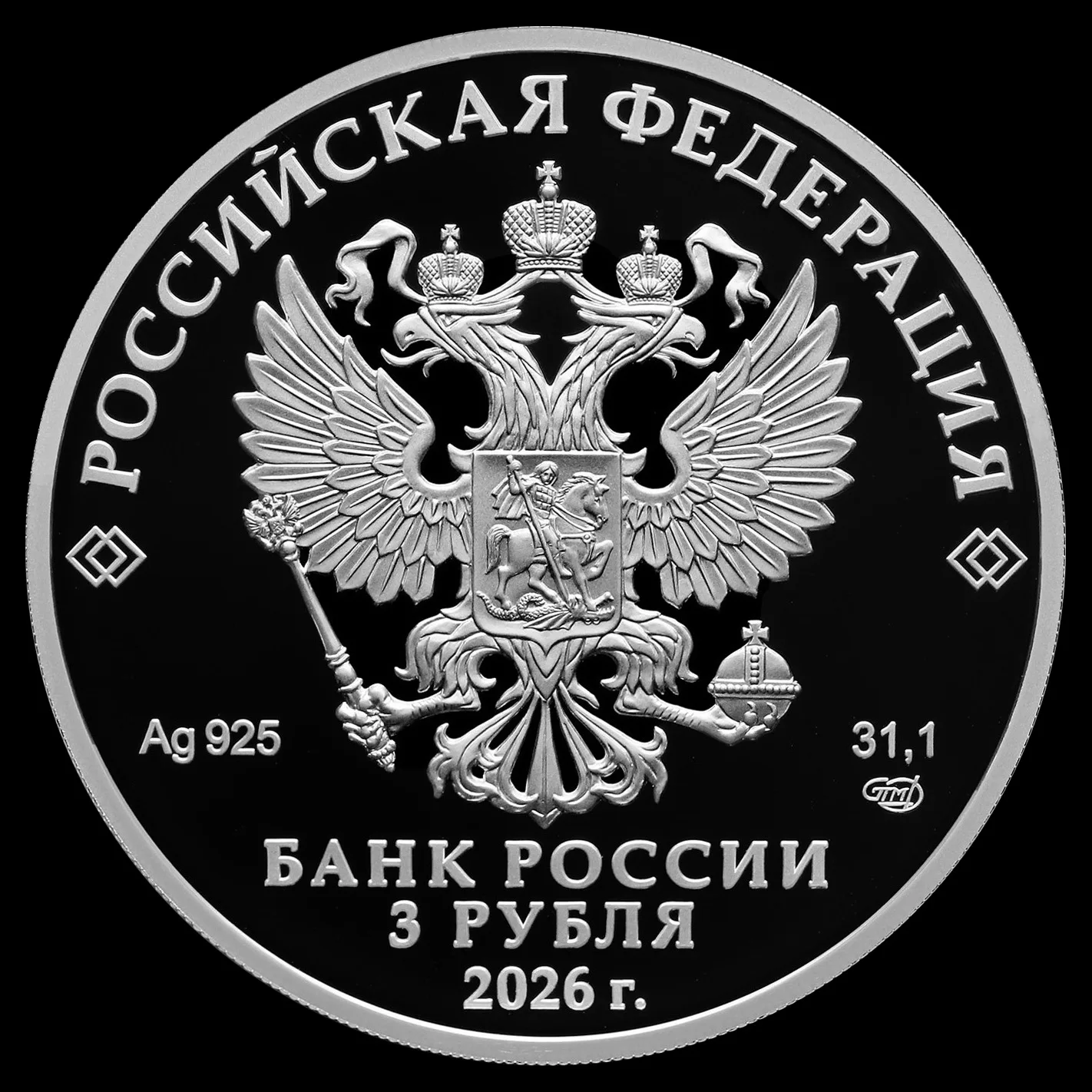
The official side of the coin carries the relief State Emblem of the Russian Federation. Around it are the inscriptions “RUSSIAN FEDERATION” and “BANK OF RUSSIA”, together with the denomination “3 RUBLES” and the year “2026”. The edge of the coin is framed by a raised rim.
Reverse
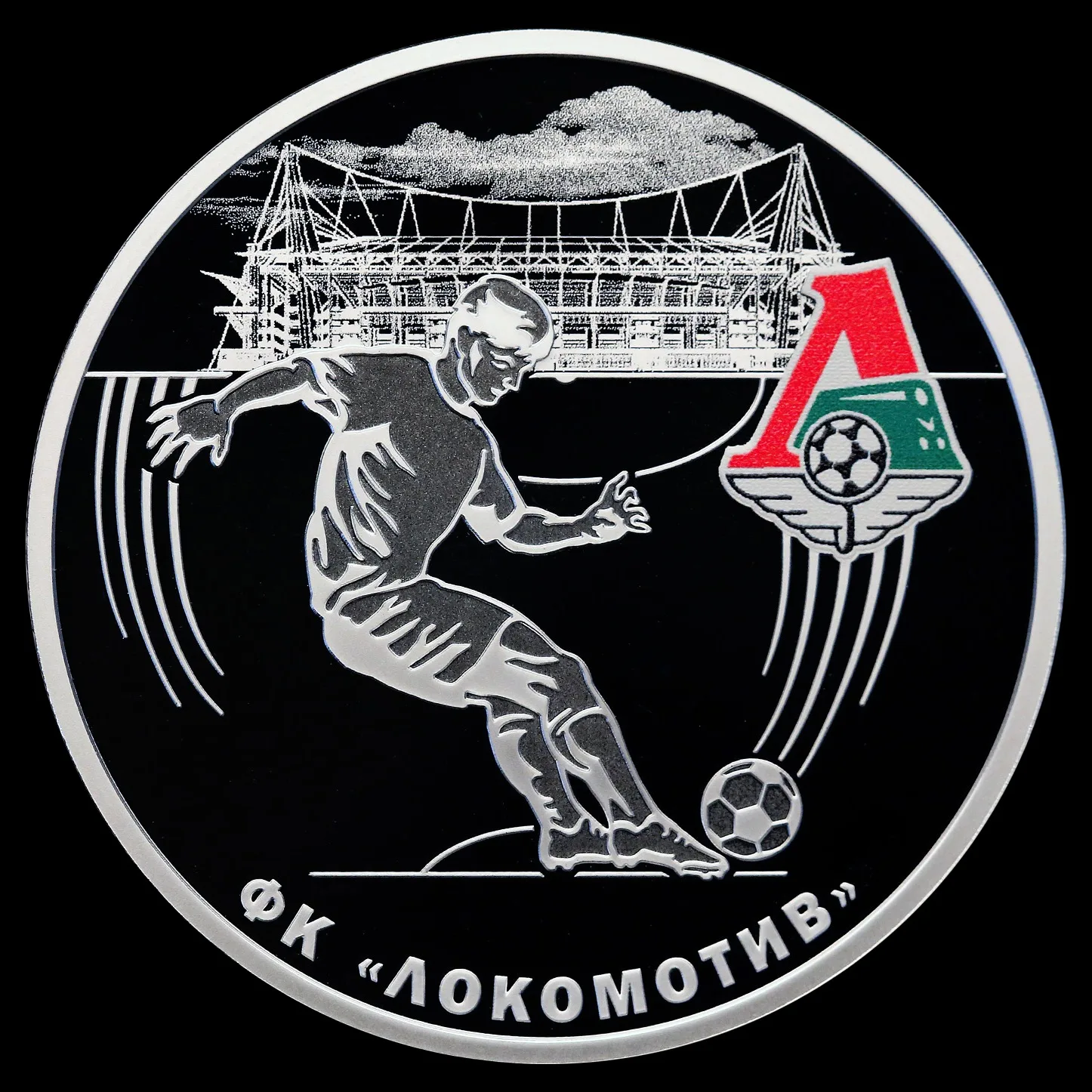
The artistic side shows a relief footballer with a ball in a dynamic pose against the backdrop of a stadium; the background is laser-matted, so the smooth figure of the player stands out clearly against it. To the right of the footballer is the club’s colour emblem, and along the lower edge runs the inscription “FC “LOKOMOTIV”.
The Lokomotiv emblem reflects the club’s railway origins. According to Wikipedia, in 1936 a large letter “L” with a steam locomotive emerging from behind it was placed on the logo. Later the steam engine was replaced by a simplified image of a green TE3 diesel locomotive — together with the red letter “L” it gave the club its colours. A winged wheel, the symbol of Russian Railways, appeared at the bottom of the composition, and in 1996 a football was placed between the locomotive and the wheel. The red-and-green palette of the colour emblem on the coin recalls this history.