
FC Spartak Moscow
PDFGeneral information
Description
Spartak is a Moscow club that has long been called the “people’s team”. It was officially founded on 18 April 1922, but its roots go deeper: its history leads back to the Russian Gymnastic Society “Sokol”, registered in 1883. Football appeared in the society in the summer of 1897, in Petrovsky Park, and in the spring of 1917 the Sokol footballers acquired their own stadium in Bolshoy Tishinsky Lane, on a wasteland known as “Goryuchka”. After the revolution the team changed its name several times: MKS (“Moscow Sports Club”), “Krasnaya Presnya”, “Pishcheviki”, “Promkooperatsiya”, “Dukat”.
The present name appeared in 1934–1935. The idea of creating a voluntary sports society on the basis of the clubs of the Industrial Cooperative belonged to Alexander Kosarev; together with Nikolay Starostin and Ivan Pavlov, the director of the Industrial Cooperative, he set about creating “Spartak”. According to the story told by Wikipedia, the name was suggested by Raffaello Giovagnoli’s book “Spartacus”: it had a flavour of ancient heroism and was at the same time ideologically acceptable. On 12 April 1935 the team took the field under its new name and beat “Trekhgorka” 7:1 in front of five thousand spectators. All four Starostin brothers — Nikolay, Alexander, Andrey and Pyotr — played for the team.
Because the Industrial Cooperative was not a department like the NKVD or the army and did not belong to the branch trade unions, ordinary people began to support “Spartak”. That is how the description “the people’s team” took hold. From the founding of the USSR championships in 1936 the club fought a stubborn struggle with Moscow “Dinamo”: in autumn 1936 “Spartak” became the first champion of the autumn tournament, then won gold in 1938 and 1939, and took the USSR Cup in 1938 and 1939. In 1942 the Starostin brothers were arrested; in 1946 the team won its third USSR Cup, and in 1947 its fourth, beating “Torpedo” 2:0.
In 1949 Nikita Simonyan joined the team and became the top scorer of the championship, and in 1950 he scored 34 goals and again headed the scorers’ list. In 1979 “Spartak”, under Konstantin Beskov, regained the championship just two seasons after returning from the First League: in the deciding match in Rostov-on-Don the red-whites won 3:2. In the early 1980s the club played in the European Champion Clubs’ Cup and the UEFA Cup, where it knocked out London’s Arsenal. A tragedy remains in the club’s history — the UEFA Cup match of 20 October 1982 at Luzhniki, when 66 supporters died in a crush on a stand; a memorial by the stadium preserves their memory.
Today “Spartak” is the most decorated club in Russia: 12-time USSR champion, 10-time Russian champion, 10-time winner of the USSR Cup and 5-time winner of the Russian Cup, winner of the Russian Super Cup and six-time winner of the Commonwealth Cup. It has reached the semi-finals of all three main European club tournaments — the European Champion Clubs’ Cup, the Cup Winners’ Cup and the UEFA Cup — and is considered the best Russian club in the history of the Champions League. According to a Yandex survey it is the most popular Russian club, and according to VCIOM one of the most popular in the country; it is in the top 20 most popular clubs in Europe.
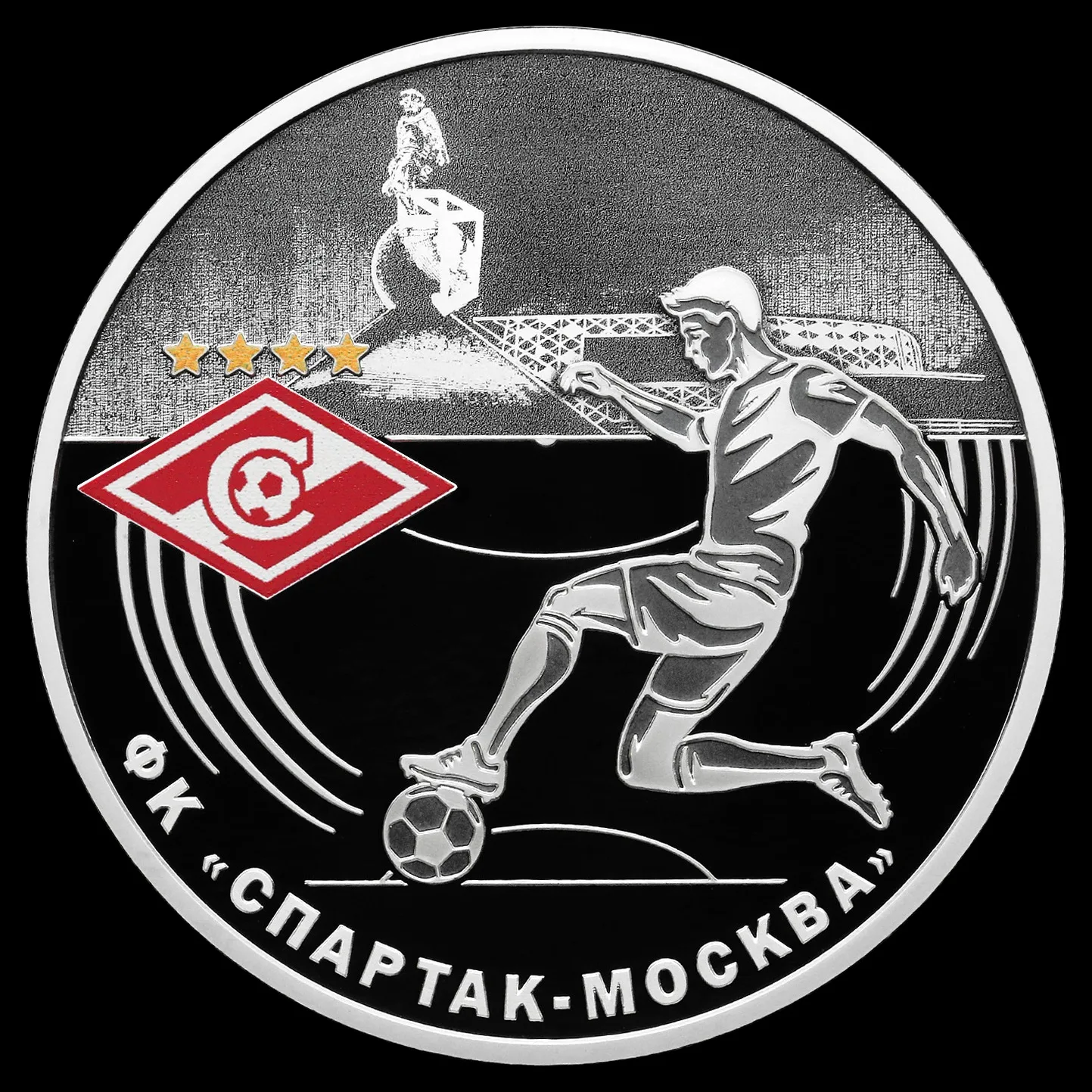
The club has several nicknames: the “red-whites”, the “gladiators”, the “people’s team”, the “Spartak men”. The emblem — a red and white rhombus with a crossed-out letter S — was sketched by Nikolay Starostin himself; it took its present form in 1949. Home matches are played at the Lukoil Arena, which holds 45,360 spectators, and the team captain is Roman Zobnin. The coin “FC Spartak-Moskva” is about a club whose name and colours are familiar to several generations of supporters.
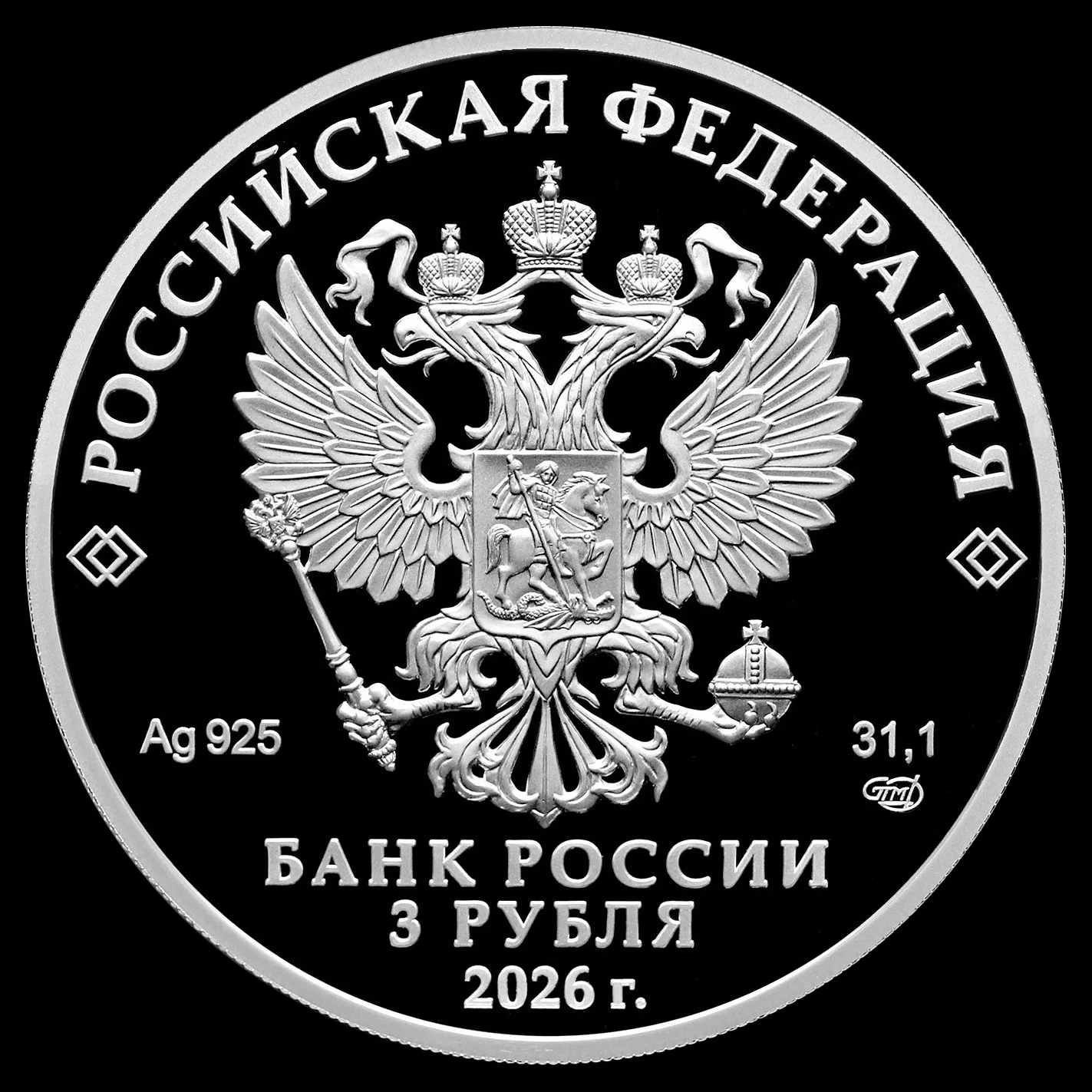
Obverse
The official side is occupied by the relief State Emblem of the Russian Federation. The inscriptions are grouped around it: “ROSSIYSKAYA FEDERATSIYA” (RUSSIAN FEDERATION), “BANK ROSSII” (BANK OF RUSSIA), “3 RUBLES” and the year “2026”. The edge of the piece is framed by a raised rim.
Reverse
The artistic side is occupied by a footballer in relief dribbling a ball, and behind him a stadium done in laser matting, because of which the figure seems to separate from the background. On the left is the club’s colour emblem: a red and white rhombus with the letter S, familiar to supporters since the 1930s, when Nikolay Starostin sketched the first version of the logo; the present design, with the white stripe on the other diagonal, took hold in 1949. Along the bottom of the circumference runs the inscription “FK ‘SPARTAK-MOSKVA’” (FC Spartak-Moskva). Red and white here are not just paints: on the coin they remain the only colours, and the club is recognised by them at first sight.