
PFC CSKA
PDFGeneral information

Description
PFC CSKA is a Moscow club that traces its roots to the football section of the Society of Ski Lovers (OLLS). The club counts 1911 as its starting point: that year a football section was organised in the society, and on 14 (27) August 1911 the team played its first official match against the club “Vega” and won 6:2. By autumn 1917 OLLS had won the Class B tournament and the Mussi Cup and moved up to Class A of the Moscow championship, and in 1922 it won the spring championship of the city and the “Tosmen Cup”, contested by the champions of Moscow and Petrograd.
The club’s name changed many times along with the eras. In 1923 the OLLS sportsmen were taken in by the Experimental Demonstration Ground of Vsevobuch, created under the wing of the Red Army. On 23 February 1928, the tenth anniversary of the Red Army, the Frunze Central House of the Red Army opened in Moscow, and all the ground’s sporting forces were transferred to it — this is how CDKA appeared. Later the club was called KKA, CDSA and CSK MO, and from 1960 it has been CSKA. Since 1994 it has been officially named the Professional Football Club CSKA — the very name shown on the coin.
Its great victories came after the war. In 1942 many players studied at the military faculty of the Institute of Physical Culture, and 16 of them received the rank of junior lieutenant — hence the nickname “the team of lieutenants”. CDKA won the USSR championships of 1946, 1947 and 1948; in 1947 the decisive result was a 5:0 win over “Traktor” in the last round, exactly as many goals as were needed, and in 1948 Vsevolod Bobrov scored the winning goal against “Dinamo”, 3:2. In 1948 the Army men made their first “golden double”, adding the national Cup, and in 1950 and 1951 they were champions again. The heroes of that team included Grigory Fedotov, Vsevolod Bobrov and Vyacheslav Solovyov. In 1952, after the Helsinki Olympics, the team was disbanded by order No. 793 of 18 August, but it was re-formed in autumn 1953.
In 1970 the Army men won gold again after a 19-year break: the title was decided in Tashkent, where in the replay of the “golden match” CSKA beat “Dinamo” 4:3. Captain Albert Shesternyov was named footballer of the year. The next two decades passed without championship titles, but in the 1990s a new generation grew up in the team — Sergey Semak, Dmitry Khokhlov, Vladislav Radimov. In autumn 1992 the club made its debut in the Champions League and at the Camp Nou beat the reigning holders of the trophy, Barcelona, 3:2.
The modern era brought the club its main trophies. CSKA became the first Russian and the first post-Soviet club to win a European tournament — the 2004/05 UEFA Cup. The club has been champion of Russia six times, has won the Russian Cup nine times and the Russian Super Cup eight times. In 2014, winning the league for the fifth time, CSKA became the first club in Russian history to collect the originals of all trophies. Together with the title of RSFSR champion and seven USSR championships, this makes it one of the most decorated clubs in the country.
Supporters call the team the “red-blues”, the “horses” and the “Army men”. The club plays its home matches at the VEB Arena, which holds 30,457 spectators; goalkeeper Igor Akinfeev remains captain. The Army lineage — from the House of the Red Army to today’s professional club — remains the main theme of its history, and it is to this that the coin dedicated to PFC CSKA turns.
Obverse
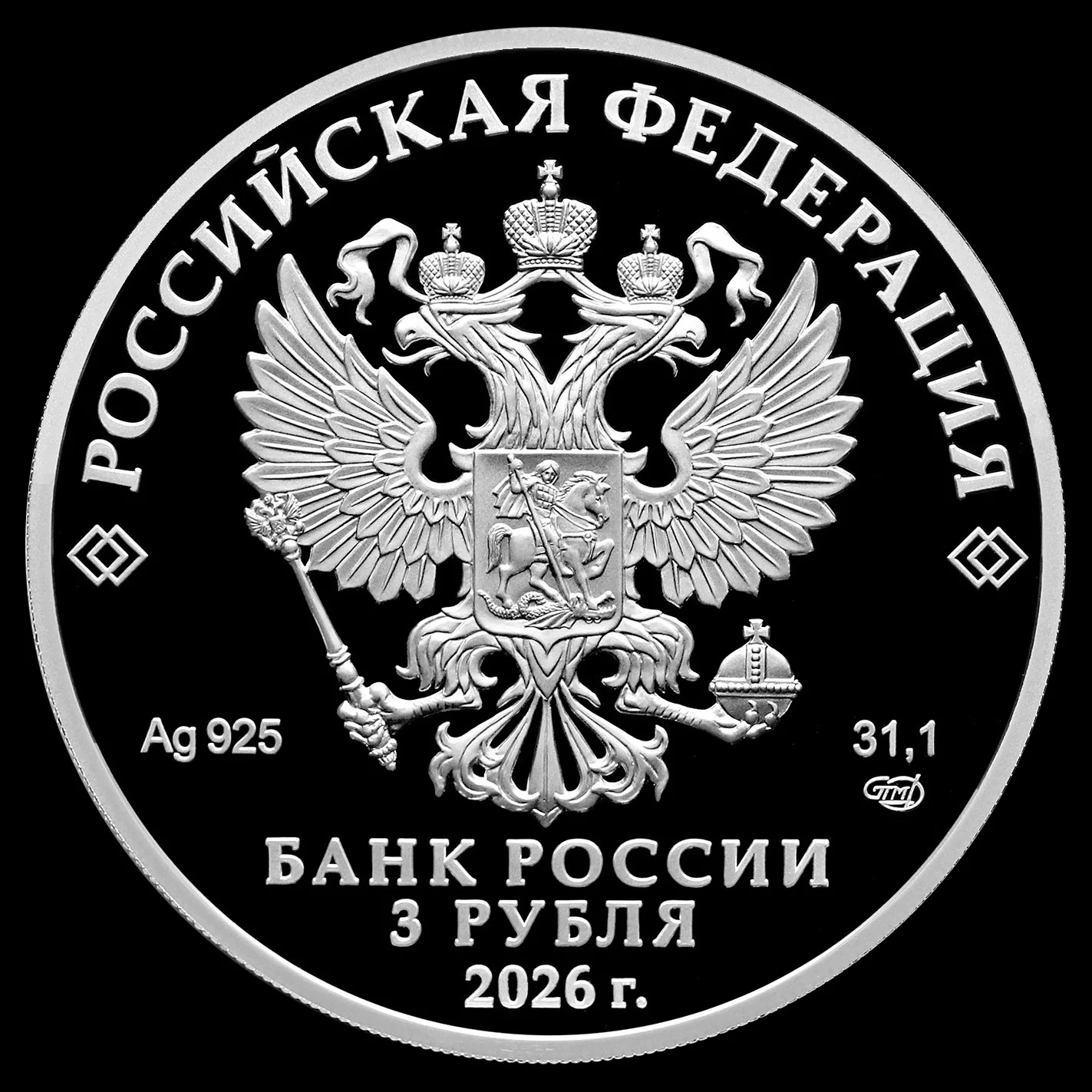
The official side of the coin carries the relief State Emblem of the Russian Federation. Around it are the inscriptions “ROSSIYSKAYA FEDERATSIYA” (RUSSIAN FEDERATION) and “BANK ROSSII” (BANK OF RUSSIA), as well as “3 RUBLES” and “2026”. A raised rim runs around the circumference.
Reverse
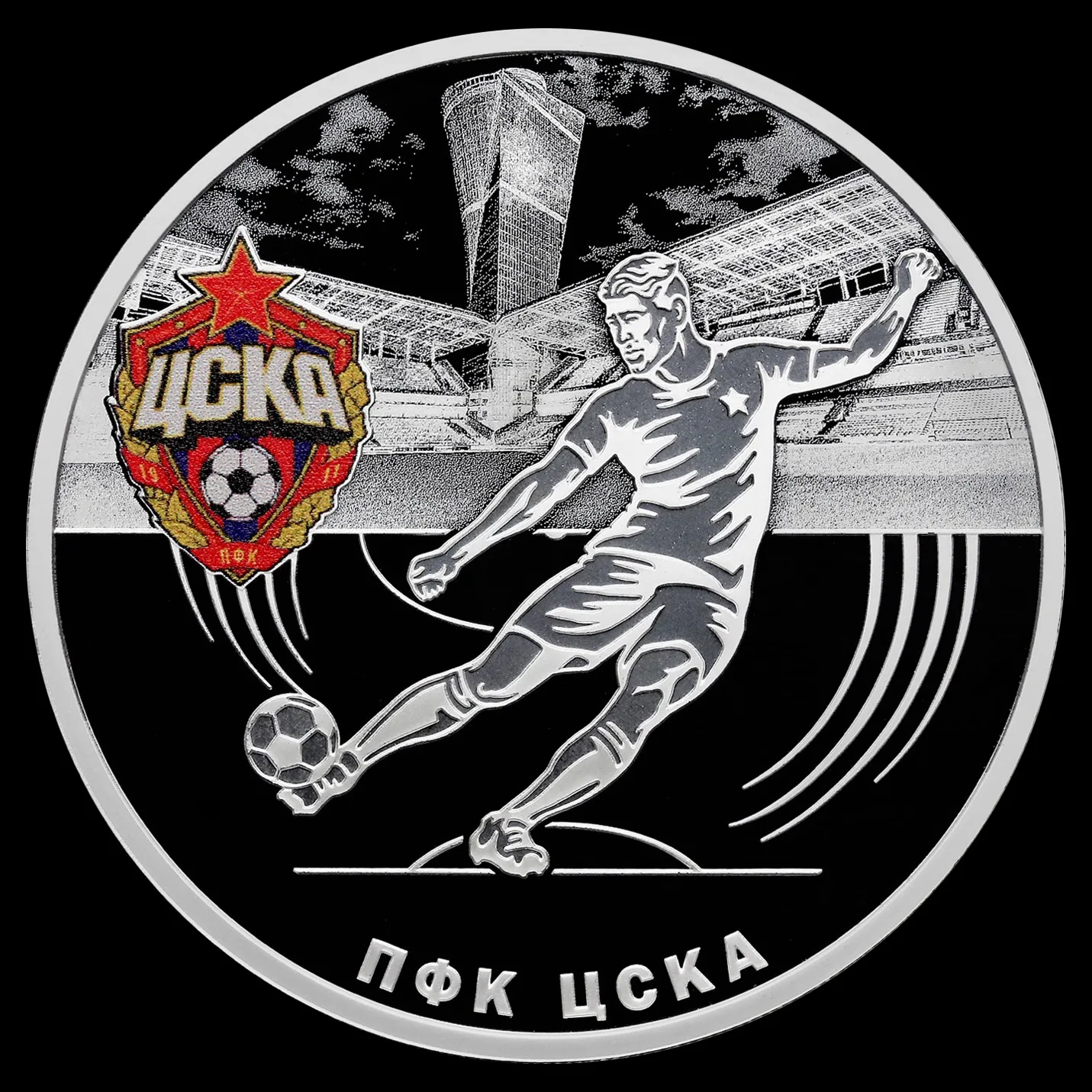
On the artistic side a footballer with a ball is shown in relief against a stadium; the background is laser-matted, and the smooth relief of the figure stands out clearly against its soft texture. On the left is the club’s colour emblem — the only coloured element of the composition, which catches the eye at once. Along the bottom of the circumference runs the inscription “PFK TSSKA” (PFC CSKA). The image of a player in motion with the ball and the stands behind him recalls the main thing the club exists for — matches in front of supporters — and the colour emblem makes the coin recognisable to anyone who follows the red-blues.